
Got a fractured bone and it is taking too long to heal? Well, several reasons can be behind the delayed healing of fractures.
The probability of fractures healing at a slow pace or not healing at all is significantly influenced by the nature of the injury and its anatomical location, along with the patient’s health. It is often high-energy fractures, fractures that cause a bone to break into multiple pieces, and injuries with considerable damage to soft tissue that heal more slowly.
In this blog, we are going to have a look at the health conditions that put some individuals at risk of complications after a bone injury, affecting both the success and duration of fracture healing.
Fractured bone fails to heal adequately within the expected period, based on clinical and imaging findings, and further treatment may be required to achieve healing.
| 👉 Did you know? A non-union fracture refers to a broken bone that does not heal adequately within the expected time period (based on clinical and imaging findings), and further treatment may be needed. |
Overview
Bone fractures heal through a proper process that involves steps like inflammation, repair, and remodelling.
However, in some cases, the normal healing process gets disrupted, resulting in slower-than-expected healing (delayed union) or no repair without medical intervention (nonunion).
Which Bone Got Affected?
Apart from mechanical stress, blood supply, and patient demographics, the location of the fracture is an important factor that influences its healing journey. For example, the nonunion rate of the upper arm bone (humerus) is among the highest, followed by the wrist, while it is rare in the case of the ankle bone.
| 👉Did you know? Humans are prone to fractures. While most fractures heal successfully, some may take longer depending on various factors. There is a 5–10% likelihood of delayed fracture healing. |
The Role of Blood Supply
A good blood supply is necessary for nourishing the injury site with oxygen, nutrients, and the required signalling molecules.
After a fracture happens, it is a well-functioning blood supply (vascularity) that supports the healing process by facilitating:
- Inflammation
- Cellular proliferation
- Tissue regeneration
Blood vessels help support the formation of new bone and provide adequate metabolic support to the developing bone tissue. However, blood supply may be affected due to severe trauma, damage to surrounding soft tissues, certain fracture patterns, and the presence of some underlying health conditions, resulting in a prolonged healing period, nonunion, or poor bone strength.
| 👉Did you know? Falls, sports injuries, and car accidents are among the most common causes of bone fractures. |
Mechanical Factors that Influence Healing
A fracture also needs appropriate mechanical stability to heal properly. Excessive movement at the fracture site, poor alignment, a large fracture gap, or inadequate fixation can also delay bone healing. Severe fractures involving multiple bone fragments and extensive soft-tissue damage may also take longer to heal.
Which Conditions Impact Blood Supply & Delay Fracture Healing?
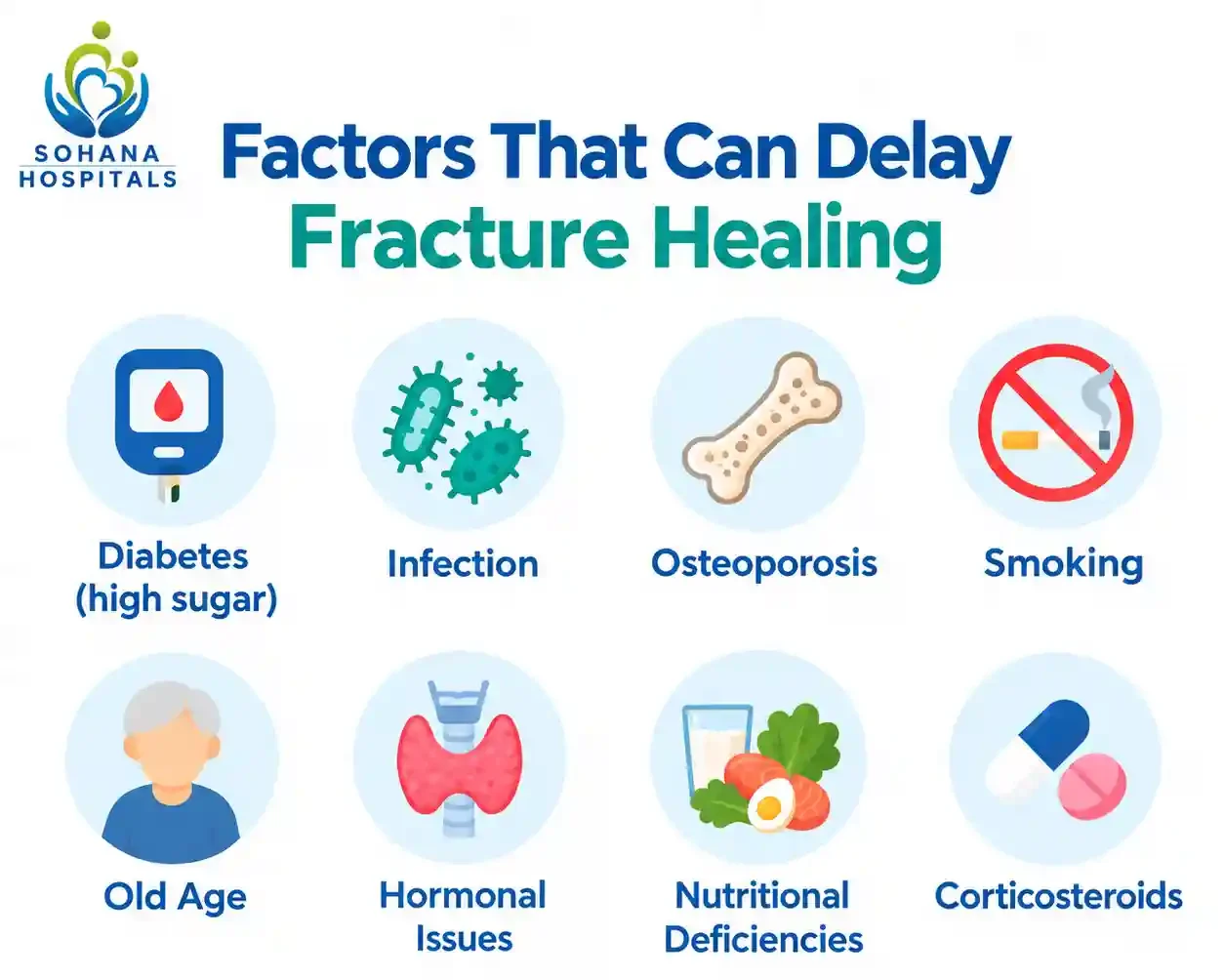
Diabetes Mellitus
Known as sugar in common language, diabetes, especially when not effectively managed, can significantly affect fracture healing. High blood sugar (hyperglycemia) can:
- Have an adverse impact on new bone formation
- Bring down the production of collagen
- Impair formation of new blood vessels is needed to provide nutritional support to the new bone
The result is delayed fracture healing. Research indicates that diabetic individuals exhibit higher rates of delayed fracture recovery as compared to healthy people, irrespective of the fracture site.
Infection
Infections, especially those that affect the bone or bone marrow (e.g., osteomyelitis), can prolong the healing process.
The presence of disease-causing micro-organisms like bacteria, viruses, or fungi at the fracture site can cause:
- Inflammation (swelling, warmth, redness, pain, etc.)
- Premature and uncontrolled death of body cells and living tissue (necrosis)
- Breaking away of a piece of dead bone from healthy, living bone tissue (sequestration)
Open fractures are more prone to infections. The development of infections in such cases can hamper the normal healing of fractured bone(s).
| 👉 Did you know? Fractures do not always cause immediate and severe pain. Some minor fractures may not hurt. |
Osteoporosis
Osteoporosis is a condition in which bones lose mass and strength, thereby raising the risk of fractures. Osteoporotic patients are prone to suffering fragility fractures, particularly in the vertebrae (in the back), distal radius (wrist bone), and femoral neck (hip bone). Since bones are not strong enough, any fractures that occur do not usually heal fast.
Read More: Why are Women at Higher Risk of Osteoporosis?
Smoking
Smoking and tobacco use can shrink blood vessels, impacting the supply of nutrient-rich blood and oxygen to the affected bone. This oxygen deficiency at the fracture site can adversely affect the natural process of bone formation and development. Studies reveal that smokers are at a higher risk of delayed bone recovery than non-smokers.
Old Age
As age increases, bone density and regenerative capacity generally decline. Formation of new bone decreases, and cellular responses become slower. Apart from this, age-related conditions, like compromised blood circulation and nutritional deficiencies, can further impact bone repair.
| 👉 Did you know? Children have a faster fracture recovery than adults, as their bones have a thick, nourishing outer layer. Also, they have active bone growth and better remodelling capacity. |
Hormonal Issues
Thyroid hormones are essential for bone metabolism. They affect both bone formation and resorption. Individuals who have low levels of thyroid hormone (hypothyroidism) may experience compromised bone remodelling. The decline in metabolic activity may also slow down the repair process of bones, delaying healing when a fracture occurs.
Nutritional Deficiencies
A healthy and balanced diet is crucial for bone healing. If your diet is lacking in Calcium, Vitamin D, Vitamin C, or protein, it may not allow for normal fracture healing.
| 👉Did you know? If you are able to move an injured limb, it does not imply that the bone is not damaged. Some hairline cracks do allow limited movement. Suspect a fracture? Seek medical assessment without further delay. |
Corticosteroids
Those who have been taking medications like corticosteroids for a long time may be at risk of delayed fracture healing. Additionally, patients using steroids on a long-term basis are at a higher fracture risk, since they can weaken bones.
*Note: The direct effect of corticosteroids on fracture union can vary depending on the dose, duration, and individual patient factors.
When to See an Orthopaedic Doctor
If a fracture is not showing expected progress, or there is significant pain, swelling, instability, or difficulty using the affected limb, consult an orthopaedic specialist.
Follow-up visits with your doctor and imaging tests like X-rays can help find out whether the fracture is healing normally or not.
Conclusion
Diverse factors may be responsible for the slow healing of bone fractures in some people. These factors include the location and nature of the fracture and particular health conditions that an individual may have.
The prominent conditions among these include diabetes mellitus, infection, osteoporosis, smoking, old age, and hormonal issues. While some of these factors, like the location and nature of the fracture and advancing age, may be beyond your control, others, like managing blood sugar levels and quitting tobacco use, are something you can do for healthier bones.
For all kinds of simple and complicated bone issues, book a consultation with the best bone doctors in Mohali at Sohana Hospital. Highly experienced and well-versed in the use of the latest technologies, our orthopaedic specialists are known for their patient-centric, compassionate approach that ensures every patient has a safe, smooth, and early recovery.