
हिंदी में पढ़ें: विटामिन D की कमी के संकेत और लक्षण
Vitamin D deficiency is fast emerging as an unrecognised epidemic in the Indian subcontinent, affecting 70%–100%[1] of the population.
The good news? The human body is capable of making Vitamin D from sunlight!
The bad news? Given modern lifestyles, few people get adequate sun exposure.
| 👉Did you know? Over the past decade, Vitamin D has been linked to the prevention and treatment of numerous health conditions. |
Why Do We Need Vitamin D?
Vitamin D is a fat-soluble vitamin necessary to maintain good health. It helps strengthen bones, improves mental health, and promotes good sleep.
Vitamin D plays a vital role in helping the body absorb calcium. This lowers the risk of calcium deficiency. Calcium deficiency can cause osteoporosis (low bone density), making the bones prone to fractures.
Vitamin D deficiency is associated with both non-communicable and communicable diseases. Examples include:
- Type 1 and 2 diabetes mellitus
- Heart disease
- Respiratory infection
- Rheumatoid arthritis
- HIV progression
- Obesity
- Osteoporosis
- Hypertension
- Asthma
- Multiple sclerosis
- Irritable bowel disease
- Various cancers (including lung, colorectal, and breast cancers)
| 👉Did you know? Why is it called the sunshine vitamin? Your skin produces Vitamin D when exposed to the sun. Vitamin D deficiency occurs when your body does not get or is unable to process sufficient quantities of vitamin D. |
How Much Vitamin D Do You Need?
Adults require a daily intake[2] of 15 to 20 mcg (600–800 IU) of vitamin D, and the value ranges between 10 and 15 (400–600 IU) for infants, kids, and teenagers, according to their age. Adults above 70 years generally require 800 IU (20 mcg) of Vitamin D daily as per the recommended dietary allowances.
The good news is that once identified, vitamin D deficiency is relatively easy to treat with supplements. The best way to improve your vitamin D levels? Eat nutritious food, bask in the morning sun, or take supplements (with doctor’s advice).
| 👉Did you know? Not too many food products, especially vegetarian ones, contain enough Vitamin D. It is, therefore, advisable to opt for fortified food products. You can check nutrition labels to check for added Vitamin D. |
What to eat to get Vitamin D:
- Fish (salmon, tuna, trout, mackerel, etc.)
- Egg yolk
- Fortified dairy products (milk, curd, cheese)
- Fortified soya products
- Fortified breakfast cereals, oatmeal & orange juice
- Almond milk
- Mushrooms
- Cod liver oil
- Supplements
Who is at Risk of Vitamin D Deficiency?
Anybody, irrespective of age, can suffer from a deficiency of vitamin D. It could be infants, kids, or adults.
However, some may be at a higher risk of Vitamin D deficiency:
- People with darker skin (meaning more melanin)
- Those who keep their skin covered with clothes all the time (as in the Middle East)
- Older people who stay indoors
- Overweight individuals
- Those who have osteoporosis
- People who have celiac disease, inflammatory bowel disease, kidney disease, liver problems, or other malabsorption disorders
- Individuals who undergo weight loss surgeries
- Those who take specific medicines (some anticonvulsants, glucocorticoids, and medicines affecting fat absorption)
- Breastfed infants
- Lactose-intolerant people or those with milk allergy
| 👉Did you know? Excess vitamin D is harmful. It can cause nausea, vomiting, kidney stones, confusion, and excessive thirst. Also, Vitamin D supplements can interfere with some medicines. So, take supplements after consulting your doctor. |
How Common is Vitamin D Deficiency?
Vitamin D deficiency is becoming increasingly common worldwide. It affects individuals widely, regardless of their gender, age, race, or where they live.
It is widely believed that up to 50%[3] of the world population is vitamin D-deficient. Studies put this number at around 1 billion[4] people globally.
Nearly 40 out of 100[5] Europeans have a vitamin D deficiency, and 13 out of 100 have a severe deficiency.
And in the Indian subcontinent, the proportion of vitamin D-deficient people ranges between 70% and 100%[6].
Want to check your Vitamin D levels? Vitamin D deficiency is confirmed through a blood test measuring serum 25-hydroxyvitamin D levels.
| 👉Did you know? Severe Vitamin D deficiency in kids causes rickets. Symptoms include poor growth, bowed or bent bones, pain in bones, weakness in muscles, and joint deformities. But it is important to note that rickets is only the visible part of a much larger burden of Vitamin D deficiency. |
What are the Signs and Symptoms Of Vitamin D Deficiency?
Symptoms depend on the severity of the deficiency and the person. Most patients with mild vitamin D deficiency may not exhibit any symptoms.
However, if you experience fatigue or mood changes, or if your bones or muscles hurt, it may point to a deficiency of Vitamin D.
| 👉Did you know? Vitamin D deficiency in pregnant women may result in a higher risk of gestational diabetes mellitus, pre-eclampsia, preterm birth, and other tissue-specific conditions. |
Here are some symptoms that patients may experience:
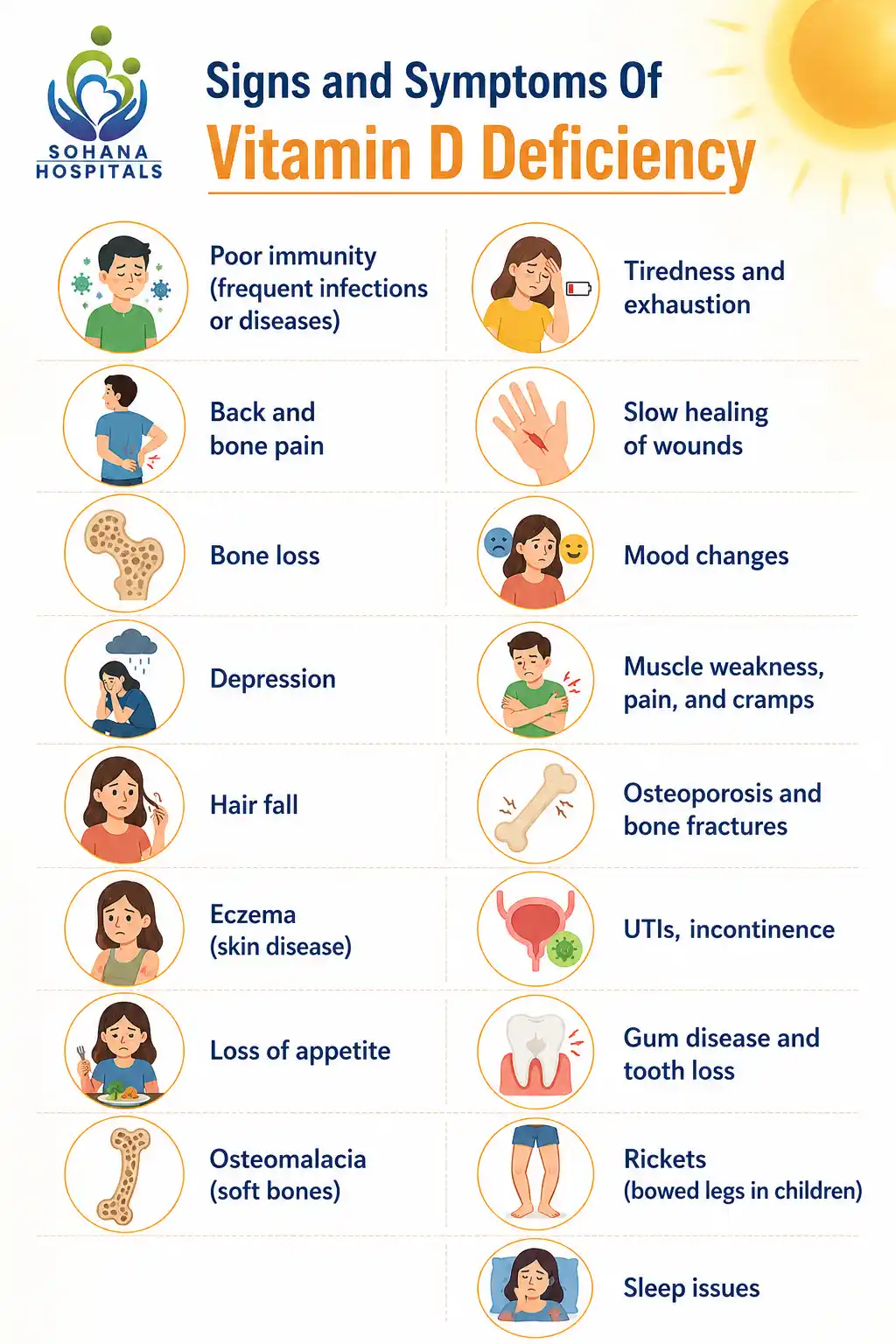
- Poor immunity (frequent infections or diseases)
- Tiredness and exhaustion
- Back and bone pain
- Slow healing of wounds
- Bone loss
- Mood changes
- Depression
- Muscle weakness, pain, and cramps
- Hair fall
- Osteoporosis and bone fractures
- Eczema (skin disease)
- UTIs, incontinence
- Loss of appetite
- Gum disease and tooth loss
- Osteomalacia (soft bones)
- Rickets (bowed legs in children)
- Sleep issues
| 👉Did you know? Several factors affect how much Vitamin D your body absorbs from sun exposure – the season, time, and length of the day, air pollution levels, presence of clouds, melanin in the skin, etc. High pollution levels filter out the UV light of 290–300 nm wavelength. |
Vitamin D deficiency may not be diagnosed right away. Signs are generally very subtle or overlap with several other health conditions. That is why you may be advised to undergo a blood test or a bone density test.
If you, a family member, or a friend is dealing with any of the Vitamin D-deficiency symptoms mentioned in the blog, visit Sohana Hospital, Mohali, near Chandigarh. A multi-super speciality hospital located in the heart of the tricity, the hospital boasts an expert team of the orthopedic doctors.
Our highly experienced doctors assess your symptoms through a combination of physical examination, medical history, and advanced diagnostics. The earlier this deficiency is identified, the sooner you can overcome it.
A child dealing with rickets surely requires early treatment to avoid any complications later in life. And so does an adult struggling with a backache or another symptom.
Get some sunshine in the early morning. It is good for your bones.
Notice any Vitamin D deficiency symptoms? Contact Sohana Hospital (+918725001155)
Reference Sources:
- https://pmc.ncbi.nlm.nih.gov/articles/PMC3942730/#:~:text=Vitamin%20D%20deficiency%20prevails%20in%20epidemic%20proportions%20all%20over%20the%20Indian%20subcontinent%2C%20with%20a%20prevalence%20of%2070%25%E2%80%93100%25%20in%20the%20general%20population.
- https://ods.od.nih.gov/factsheets/VitaminD-HealthProfessional/#:~:text=These%20values%20range%20from%2015%20to%2020%20mcg%20(600%E2%80%93800%20IU)%20for%20adults%20and%20from%2010%20to%2015%20mcg%20(400%E2%80%93600%20IU)%20for%20infants%2C%20children%2C%20and%20adolescents%2C%20depending%20on%20age.
- https://www.sciencedirect.com/science/article/pii/S0735109708031756#:~:text=Vitamin%20D%20deficiency%20is%20a%20highly%20prevalent%20condition%2C%20present%20in%20approximately%2030%25%20to%2050%25%20of%20the%20general%20population.
- https://pmc.ncbi.nlm.nih.gov/articles/PMC3068797/#:~:text=Over%20a%20billion%20people%20worldwide%20are%20vitamin%20D%20deficient%20or%20insufficient.
- https://pmc.ncbi.nlm.nih.gov/articles/PMC7091696/#:~:text=Recent%20large%20observational%20data%20have%20suggested%20that%20~40%25%20of%20Europeans%20are%20vitamin%20D%20deficient%2C%20and%2013%25%20are%20severely%20deficient
- https://pmc.ncbi.nlm.nih.gov/articles/PMC3942730/#:~:text=Vitamin%20D%20deficiency%20prevails%20in%20epidemic%20proportions%20all%20over%20the%20Indian%20subcontinent%2C%20with%20a%20prevalence%20of%2070%25%E2%80%93100%25%20in%20the%20general%20population.