
हिंदी में पढ़ें: मनोभ्रंश की रोकथाम: जोखिम को कम करने के लिए जीवनशैली में 10 बदलाव
According to the World Health Organisation (WHO), dementia risk can be reduced by adopting healthier lifestyle habits.
Yes! You can lower your risk of dementia by exercising regularly, not smoking, avoiding excessive alcohol consumption, maintaining a healthy weight, eating well, and keeping parameters like blood pressure, cholesterol, and blood sugar in check.
| 🚨Alert: 14 out of 100 cases of dementia globally may be a result of smoking! |
Manage Lifestyle: Reduce Dementia Risk
While Alzheimer’s disease and other dementia disorders lack proven prevention, a healthy lifestyle may help manage risk factors. It is because genes, race, ethnicity, gender, and environment also influence your probability of developing cognitive impairment.
Here are some factors that you can control:
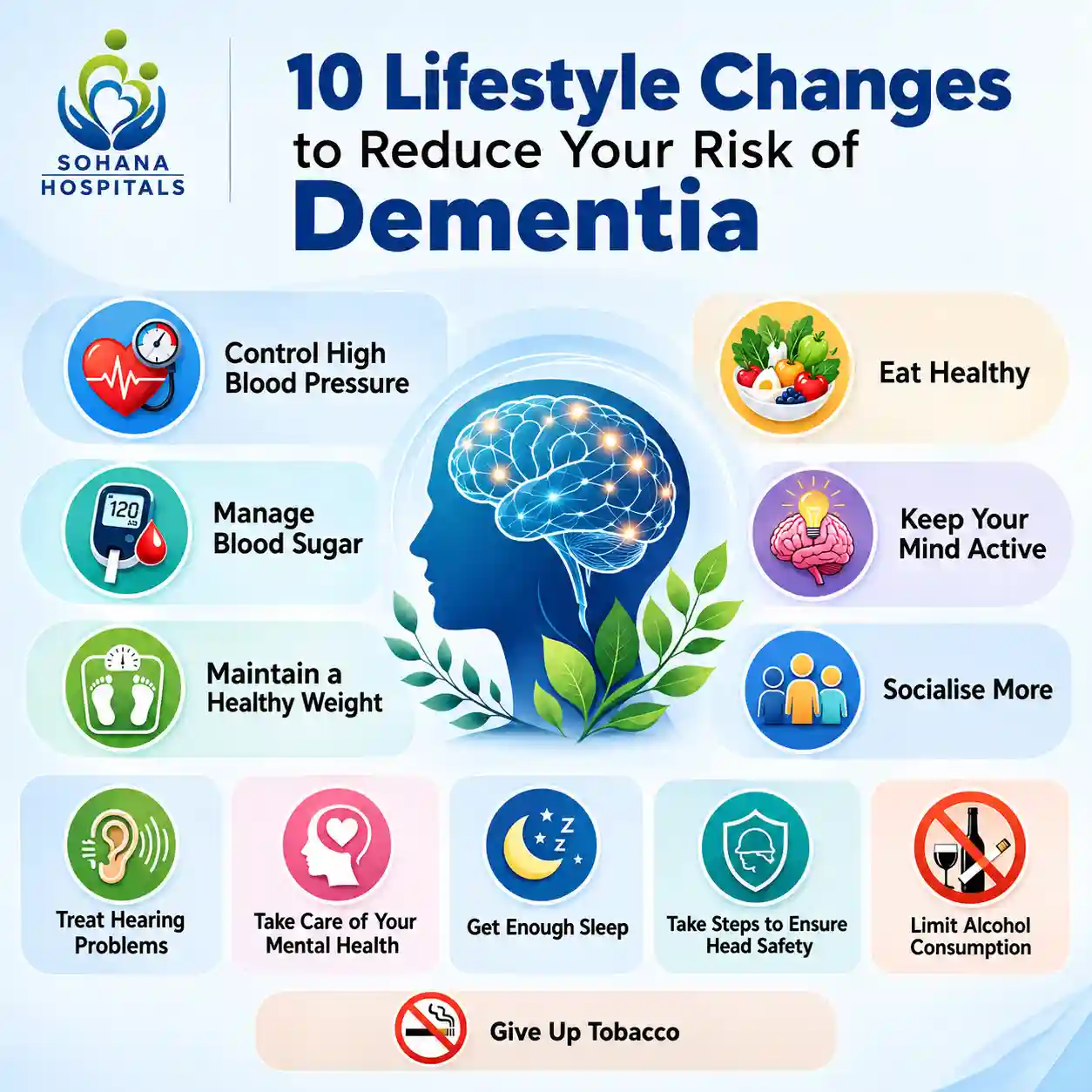
Control High Blood Pressure
High BP? How does it increase the risk of dementia? Hypertension can harm your heart health, blood vessels, and brain. It increases your risk of stroke and vascular dementia.
*Tip: Take your prescribed BP medications, exercise regularly, and quit smoking.
Manage Blood Sugar
Diabetes can bring with it a package of diseases, and dementia is one of them. How? Unmanaged sugar levels can be harmful to heart health, brain stroke, cognitive decline, and dementia.
*Tip: Eat healthy, stay physically active, stop smoking, and check blood sugar levels.
| 🚨Alert: 57 million people globally have dementia, and almost 10 million new cases come up annually (WHO: 2021 data). |
Maintain a Healthy Weight
Which is one factor responsible for all major diseases? It’s obesity, high BMI, or being overweight. It lays the foundation for health conditions like diabetes and heart problems.
*Tip: Stay active and make healthy food choices.
| 🚨Alert: Women are more susceptible to Alzheimer’s, with 1 in 5 women versus 1 in 10 men developing the disease (at age 45). This is partly because women generally live longer than men. |
Eat Healthy
This is something that lies at the base. Food is meant to give nutrition to the body and keep us healthy. But ironically, food has become one of the most ignored aspects in the modern world, which is leaning toward processed and junk food.
*Tip: Include whole grains, plenty of fruit and vegetables, low-fat dairy, and unsaturated fats. Avoid processed food items that are high in salt and sugar.
| 🚨Alert: Alzheimer’s disease (AD) accounts for 60-70% of dementia cases, making it the most common type of dementia. |
Keep Your Mind Active
We talked about physical activity, but what about mental agility? Use it or lose it. The saying holds true for your brain, too. Keep your mind active by exercising it and giving it new challenges.
*Tip: Engage in reading, gardening, volunteering, playing board games, or learning a new language or skill, etc.
Socialise More
The modern world has rendered many isolated from social relationships. Loneliness and social isolation have been associated with higher risks of cognitive degeneration and Alzheimer’s disease.
*Tip: Connect with family and friends or join social clubs.
| 🚨Alert: Presently, dementia ranks 7th among the major causes of death. It is a prominent cause of disability and dependency among the elderly worldwide. |
Treat Hearing Problems
Just as you pay attention to your sight, take care of your hearing, too. Your senses connect you to the outside world and keep your mind active. Hearing loss may raise dementia risk in the elderly by affecting cognition.
*Tip: Keep your headphone volume below 60% and do not use them for more than an hour at a time. Use earplugs in noisy environments. Use hearing aids if required. Get ear tests every 3-5 years or earlier if you notice hearing difficulties.
Take Care of Your Mental Health
We talked about physical health. We also talked about keeping your brain active. But what about mental health? Evidence indicates a link between depression and a higher risk of dementia.
*Tip: Manage anxiety and depression alongside your cholesterol and sugar. Get regular screenings for overall health.
| 🚨Alert: Every 3 seconds, somebody in the world develops dementia.🚨 |
Get Enough Sleep
How important is sleep for brain health? Research shows an association between sleep patterns earlier in life and dementia risk later on. This includes both inadequate sleep and excessive sleep.
*Tip: Try to get 7-8 hours of sleep daily; otherwise, seek medical help.
Take Steps to Ensure Head Safety
Traumatic brain injury, especially one that is severe enough to make an individual lose consciousness, has been seen to increase the risk of dementia by 50% compared to other people.
*Tip: Ensure head safety by taking measures to avoid falls. Wear anti-skid footwear and the right gear while driving and playing sports.
| 🚨Alert: Dementia is expected to affect nearly 78 million individuals in 2030 and 139 million people in 2050.🚨 |
Limit Alcohol Consumption
Why do doctors always tell you to refrain from consuming alcohol? One reason is that it can increase the likelihood of falls. Also, it can worsen diabetes, high BP, memory loss, stroke, and mood disorders.
*Tip: NIAAA (National Institute on Alcohol Abuse and Alcoholism) restricts men’s intake of liquor to 2 drinks a day, and that of women to just one drink a day.
Give Up Tobacco
Here we give you yet another reason to quit smoking! Smoking makes you more vulnerable to heart diseases, which is seen to elevate the risk of dementia. Smokers are often at greater risk of cognitive decline, dementia, Alzheimer’s disease, and vascular dementia.
*Tip: Quitting smoking at any time helps. Quit smoking to reduce your dementia risk.
| 🚨Alert: Current smokers have a 30% higher risk of developing dementia. 👉 And what about Alzheimer’s? 40% higher risk! 👉 For every 20 cigarettes smoked a day, dementia risk goes up by 34% |
The Bottom Line
Dementia is witnessing a steady rise in the global population. Among the many factors contributing to dementia risk, some, like family history, gender, and ethnicity, are unavoidable.
But the good news is that you can modify your lifestyle habits to reduce your risk of dementia. Eat healthy, stay physically active, keep all essential health parameters within the permissible limits, and give up unhealthy habits.
Facing memory lapses, difficulty communicating, or time-place confusion? Get in touch with the best neurologist in Chandigarh at Sohana Hospital. The leading super-speciality hospital offers the most advanced diagnostics along with management and treatment options for a host of brain disorders, with dementia and Alzheimer’s disease being two of them.
Early diagnosis and management can help delay progression and allow the patient to live a better quality of life. And most importantly, remember that you can significantly improve your chances of living a healthy life.
Adopt a healthy lifestyle – Keep dementia away!
Reference Sources
- World Health Organization. Adopting a healthy lifestyle helps reduce the risk of dementia. https://www.who.int/news/item/14-05-2019-adopting-a-healthy-lifestyle-helps-reduce-the-risk-of-dementia – 14 May 2019
- National Institutes of Health. Healthy lifestyle and the risk of Alzheimer dementia. https://pmc.ncbi.nlm.nih.gov/articles/PMC7455318/. – 2020 Jul 28
- American Heart Association. https://www.heart.org/en/news/2021/07/06/smoking-harms-the-brain-raises-dementia-risk-but-not-if-you-quit. Smoking harms the brain, raises dementia risk – but not if you quit – July 6, 2021
- World Health Organization. Dementia. https://www.who.int/news-room/fact-sheets/detail/dementia – 3 July 2026
- Alzheimer’s Association. Alzheimer’s Disease Facts and Figures. https://www.alz.org/alzheimers-dementia/facts-figures
- Alzheimer’s Society. Depression and dementia risk. https://www.alzheimers.org.uk/about-dementia/managing-the-risk-of-dementia/risk-factors-for-dementia/depression
- Alzheimer’s Disease International. https://www.alzint.org/about/dementia-facts-figures/dementia-statistics/
- National Institutes of Health. Lack of sleep in middle age may increase dementia risk https://www.nih.gov/news-events/nih-research-matters/lack-sleep-middle-age-may-increase-dementia-risk – April 27, 2021
- National Institutes of Health. Smoking, dementia and cognitive decline in the elderly, a systematic review. https://pmc.ncbi.nlm.nih.gov/articles/PMC2642819/ – Dec 23, 2008
- National Institutes of Health. Drinking Patterns and Their Definitions. https://pmc.ncbi.nlm.nih.gov/articles/PMC6104961/ – Jan 2018
- National Institutes of Health. Dementia Resulting From Traumatic Brain Injury. https://pmc.ncbi.nlm.nih.gov/articles/PMC3716376/ – Jul 19, 2013
- Alzheimer’s Research UK. Head injury and dementia risk explained https://www.alzheimersresearchuk.org/dementia-information/dementia-risk/head-injury-and-dementia-risk/