
Alzheimer’s disease (AD) is the most common form of dementia – a condition that gradually affects memory, thinking, and the ability to perform everyday activities.
Alzheimer’s occurs due to impaired functioning of brain cells, especially neurons – the nerve cells that enable us to do everything from thinking and talking to eating and walking.
Let’s understand what affects these brain cells and their working to ultimately result in AD.
| 👉Did you know? Dementia affects millions of people worldwide, with a new case emerging approximately every 3 seconds. In 2020, more than 55 million people across the globe were living with dementia. (via Alzheimer’s Disease International) |
Protein Build-up In & Around Brain Cells
The root cause of Alzheimer’s disease is believed to be an abnormal build-up of proteins inside the brain cells and also around them.
2 of these proteins are:
- Amyloid: Abnormal accumulation of this protein can lead to the formation of plaques around brain cells
- Tau: Its deposits result in tangle formation inside brain cells (via NHS)
Researchers still have not fully understood why these changes occur in most people. Alzheimer’s is believed to involve a complex interaction of genetic, biological, environmental, and lifestyle factors. Another key factor is that symptoms may appear many years later.
| 👉Did you know? Nearly 7.7% of Indians aged over 60 are affected by dementia, accounting for around 8.8 million cases. (via NIH) |
With the adverse impact on brain cells, there is a decline in neurotransmitters (chemical messengers that support communication between brain cells). It is seen that individuals with AD have low levels of acetylcholine (a neurotransmitter that impacts memory, attention, and learning).
With the passage of time, various regions of the brain start shrinking. The initial ones are typically those responsible for memory.
However, Alzheimer’s can be of different forms. Some unusual forms may affect other regions of the brain. The patient may experience vision or language issues instead of memory problems.
| 👉Did you know? Alzheimer’s risk factors you cannot control include: – Age – Family history – Genes |
Risk Factors for Alzheimer’s Disease
While precise causes of Alzheimer’s disease are not yet known, some factors can elevate your risk:
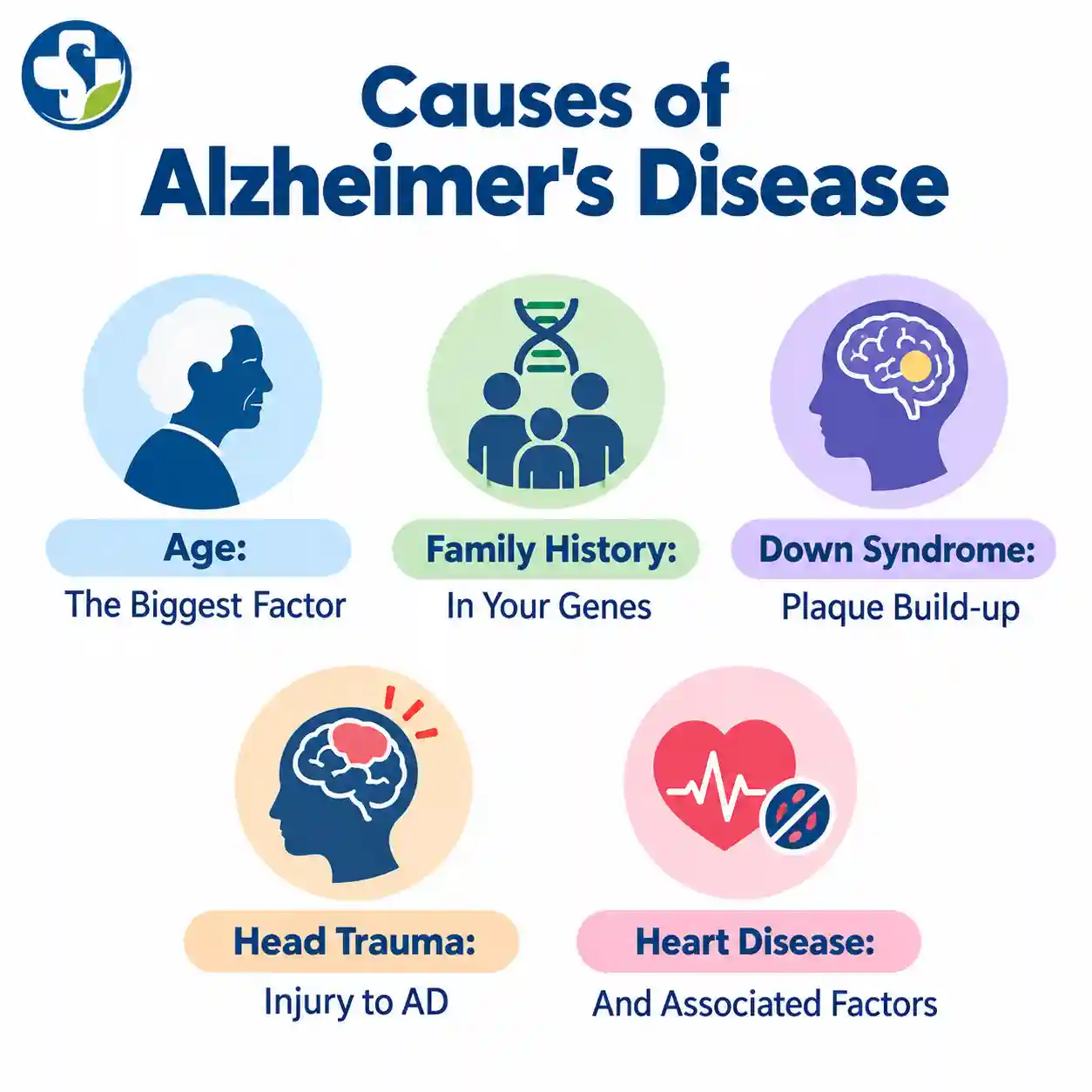
Age: The Biggest Factor
The risk is multiple times as one hits the age of 65. In fact, the probability of being affected by AD increases 2x every 5 years once you are 65.
Does that mean people younger than 65 are in the safe zone? No! Roughly 1/20 AD patients are aged below 65. Known as young-onset or early-onset Alzheimer’s, it can affect those aged 40 and above. (via NHS)
| 👉Did you know? You can manage some of the Alzheimer’s risk factors: – Lifestyle habits (smoking, alcohol, lack of physical activity, etc.) – Weight – Stress and depression – Social isolation – Blood pressure – Diabetes – Cholesterol |
Family History: In Your Genes
Just as with most other diseases, your AD risk can be higher if your parent(s) had the condition.
In some families, passing on one particular gene is responsible for Alzheimer’s disease, and there is a high likelihood of the condition passing on through generations.
If Alzheimer’s runs in your family, especially if any family members developed the condition at a young age, it is important that you get in touch with a specialist to understand your risk as you age.
More than 1 family member with AD, higher AD risk.
Note: Having a parent or relative with Alzheimer’s does not mean that a person will definitely develop the condition.
| 👉Did you know? Deterministic genes account for less than 1% of Alzheimer’s cases. (via Alzheimer’s Association) |
Down Syndrome: Plaque Build-up
Those with Down syndrome may be more vulnerable to AD. Why?
The underlying genetic alterations behind Down syndrome can also lead to the building up of amyloid plaques in the brain over time. People with Down syndrome have a substantially higher risk of developing Alzheimer’s disease as they age.
| 👉Did you know? Alzheimer’s risk rises with age. Here’s the proportion of people affected by AD or some other form of dementia: Aged above 65: Nearly 1 in 14 peopleAged above 80: Roughly 1 in 6 peopleAged below 65: Almost 1 in 13 people (via NHS) |
Head Trauma: Injury to AD
It is believed that a severe head injury may raise a person’s risk of developing Alzheimer’s disease later in life.
| 👉Did you know? You can minimise your risk of head injury by: – Wearing a seatbelt when travelling in an automobile – Wearing a helmet while driving – Using proper gear when participating in sports – Being mindful of falls |
Heart Disease: And Associated Factors
Studies reveal that some lifestyle habits and conditions linked to cardiovascular disease can make you more susceptible to AD.
Which are these lifestyle factors, and what can you do?
| Factor | Solution |
| Smoking | Quit smoking |
| Obesity | Maintain a healthy weight.Consume a healthy diet with more fruits, vegetables, whole grains, nuts, and seeds. Limit intake of sugary foods and drinks, processed food items, alcohol, and other unhealthy food items.Stay physically active with regular exercise.Exercise your brain by learning new skills or language, solving puzzles, and attempting other mind games.Get regular health screenings to detect any signs of physical and mental conditions early. |
| High cholesterol levels | |
| High blood pressure | |
| Diabetes |
Apart from the above-mentioned risk factors, some other aspects may also raise the risk of AD and dementia, although they may not be directly responsible for dementia.
Here are other things you should be careful about:
- Loss of hearing
- Untreated vision loss
- Depression (when left untreated)
- Social isolation
- Not getting adequate physical activity
- Sleep deprivation
- Air pollution
*Note:
- Depression can be a reason as well as a symptom of AD. However, depression does not necessarily mean that a person has Alzheimer’s disease.
- The suggested activities can support cognitive health but may not guarantee prevention of Alzheimer’s disease.
Conclusion
The causes behind developing Alzheimer’s disease still remain largely unknown. But we know the risk factors. While some of these risk factors, like age, heredity, and genes, are not possible to control, you can manage the other aspects that may raise your AD risk.
Facing any memory issues, cognitive challenges, or language struggles? A consultation and thorough examination with the top neurologists may help you get an early diagnosis and timely treatment. Advanced diagnostics and the latest treatment/management options can help:
- Identify the cause of symptoms
- Determine suitable management and treatment options
- Slow down the progression of Alzheimer’s and support an improved quality of life