
*हिंदी में पढ़ें: कमजोर हड्डियों के चेतावनी संकेत
Bones naturally lose density and grow weaker with age, but are there any warning signs?
Let’s see how to identify the silent signs of bones becoming weaker and prevent serious conditions, like osteoporosis. Osteoporosis occurs when the body loses too much bone, forms too little, or both. When this happens, bones become porous and weak.
Osteoporosis typically progresses without symptoms. That is why it is often called a “silent disease”. People usually discover they have osteoporosis when they suffer a fracture.
Weakening bones may not have any clear symptoms, but only subtle hints. In this blog, we’ll discuss the early warning signs, why it is important, and when to seek medical advice.
| 👉 Did you know? Just as exercise helps build strong muscles, it also helps build stronger bones! |
Why is Early Detection Important?
Weak bones may result in chronic pain, fractures, and a diminished quality of life. The earlier you identify the symptoms of weak bones (and hence, reduced bone density), the easier it will be for you to take the necessary steps to make your bones stronger.
Understanding the initial signs of bone loss can help you stay safe from conditions like osteoporosis, avoid complications, and stay active.
What are the Silent Signs of Weak Bones?
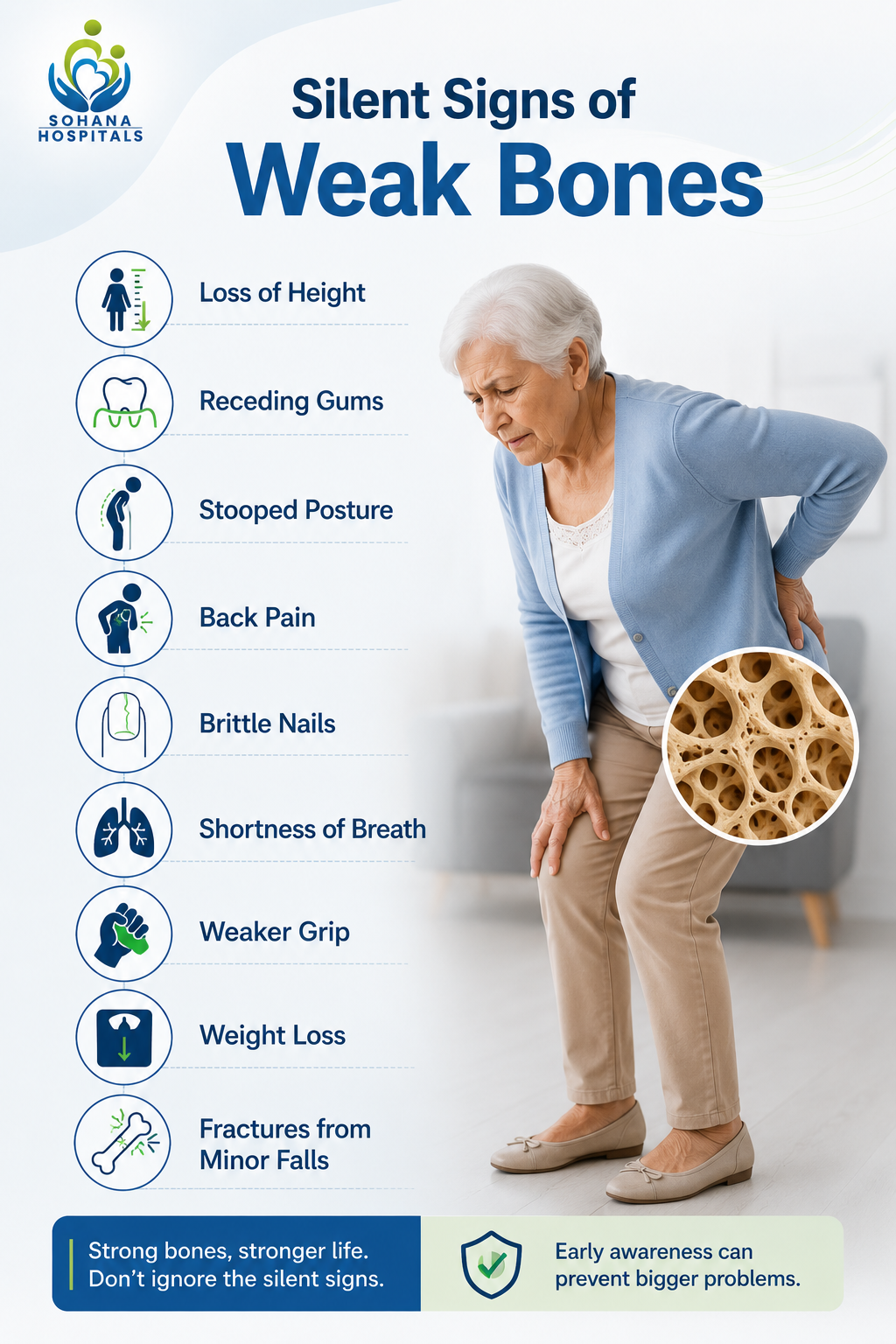
Loss of Height
Did anybody point out that you seem shorter than you used to be? Well, a loss of more than 2–4 cm in height could indicate a shrinking spine because of vertebral compression fractures caused by osteoporosis.
Several older adults experience this sign of osteoporosis. Measure your height at least once a year for early detection of bone loss.
Receding Gums
As surprising as it may seem, your dentist may notice the early signs of weakening bones. How? Your jawbone supports your teeth. When it loses strength, you may lose teeth easily, or your gums may recede.
*Note: Receding gums are often caused by gum disease and should not be considered a reliable early sign of osteoporosis.
Stooped Posture
Has a hunch appeared in your upper back? Alternatively, do you find it hard to stand straight? A stooped posture or developing a “dowager’s hump” may result from multiple vertebral compression fractures and indicate spinal bone loss or fracture.
| 👉 Did you know? Studies indicate a direct link between tobacco use and reduced bone density. |
Back Pain
If you often experience unexplained pain in your back, the reason may be minor fractures or collapsed vertebrae in your spine. Such fractures can occur gradually over time as bones continue to get weaker.
Brittle Nails
Do nails have any link with bone health? Yes! Nails breaking often may sometimes point to low bone density. Additionally, if you see vertical ridges in your nails, it may be a sign of calcium deficiency. Although it is not a direct consequence of weak bones, it may be a worthy hint if other symptoms are also present.
*Note: Brittle nails alone are not considered an early sign of osteoporosis.
Shortness of Breath
If your spine has started getting compressed due to bone loss or fracture caused by advanced osteoporosis, it may affect your lung capacity. It means shortness of breath can be a symptom of bone density loss. It may also happen due to other serious issues.
So, to ascertain that your shortness of breath is indeed linked with osteoporosis, it must be examined.
| 👉 Did you know? Bones lose density as you grow older, but you can slow down or even stop bone loss by adopting a lifestyle that includes regular exercise and a bone-healthy diet, among other things. |
*Read more: 9 Practical Tips To Increase Bone Density Naturally
Weaker Grip
No longer able to open jars that you used to open so easily? Hands losing strength or facing difficulty with routine tasks like opening jars could be a symptom of overall muscle weakness and poor bone health. This may increase the risk of falls and fractures.
A simple instrument called a hand dynamometer can help measure grip strength (at home or in a doctor’s clinic).
Weight Loss
People with a slender frame and low body weight are prone to bone loss. So, if you’ve been dieting hard and have lost significant weight or experienced unintended weight loss, you may be at risk of low bone density and a higher risk of osteoporosis. Though an indirect sign, it signals you to stay cautious.
Fractures from Minor Falls
Just a little bump gave you a fractured bone? This could be due to declining bone density. Your bones may have become weaker, making them prone to easy fractures. Fragility fractures after a minor fall or minimal trauma are a hallmark of osteoporosis.
| 👉 Did you know? Women are 4X more at risk of osteoporosis than men. Nearly 50% of women and 25% of men over age 50 sustain a fracture due to osteopenia or osteoporosis. |
*Read more: Why are Women at Higher Risk of Osteoporosis?
What are the Risk Factors for Weak Bones?
It is important to watch out for early warning signs of bone loss, but it is equally important to understand your risk of bone-weakening.
Specific factors can raise your probability of losing bone strength. You can control some of them, while others may be beyond your control.
But it is good to be aware of all of them. Here are the prominent risk factors for bone loss:
- Older age
- Being female
- Smoking
- Excessive alcohol consumption
- Menopause
- Unhealthy food habits
- Lack of physical activity
- Vitamin D deficiency
- Low calcium intake
- Long-term corticosteroid use
- Rheumatoid arthritis
- Hyperthyroidism
- Family history
- Slender body frame
- Certain medications
| 👉 Did you know? Women lose up to 20% or more bone in the first decade of menopause. |
Which Diseases Are Associated with Weak Bones?
Common diseases linked with low bone density include:
- Osteoporosis
- Osteopenia
- Osteomalacia (and Rickets)
- Paget’s disease
- Osteonecrosis
- Fragility fractures
- Vertebral compression fractures
Doubt your bones are losing strength? Visit Sohana Hospital in Mohali to have a DEXA (Dual-energy X-ray Absorptiometry) for bone density. Also, if any bone issues are diagnosed, you can seek treatment from the best bone doctors in Punjab.
The super-speciality hospital boasts the most advanced diagnostics and treatment facilities under one roof. What’s more, expert doctors devise personalised treatment plans for you based on your age, medical history, lifestyle, and other aspects.
Identify signs early, take steps to strengthen your bones before it’s too late!