
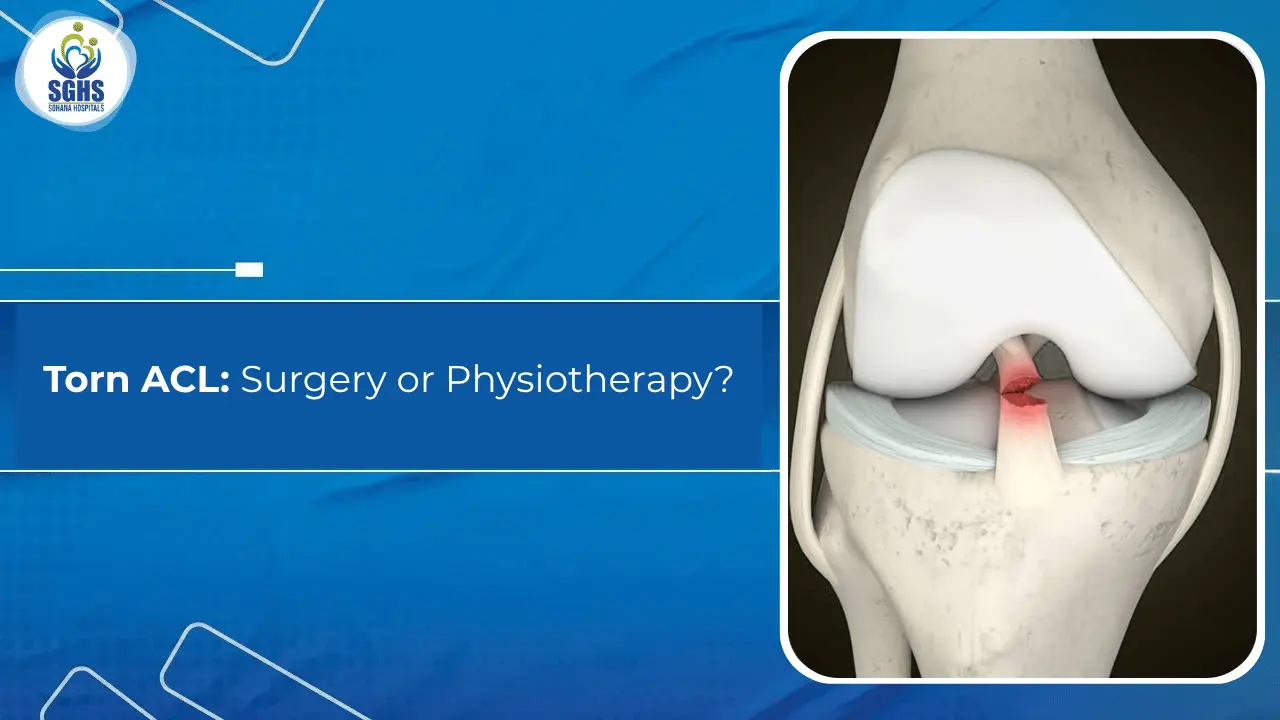
Have you torn your ACL (Anterior Cruciate Ligament) while playing sports or after a sudden twist or knee injury? An ACL tear can cause knee pain, swelling, instability, and difficulty moving the knee. Wondering whether you must undergo surgery or if the condition can be managed with physiotherapy?
The answer differs from person to person, depending on the age, symptoms, extent of the tear, associated injuries, activity level, and personal preferences. Someone who actively participates in competitive sports may require a different treatment than a person who only engages in low-impact activities.
In this blog, we are going to discuss whether you can manage with only physiotherapy or may require ACL reconstruction surgery.
| 👉 Not every ACL tear requires surgery, but physiotherapy alone may not help everyone regain sufficient knee stability. |
Understanding ACL and ACL Tear
ACL (Anterior Cruciate Ligament)
- One of the key ligaments that helps maintain stability in your knee
- Performs the function of controlling forward motion and shin bone rotation
Reasons for ACL Injuries
- Sudden changes in direction
- Improper landings
- Stopping abruptly
- Direct impact to the knee
ACL injuries usually happen in sports, but may occur in other activities, too. Sometimes, the injury may be accompanied by a popping sound.
Symptoms of an ACL Tear
- Pain
- Swelling and inflammation
- Inability to put weight on the injured leg
*Note:
- Not every ACL tear affects the weight-bearing capacity of the knee/leg.
- Severe pain or difficulty walking after an injury deserves prompt medical assessment.
Types of ACL Tears
| Type of Tear | Explanation |
| Partial Tear | Not all fibres of the ligament are injured. |
| Complete Tear | The tear is complete, involving the full disruption of the ACL fibres. It may cause significant knee instability. The affected knee may also lose its weight-bearing ability. |
| Combined injury | The cartilage, meniscus, or another ligament of the knee also sustains damage along with the ACL. |
When Can You Choose Physiotherapy for ACL Tear?
Sometimes, you can manage an ACL tear with physiotherapy. Let’s see when physiotherapy can help:
- It’s a partial ACL tear injury
- Some complete ACL tears where the knee remains functionally stable
- No participation in high-impact activities or contact sports is needed
- Functionality in routine activities is not much affected
- Underlying medical conditions make surgery unviable
- Patient is interested in trying conservative treatments first
Benefits of Structured Physiotherapy for ACL Tear
- Can help control pain, swelling, and inflammation
- May improve strength in quadriceps and hamstring muscles
- May enhance knee movement and walking
- Better balance and coordination
- Can be tailored as per the particular activities you want to perform
- Helps train you to avoid risky movements
*Note:
- Physiotherapy does not reconnect the torn ligament.
- Commitment is essential for physiotherapy to be effective.
- Requires regular monitoring since repetitive instability in the knee can lead to the joint cartilage or meniscus also getting damaged, particularly in people who return to demanding activities without adequate knee stability.
- Some patients may continue to experience instability and require surgery.
- You can manage initially with physical therapy, but choose surgery later on if there is instability in the knee or you want to engage in high-impact activities.
When May ACL Surgery Be Necessary?
Some patients may not benefit from physiotherapy. In such cases, ACL reconstruction surgery may be advised. Let’s have a look:
- Completely torn ACL along with significant instability
- The knee lacks stability and function
- The patient is a player, desiring to get back to the field (badminton, basketball, football, etc.)
- Occupation involves heavy physical activity, frequent climbing or turning, etc.
- Another ligament or meniscus is also damaged
- Knee continues to be unstable and lacks normal movement even post-rehabilitation
| 👉 Which is a more important factor – age or activity level – when choosing between physiotherapy or surgery for torn ACL?It’s activity level. Physically active individuals may need a stable knee for optimal performance in sports/work. However, the decision also depends on knee instability, associated injuries, overall health, etc. |
ACL surgery is usually a minimally invasive arthroscopic (keyhole) procedure. An important aspect is that physical therapy is needed both before and after surgery.
Before surgery, it helps lower inflammation and improve mobility. After surgery, tailored physiotherapy helps restore strength and balance, which further aids in bringing back knee control, stability, and movement.
Which Factors Help Decide the Right Treatment?
Your orthopaedic doctor may take into account several factors before they suggest a particular treatment:
- Is the tear partial or complete?
- How unstable is the knee?
- What are your sports and work commitments?
- What’s your age?
- How is your overall health?
- Is there any cartilage, meniscus, or ligament injury, too?
- Did you have any knee issues in the past?
- Did physiotherapy prove effective?
- What are your personal goals?
- Does the knee repeatedly give way during daily activities?
- Are you determined to perform physiotherapy diligently?
- What are the risks, benefits, and expected recovery associated with surgical and non-surgical treatment?
Sohana Hospital has an experienced orthopaedic team comprising trained physiotherapists, arthroscopy surgeons, and joint replacement surgeons.
The team aims to help patients improve knee stability, strength, and function and return to appropriate daily activities or sports, depending on their individual recovery.
Remember: If you happen to damage your ACL while playing sports or as a result of an accident, it is important to get the right treatment after consulting an experienced knee joint doctor in Mohali, Chandigarh.