
Kids are very physically active – playing, jumping, running, and sometimes falling, too. And kids’ bodies and bones are very different from those of adults, the reason being that kids are growing and developing.
If they develop any bone and joint issues, they must be treated early to avoid complications later on. It is here that paediatric orthopaedic specialists step in. They diagnose and treat bone, muscle, and joint issues in kids of all ages.
If your child complains of pain, finds it difficult to walk, or has any visible bone issues, seek the help of a paediatric orthopaedist. Understanding bone and joint issues in children can help you identify any problems in your child early and get timely treatment.
What is Paediatric Orthopaedics?
Paediatric orthopaedics is a specialised field of medicine dealing with diagnosing and treating bone, muscle, and joint issues in kids of all ages, from infants and children to teenagers.
Since children’s bones are still in the growing stage, their orthopaedic needs are different from those of adults. Paediatric orthopaedic doctors understand these requirements and provide suitable treatments that promote healthy growth in kids.
Children’s bones are softer and more flexible than adult bones. This puts them at risk of specific injuries and conditions. Also, some problems may be present at birth, while others may develop afterwards.
Whether your child sustains a minor fracture or has a major bone deformity, a paediatric orthopaedist has the right training and experience to address these issues. They aim at ensuring that children grow properly and have strong, healthy bones.
Common Bone & Joint Problems in Children
Kids may suffer from various orthopaedic issues. Some are harmless and resolve on their own, while others require proper treatment. Let us have a look at some of the most common orthopaedic problems in children.
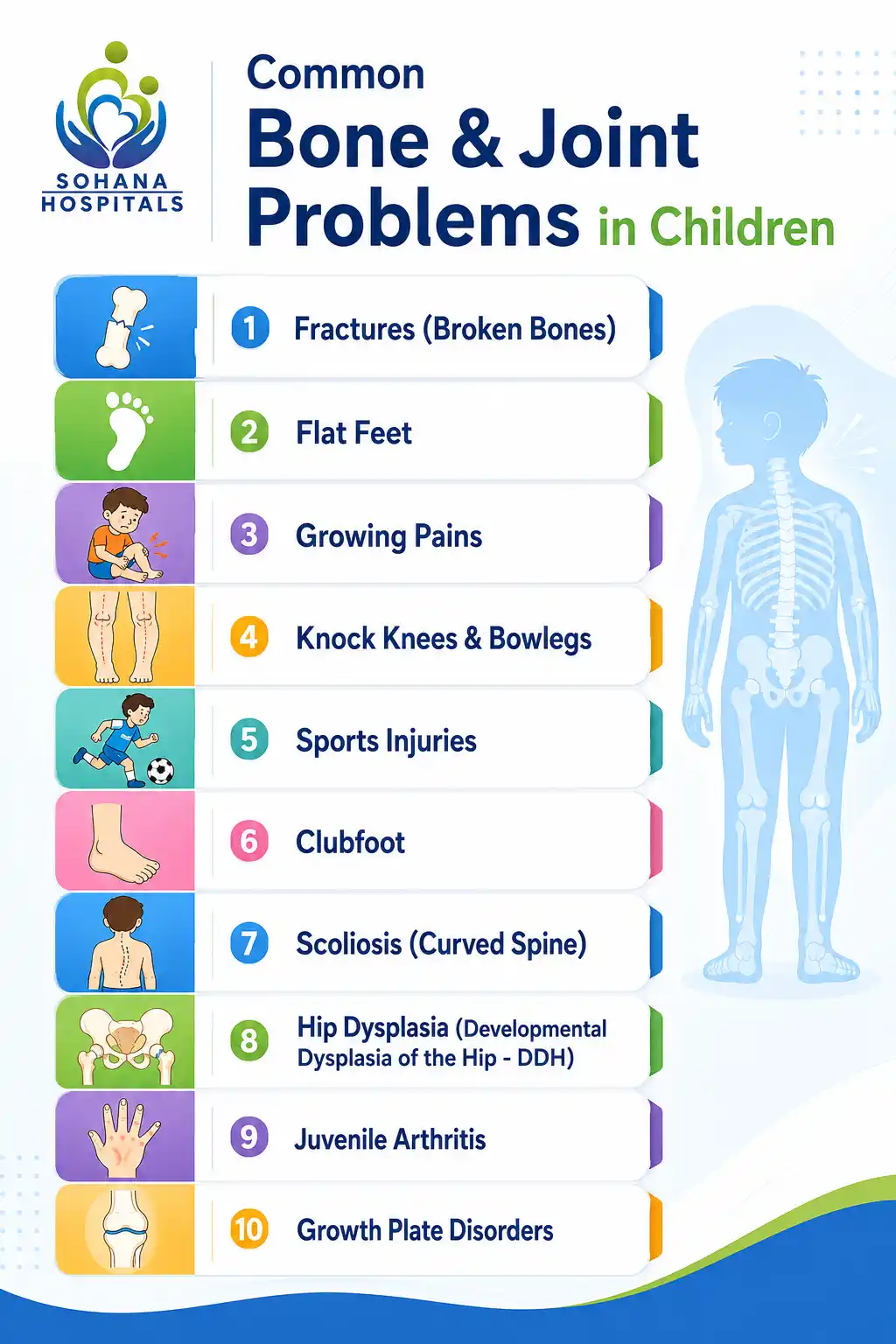
1. Fractures (Broken Bones)
Kids love to play, and this puts them at a higher risk of falling and getting hurt. Fractures or broken bones are a major reason why parents rush to a paediatric orthopaedic physician.
How to identify a fracture? If the injured area is swollen and painful, and the child is unable to move it, it may be a fracture. While some fractures can be treated using a cast, others may necessitate orthopaedic surgery.
2. Flat Feet
Flat feet are something most kids are born with, but it generally improves with the kids’ growth. But in some children, the arch lacks proper shape.
When this happens, the child may complain of foot pain and face difficulty walking. It is time to consult a specialist. They may recommend exercises, special shoes, or some therapy. In rare cases, surgery may be required.
3. Growing Pains
Growing pains are non-inflammatory muscle aches in both legs that several children aged 3-12 years face, usually at night. Though harmless, they can be frustrating for the child.
Parents can help the child by giving them a leg massage or a warm bath. Stretching may also be helpful. If the pain is severe or interferes with daily life, it would be good to seek medical intervention.
4. Knock Knees & Bowlegs
Knock knees are when the feet are apart, but the knees touch. Bow legs refer to legs curved outwards. Bowlegs usually improve by around 2 years of age, while knock knees often improve naturally by around 7 years of age.
If the problem is severe or does not improve, the child may be advised to wear braces. Severe cases may require surgery.
5. Sports Injuries
Children may get injured while participating in games and sports. They may sustain injuries like ligament tears, sprains, and even fractures.
In most cases, children recover with rest, ice application, compression, elevation, and physical therapy. However, severe injuries like fractures must be treated by a paediatric orthopaedic surgeon.
6. Clubfoot
Clubfoot is a congenital (present at birth) foot defect. The foot twists inwards and may result in walking difficulties if left untreated.
Early treatment includes non-surgical methods, such as bracing or casting, that help correct the foot position. If the foot is severely distorted, it may require surgery.
7. Scoliosis (Curved Spine)
Scoliosis is an abnormal sideways twisting of the spine. It can be seen in children aged 10-15 years. It commonly develops during growth spurts. There may be symptoms such as uneven shoulders, waist, or hips.
If the spine has a mild curvature abnormality, doctors may prefer to wait and observe. For moderate to severe cases, braces or sometimes surgery may be advised.
8. Hip Dysplasia (Developmental Dysplasia of the Hip – DDH)
Hip dysplasia is an abnormality in a child’s hip joint formation. It may cause walking difficulties if untreated.
Doctors use a physical examination or an ultrasound to diagnose DDH in newborn babies. Depending on the complexity of the case, it may be treated through casting, bracing, or surgery.
9. Juvenile Arthritis
Juvenile arthritis, commonly referred to as Juvenile Idiopathic Arthritis (JIA), is the most common type of chronic arthritis that affects children aged below 16 years. It is an autoimmune condition, meaning that the body’s immune system starts attacking healthy joint tissues of the child.
If your child has persistent pain in joints, stiffness, swelling, and tiredness, do get in touch with a paediatric orthopaedic doctor.
10. Growth Plate Disorders
Growth plates are soft areas of developing cartilage located near the ends of a child’s long bones. Because they are softer and more vulnerable than mature bone, they can be affected by injuries, infections, or certain medical conditions.
Growth plate disorders may lead to pain, swelling, limping, or abnormal bone growth. Early diagnosis and appropriate treatment are important to ensure normal bone development and prevent long-term complications.
When to Consult a Paediatric Orthopaedic Doctor?
If your child exhibits any of the following, it would be good to seek expert advice from a trusted paediatric orthopaedic doctor. They will assess the child’s condition through a combination of a physical examination, blood tests, imaging tests (like X-rays), etc., for a precise diagnosis.
- Persistent bone or joint pain
- Delayed milestones
- Swelling or tenderness
- Unusual posture
- Visible abnormality in any limb
- Difficulty walking
- Child limping or falling frequently
- Difficulty using hands or arms
- Delayed growth
- Child’s legs are not of the same length
- Fracture(s)
- Severe injuries
- Spine problems (e.g., scoliosis)
Seeking advice and treatment from a trusted children’s bone specialist ensures your child gets the best treatment and recovers well.
Conclusion
Children may suffer from various musculoskeletal (bone and joint) conditions, some of which may be present at birth, while others may develop later on. However, one common thing advised for parents is to be cautious and identify any issues early on. This is because good bone and joint health in kids is essential to their healthy growth and a good future.
Children may not know they have a problem and may not talk about it. It is up to parents to ensure they do not have any of the above-mentioned signs and symptoms of common orthopaedic disorders.
If your child often complains of pain or if you have any doubts about their bones or joints, get in touch with the best orthopaedic doctors in Mohali at Sohana Hospital.
Child orthopaedists are specially trained to deal with children, understand their problem(s), and treat them in the best possible manner. At Sohana Hospital, our child specialists are known for providing compassionate and personalised conservative, non-surgical, and surgical treatment to each child according to their unique condition.