
*हिंदी में पढ़ें: क्या युवा वयस्कों को भी स्ट्रोक हो सकता है?
Imagine you are with a young colleague at the office, and suddenly you notice them struggling to maintain balance, along with a drooping face and difficulty speaking.
The thought that would instantly flash in your mind would probably be – “Those are typical signs of a stroke, but…she is too young to have a stroke!”
Well, the unfortunate fact is that stroke is no longer restricted to the elderly. It can strike anybody at any age. Cases of stroke in people aged below 50 are becoming increasingly common.
In this blog, we are going to explore the causes of strokes in younger people and how to identify stroke symptoms. Be aware, be fast, and save a life!
What Do Statistics Say?
Various factors have resulted in a rise in strokes in the younger population. The prominent risk factors include high blood pressure, diabetes, and blood clots, as well as lifestyle factors and genetics.
Here is what research reveals:
🚨 India faces a significant burden of stroke, and it is consistently rising
🚨 Stroke is the 4th major cause of death in the country
🚨 It is the 5th leading cause of disability
🚨 Prevalence ranges between 119 and 145 per 1,00,000 people
🚨 Higher prevalence in cities than rural areas
🚨 Younger average age of patients in India than in Western countries
🚨 Nearly 20–30% of cases occur in individuals aged below 50
What is a Stroke?
A stroke, or a brain attack, is a medical emergency that occurs when a blood vessel in the brain gets blocked (ischaemic stroke) or ruptures (haemorrhagic stroke), disrupting blood and oxygen supply to the brain.
This results in the death of brain cells, and the patient may have to face serious consequences, including permanent disability or even death.
What are the Causes of Strokes in Young People?
Lifestyle habits and diseases are among the major risk factors for stroke. Young Indian adults are increasingly falling prey to obesity, hypertension, and diabetes. (via PMC) These conditions significantly raise the risk of stroke.
The major risk factors for strokes include:
- High blood pressure
- High cholesterol
- Heart disease
- Diabetes
- Obesity
- Unhealthy diet
- Sedentary lifestyle
- Excessive alcohol consumption
- Tobacco use
These are on the rise in younger adults, and hence, the rising incidence of strokes.
Several other factors are associated with increased stroke risk in younger people, such as:
- Viral infections, such as HIV
- Blood clotting disorders
- Pregnancy
- Drug use
- Migraine with aura (linked with increased risk of an ischemic stroke)
- Sickle cell disease (almost 25% of patients experience a stroke by age 45)
- Genetics and family history of stroke
- Use of contraceptive pills (especially in women who smoke, have high BP, etc.)
- Use of certain medications (e.g., blood thinners, which can raise the risk of bleeding in the brain)
*Note: Anticoagulant (blood-thinning) medicines can increase the risk of haemorrhagic (bleeding) stroke, but they are prescribed when their benefits outweigh the risks.
What are the Symptoms of Stroke?
Stroke signs and symptoms are almost similar across people of different ages. BE FAST is a simple acronym to identify stroke symptoms easily.
B – Balance (difficulty walking)
E – Eyesight changes
F – Facial drooping on one side, particularly the smile
A – Arm weakness, especially on just one side (inability to raise it)
S – Speech difficulty (slurred or unclear speech)
T – Time to call emergency medical services!
In younger people, some subtle symptoms may also be indicators of a stroke:
- Sudden numbness in hands
- Dizziness or confusion (difficulty thinking clearly)
- Difficulty understanding simple instructions
- Severe headache
Women may also have some other seemingly unrelated stroke signs:
- Fatigue
- Trouble breathing
- Unconsciousness
- Nausea & vomiting
- Hallucinations
Strokes often strike very abruptly. But nearly 10-20% of stroke patients experience a “warning stroke,” or a transient ischemic attack (TIA). A TIA is a “mini-stroke” that may precede a full-blown stroke by up to 90 days. It occurs when a clot temporarily clogs a blood vessel.
How to identify a TIA? A TIA usually causes temporary stroke-like symptoms such as facial drooping, arm weakness, speech difficulty, numbness, or vision changes that resolve within minutes or hours. The patient may also experience a severe headache. Even if symptoms disappear, seek emergency medical care immediately.
If you happen to spot anybody exhibiting any of the symptoms discussed above, do not ignore them! Prompt medical intervention can save the person’s life and more of their brain.
How to Prevent Stroke?
While it may not be completely possible to prevent a stroke, young adults can definitely reduce their stroke risk.
Here is what we advise you to do:
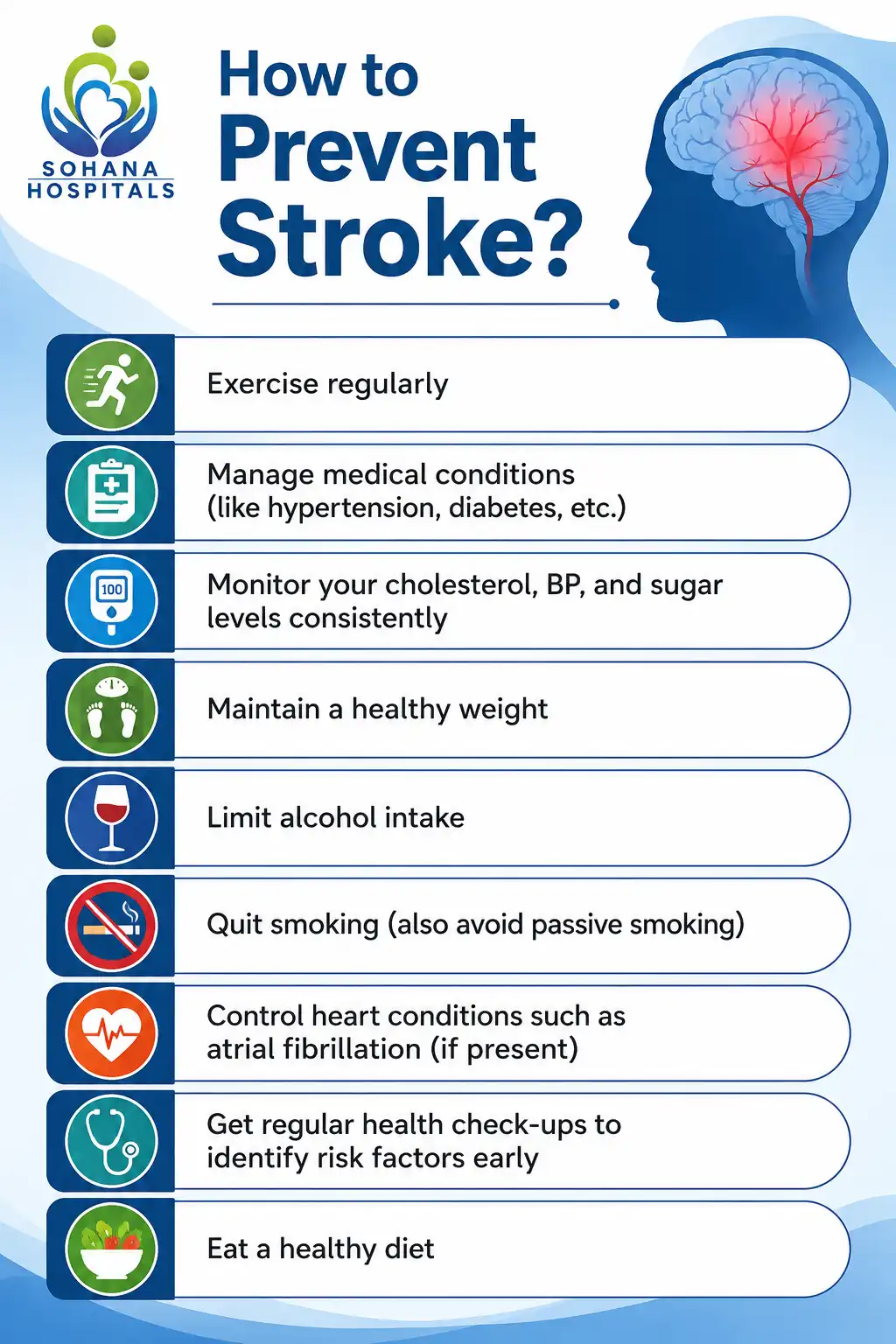
- Exercise regularly
- Manage medical conditions (like hypertension, diabetes, etc.)
- Monitor your cholesterol, BP, and sugar levels consistently
- Maintain a healthy weight
- Limit alcohol intake
- Quit smoking (also avoid passive smoking)
- Control heart conditions such as atrial fibrillation (if present)
- Get regular health check-ups to identify risk factors early
- Eat a healthy diet
Sohana Hospital – The Best Stroke Hospital in Mohali, Chandigarh
Somebody in India suffers a stroke every 20 seconds. A stroke often has devastating consequences for the patient and their family.
The first hour after a stroke is often referred to as the golden hour. The earlier treatment begins, the greater the chance of saving brain tissue and reducing long-term disability.
Sohana Hospital, Mohali, is ready to handle stroke emergencies 24/7. With its team of highly experienced neurologists and comprehensive neurocritical ICUs (Intensive Care Units), the hospital specialises in stroke diagnosis and treatment:
- CT Scan (Computed Tomography)
- MRI (Magnetic Resonance Imaging)
- Clot-dissolving thrombolysis injection
- Mechanical thrombectomy (minimally invasive clot removal) in acute stroke patients within the golden hour
Our treatment approach also includes rehabilitation with occupational, speech, and other therapies. Our multidisciplinary team of neurology specialists supports patients through every stage of their recovery journey.
Conclusion
Ten years ago, if a young adult experienced unusual symptoms, few would think of a stroke being a possibility. Unfortunately, it’s quite common now. High blood pressure, obesity, and diabetes are the major factors that increase stroke risk in young people.
Stroke is a critical medical condition that requires prompt care. A phrase frequently used in this context is “Time is brain”; the reason being that thousands* of brain cells start dying every minute as a stroke strikes.
Given that stroke is becoming increasingly common in younger people, it is the need of the hour to take preventive measures. And if you notice anybody exhibiting stroke symptoms, do rush them to the emergency. Every life is precious!
BE FAST – Minimise Stroke Damage
*Note: During an untreated ischaemic stroke, the brain loses approximately 1.9 million neurons every minute.