

Experiencing knee joint pain, stiffness, muscle aches, or sports injuries? And wondering whom to consult – a physiotherapist or an orthopaedic specialist?
Both types of healthcare providers play an important role in treating musculoskeletal conditions, but knowing when to see an orthopaedic specialist instead of a physiotherapist can help you save time, avoid unnecessary tests, and ensure you get the right care promptly. This can help you recover faster and return to daily life with better mobility and comfort.
At Sohana Hospital, Mohali, both departments work in close collaboration to provide world-class care to patients.
Understanding the Difference
A physiotherapist helps you improve movement, strength, flexibility, and function in different parts of your body through specific exercises, manual therapy, and other rehabilitation techniques. Physiotherapy is often recommended for recovery after injuries, surgeries, or for managing chronic pain conditions.
An orthopaedic specialist, on the other hand, is a doctor trained to diagnose and treat conditions affecting bones, joints, muscles, ligaments, tendons, and the spine. Orthopaedic specialists often utilise diagnostic tests such as X-rays, MRI scans, and blood tests to identify the root cause of the problem and recommend appropriate treatment.
A significant difference between a physiotherapist and an orthopaedic specialist from a layperson’s perspective is that a physiotherapist can use only exercise and manual therapy for treatment (no medicines or surgical intervention), while an orthopaedic specialist can also prescribe medications and perform surgeries if need be.
When Physiotherapy May Be Enough
Many patients approach a physiotherapist early in order to avoid surgery, regain lost movement, and return to normal life faster.
Physiotherapy is often beneficial for:
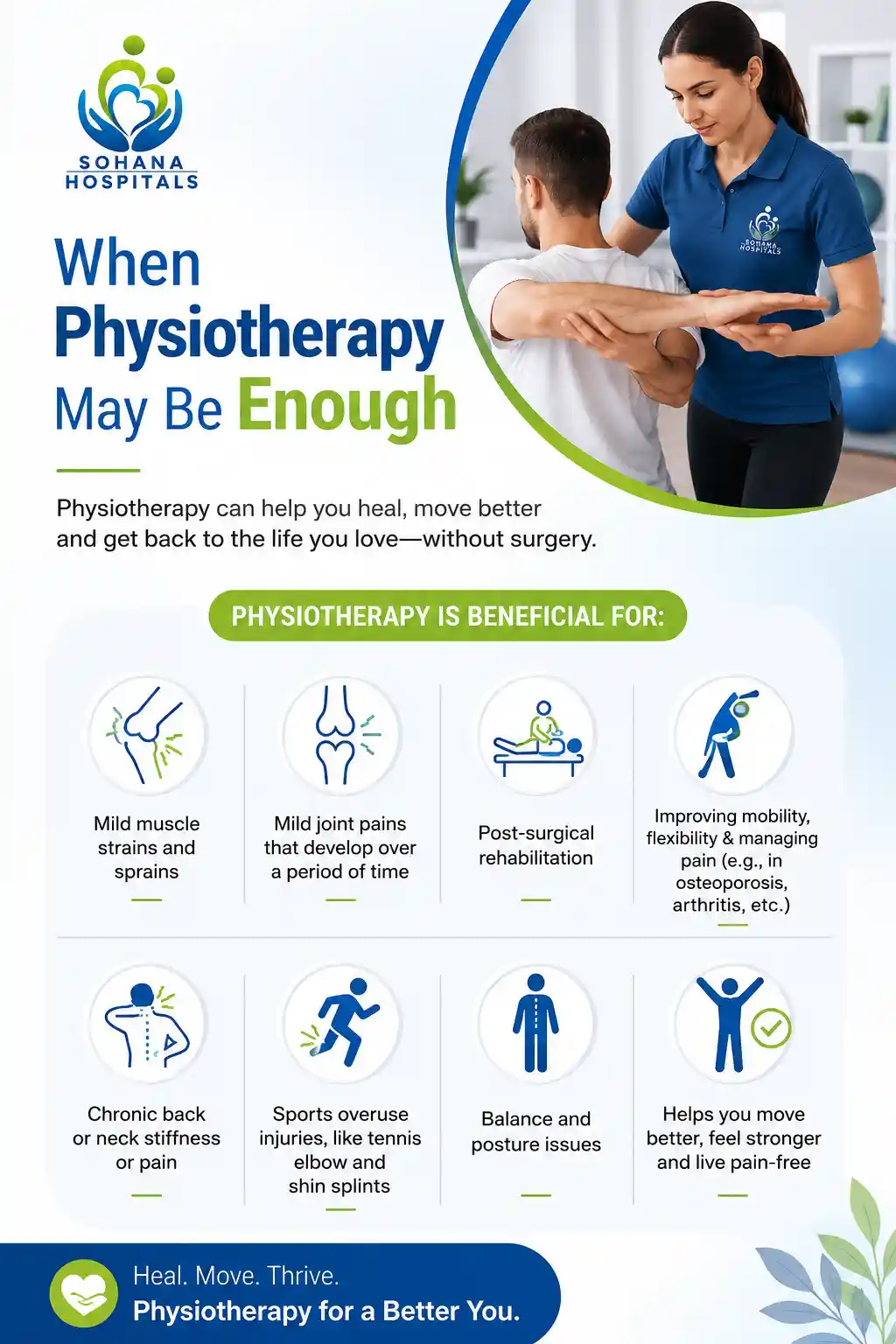
- Mild muscle strains and sprains
- Mild joint pains that develop over a period of time
- Post-surgical rehabilitation
- Improving mobility and flexibility and managing pain (e.g., in osteoporosis, arthritis, etc.)
- Chronic back or neck stiffness or pain
- Sports overuse injuries, like tennis elbow and shin splints
- Balance and posture issues
However, there are situations where it would be better to consult an orthopaedic specialist.
Signs You Should See an Orthopaedic Specialist
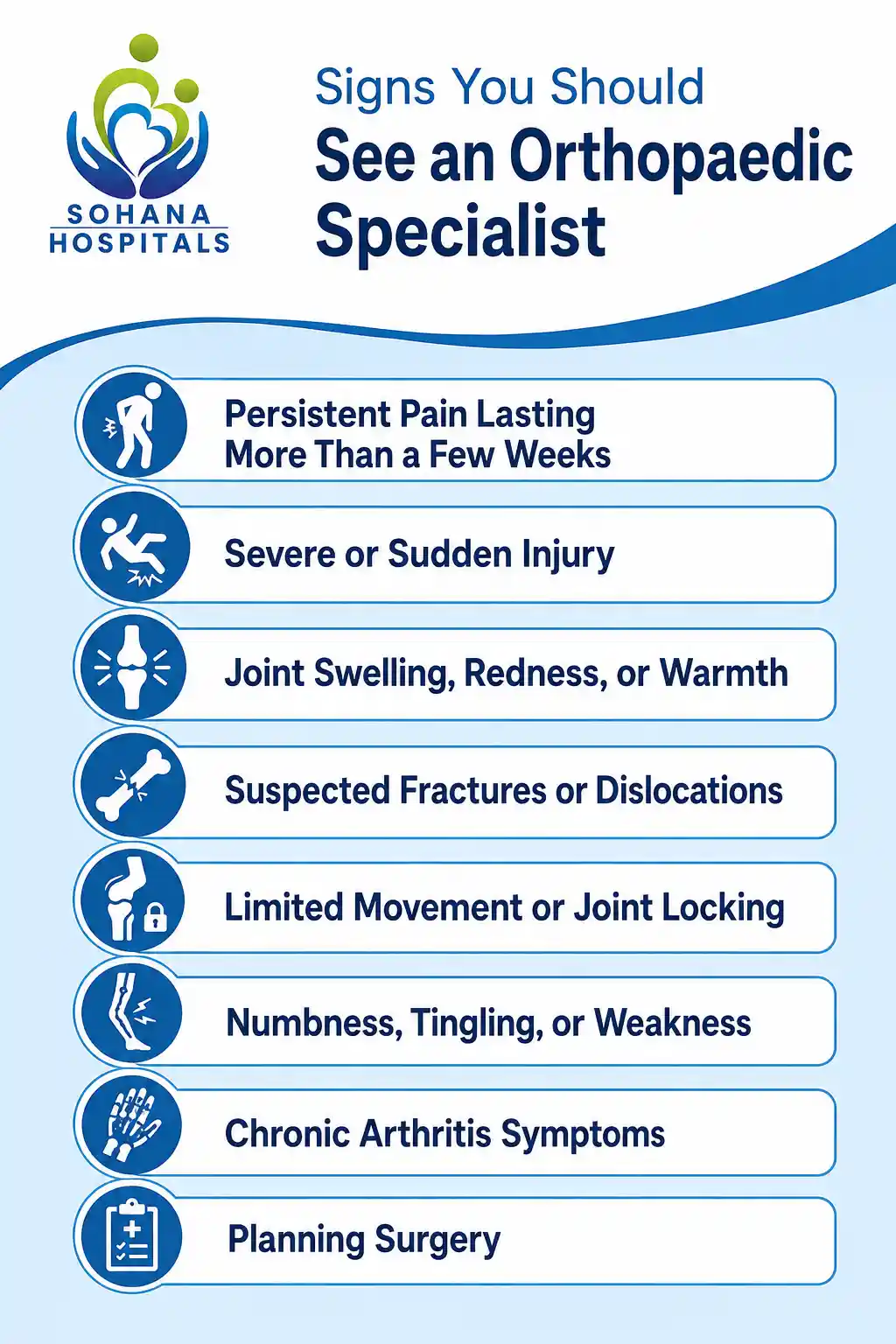
1. Persistent Pain Lasting More Than a Few Weeks
If your pain does not improve despite rest, medications, or physiotherapy, it may indicate an underlying condition that requires medical evaluation by an orthopaedic doctor.
For example, you should not ignore persistent pain in the knee, hip, shoulder, back, or other joints, especially when it starts disrupting sleep or daily activities.
2. Severe or Sudden Injury
In case of a fall, sports injury, accident, or any such injury that suddenly twisted a joint (e.g., knee), which makes it hard for you to bear weight, move a limb, or perform normal activities, you should consult an orthopaedic specialist at the earliest.
Such symptoms may be due to fractures, ligament tears, tendon injuries, or joint damage that require an orthopaedist’s attention, and physiotherapy may not be the right choice in the beginning.
Also Read: Sports Injuries: Causes, Symptoms & Best Treatment Options
3. Joint Swelling, Redness, or Warmth
If a joint is swollen, with redness and warmth, it may indicate inflammation, infection, or other serious conditions.
These symptoms demand the attention of an orthopaedic doctor. They will conduct a thorough medical assessment and provide appropriate treatment to prevent long-term damage.
4. Suspected Fractures or Dislocations
A physiotherapist cannot diagnose or treat fractures and dislocations.
If you feel you have suffered a fracture (broken bone) or have a joint that looks visibly deformed (out of place), you must consult an orthopaedic expert. They will recommend the requisite imaging tests and provide the right treatment.
5. Limited Movement or Joint Locking
Are you finding it hard to bend or straighten a joint (e.g., your knee)? Difficulty bending or straightening a joint, sudden loss of motion, or a joint that locks during movement can indicate conditions such as meniscus tears, cartilage injuries, or advanced arthritis. These often require orthopaedic evaluation.
6. Numbness, Tingling, or Weakness
Pain accompanied by numbness, tingling, burning sensations, or muscle weakness may suggest a nerve issue.
Common causes include slipped discs, spinal stenosis, or nerve compression. An orthopaedic spine specialist is the right person to approach. They can identify the cause and recommend the most suitable treatment plan.
7. Chronic Arthritis Symptoms
If you have been experiencing continuous joint pain, stiffness, or swelling due to arthritis, and it has started interfering with your daily life, it is yet another symptom that requires the expertise of an orthopaedic doctor. They can assess the severity of joint damage and explain advanced treatment options to you.
It is important to note that early intervention may help delay arthritis progression and help you retain mobility.
8. Planning Surgery
Have you tried conservative treatments, but there’s no relief? It’s time to visit an orthopaedic healthcare provider. They will inform you about advanced options, such as stem cell therapy, arthroscopy, robotic joint replacement, Inteliijoint® knee and hip replacement.
You can clear all your doubts and get answers to your queries. Following this, you can make up your mind which option to utilise for pain-free mobility.
What Orthopaedic Surgeons Do
Orthopaedic specialists are qualified to prescribe various imaging tests and different kinds of treatments.
They may:
- Conduct a physical examination
- Ask questions about your medical history
- Suggest blood and imaging tests, including X-rays, MRI, and CT Scans
- Discuss your treatment options
Depending on your condition, the orthopaedic doctor may suggest one or more of the following treatment options:
- Physiotherapy and rehabilitation
- Medications to control pain and/or inflammation
- Supportive devices (braces, casts, or splints)
- Injections (corticosteroids, PRP, hyaluronic acid)
- Stem cell therapy
- Arthroscopy
- Joint Surgery (manual or minimally invasive) – ACL/PCL reconstruction, fracture treatment, joint replacement, etc.
*Note: They may also advise you some of the latest advancements in treatments, such as total joint replacement, especially THA (Total Hip Arthroplasty) and TKA (Total Knee Arthroplasty or Total Knee Replacement) using Robotic Joint Replacement technology and Intellijoint® AI-Guided Joint Replacement.
A Quick Glance: When to See an Orthopaedic Doctor
It can be confusing to decide where to begin. Here, we present the crux of the above discussion in table form for your easy reference:
| Symptom | Whom to See | Reason |
| Persistent neck/back pain | Physiotherapist or Orthopaedic Doctor | Depends on severity, duration, and nerve-related symptoms |
| Fracture / sudden accident | Orthopaedic doctor | Needs immediate imaging tests and treatment |
| Deformed bone/joint | Orthopaedic doctor | Points to a serious injury or dislocation needing prompt attention |
| Torn ligament | Orthopaedic doctor | Imaging tests to confirm if surgery is required |
| Sprain | Physiotherapist | Rehab is often the first treatment, provided there isn’t any fracture |
| After surgery | Physiotherapist | Regaining movement and flexibility |
| Arthritis | Orthopaedic doctor | Advanced non-surgical & surgical treatment may be needed |
The Best Approach: Working Together
It is important to remember that you get the best results when your orthopaedic specialist(s) and physiotherapist(s) work together as a team. They are not competitors; they complement each other.
Patients benefit the most from a collaborative approach. The orthopaedic specialist makes a correct diagnosis and provides suitable treatment. After this, the physiotherapist steps in for rehabilitation. In fact, physiotherapy is often essential before and after orthopaedic treatment.
Here are some examples:
- For sports injury patients undergoing PCL reconstruction surgery, physiotherapy allows them to make a safe return to sports.
- Rotator cuff injury patients may recover with only physiotherapy or get surgery first and then physiotherapy.
- For joint replacement patients, physiotherapy is essential after surgery, even if it is a robotic knee replacement or Intellijoint® hip replacement.
To put it simply, the orthopaedic surgeon diagnoses and treats the structural problem, while the physiotherapist helps your body learn to use the repaired joint safely.
Conclusion
When it is about bone, joint, and muscle issues, there is no one-size-fits-all solution. For some patients, physiotherapy alone may be enough. Other patients may require expert care from an orthopaedic specialist. And quite frequently, patients would need the expertise of both.
If you have severe injury, persistent pain, swelling, or any other above-mentioned symptoms, do not delay. Consult the best orthopaedic surgeons at Sohana Hospital. High expertise, a committed approach, and compassionate care are what set our orthopaedists apart. With the most advanced technologies at their disposal, they strive to set new standards in patient care each day.
Early assessment can help determine the underlying cause, prevent complications, and ensure you get the best treatment. At Sohana Hospital, trusted orthopaedic surgeons and physiotherapists come together to deliver the best results for all patients.
👉 Don’t wait for pain to take over your life – Take the first step towards relief today.
FAQs – Physiotherapist vs Orthopaedic Specialist
Can I see a physiotherapist without a referral?
In India, you do not require a referral to consult a physiotherapist. However, if your symptoms suggest a fracture, ligament tear, nerve compression, infection, or another condition requiring medical evaluation, your physical therapist may refer you to an orthopaedic doctor to rule out any serious injuries.
Can a physiotherapist prescribe medicines?
No. A physio cannot prescribe any medication. They use non-surgical treatment approaches, such as heat and cold therapy, exercises, manual therapy, and electrical stimulation for pain management.
Which is more expensive: physiotherapy or orthopaedic treatment?
Physiotherapy is often less expensive than orthopaedic treatment (surgery). However, overall costs depend on the condition, tests required, the number of physiotherapy sessions needed, and whether surgical treatment is necessary.
Can physiotherapy treat osteoarthritis?
No, as it cannot regrow cartilage. But physiotherapy can help reduce pain significantly and slow down OA progression by strengthening the muscles around the joint. With this, patients may be able to delay or even avoid surgery.