

*हिंदी में पढ़ें: गाउट (गठिया) के चरण क्या-क्या हैं?
Gout is one of the most common types of (inflammatory) arthritis. It occurs due to excess uric acid levels in the body, forming crystals in joints. This leads to severe pain, swelling, and redness.
Gout typically starts in the big toe joint. However, it can also impact other joints like wrists, ankles, and knees. While not common, sometimes gout symptoms tend to mimic other inflammatory conditions like psoriatic arthritis or rheumatoid arthritis.
Much like other forms of inflammatory diseases, gout also progresses in stages. For most of the affected individuals, gout management and flare-up minimisation can be possible, granted treatment is started in the early stages. Read along to learn more about the stages of gout and the early warning signs.
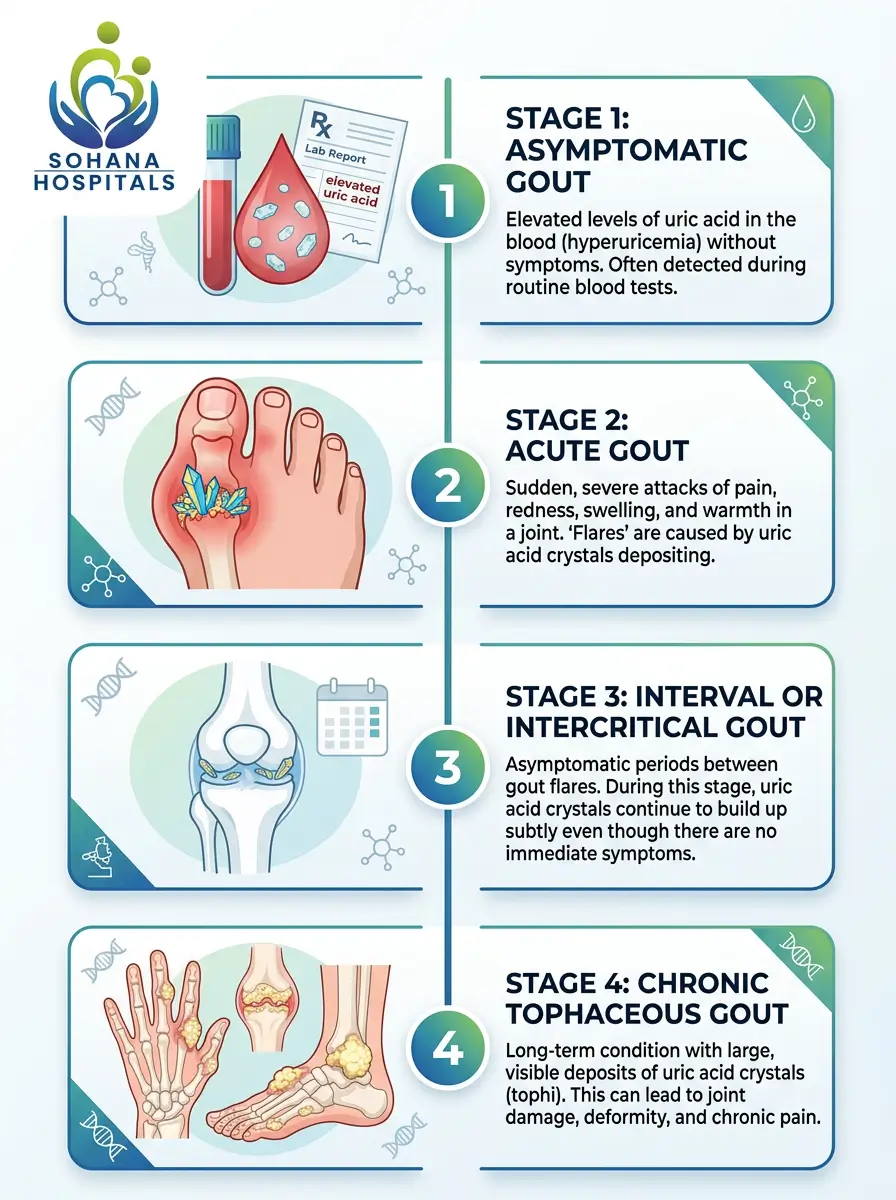
Stage 1: Asymptomatic Gout
Initially, excess uric acid accumulation begins to form crystals in the joint of the big toe. Uric acid is a natural waste substance produced when purines are broken down by the body. Purines are found in certain foods, including shellfish, alcoholic drinks, high-fructose drinks, and red & organ meat.
Normally, uric acid is naturally dissolved in blood, is filtered out by the kidneys, and excreted in the form of urine. That being said, the production of too much uric acid may result in a delay or the body’s inability to eliminate it. This leads to high uric acid levels in the body – this is called hyperuricemia. For many, hyperuricemia does not cause symptoms; for others, it can be an early warning sign for gout.
Stage 2: Acute Gout
When the excess uric acid causes the formation of crystals around joints, it can lead to intense swelling, tenderness, and pain. In this stage, the affected individual starts actively experiencing symptoms episodically. There are periods known as flare-ups or gout attacks, where you might feel heightened symptoms.
Gout symptoms come and go unexpectedly and can last for a period of a few days to up to weeks. For most people, the first gout attack is the first time they suspect they might have gout. For a proper diagnosis, your doctor will test for crystals around the affected joint. The presence of crystals confirms gout, setting it apart from other forms of inflammatory conditions.
💡DID YOU KNOW? Gout is commonly confused with calcium pyrophosphate deposition disease (CPPD), a disease commonly referred to as “pseudogout” owing to the resemblance of its symptoms to gout. The only difference between the two is that the crystals in pseudogout are formed of calcium pyrophosphate dihydrate, whereas in gout, the crystals are formed from uric acid.
Treatment during the 2nd stage is primarily aimed at pain relief and reducing inflammation, along with preventing further attacks by managing uric acid. This typically includes a low-purine diet paired with specific medication that either accelerates the excretion process of uric acid or slows down its production.
Stage 3: Interval or Intercritical Gout
Once you have experienced your first gout attack (in stage 2), you are likely not to experience symptoms until another flare-up. It could take months to years before another gout attack. The 3rd stage is typically when attacks come at intervals (long or short) – this is why this stage is known as interval or intercritical gout.
The absence of symptoms is not to be confused with the absence of uric acid or the inflammatory condition altogether. This is to say that even when you are not experiencing gout attacks, uric acid can continue to build up inside your body. Therefore, treatment for this stage also includes uric acid-reducing medications.
If your body weight is more than the ideal weight for your height, losing a few kilos can help significantly in the management of gout. It is also essential to drink enough water (2.5 to 3L daily) and consume a low-purine diet.
Stage 4: Chronic Tophaceous Gout
If uric acid production is not controlled during the interval stage (3rd stage), gout can progress to the final and most critical stage.
Chronic gout is when urate crystals, known as tophi, can manifest as nodules or bumps under the skin. A tophus may form in the joint, in the bursa sac that cushions and safeguards the joint, in the cartilage, bones, or under the skin.
Tophi formed in the small finger joints can lead to physical damage, restricting movement. Tophi formed in the bone and cartilage can cause joint damage and deformity. Tophi formed under the skin, run the risk of getting infected and becoming painful.
Other issues that can occur during the 4th stage include aching joints and kidney stones. But thanks to highly effective modern treatment, most patients do not get to stage 4. Those who continue the use of uric acid-reducing medication are able to prevent further attacks and completely eliminate visible tophi (in select cases).
Sohana Hospital boasts a team of expert rheumatology doctors who employ modern diagnostics and cutting-edge treatment in taking care of even the most complex of inflammatory conditions. A personalised approach is used for every patient, where our rheumatologists team up with multiple other departments (if required) to deliver the most efficient treatment.
If you or a loved one is suffering from gout, don’t delay treatment. Visit Sohana Hospital, Mohali, today and get long-term relief from your joint problems.