
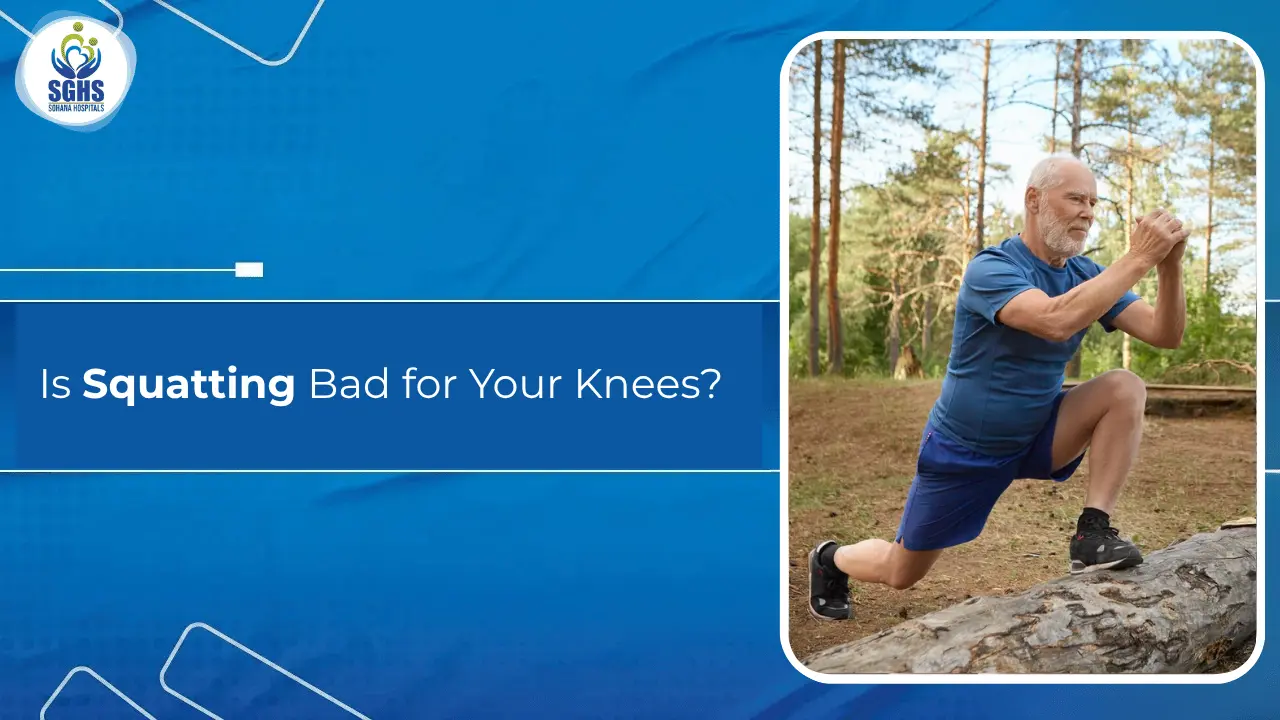
Many people believe squats will damage their knees, lead to arthritis, or that they must avoid deep squats. It is more so for those whose knees hurt when they exercise, participate in sports or other high-impact activities, or while getting up from a sitting posture.
But the good news? Squatting is not fundamentally harmful to healthy knees when performed with appropriate technique, load, and progression.
Squatting is something we may do a lot of times, without realising. For example, while sitting, standing up, picking up things, gardening, playing with our children.
In fact, before we turned modern, Indian toilets used to be (and in some places, still are) squatting-based. We gave them up in favour of Western sitting toilets.
What matters is not squatting but how much pressure your knees are subjected to, whether your body adapts to that pressure, and whether you work to gradually build your endurance.
Squatting: Is It Bad for Knees?
No, not necessarily. For most people, appropriately performed squats can be part of a healthy strength-training routine.
When you squat, leg muscles and joints, including knees, have to bear load. However, placing load on a joint is not inherently detrimental.
The human body has a tendency to adapt to physical loads. When you begin to gradually put load on your joints and muscles, it helps to strengthen them. Their ability to cope with routine activities may slowly increase. With this, you may be able to play sports and exercise better.
Fearful of harming your knees and therefore avoiding squats altogether? It may result in diminished strength and confidence. The aim should not be to refrain from loading your knees, but to identify the right level and work to enhance your capacity.
| 👉 Did you know? Squats may be beneficial for everyday movement since they involve and strengthen several joints and muscles, including hamstrings, glutes, and quadriceps. |
Deep Squats: Crossing 90 Degrees
A common misconception among people is that squatting past 90 degrees can be traumatic for the knees. But the fact remains that if your knees are healthy with adequate mobility and strength, there is no reason you should avoid deeper squats.
Here is what you need to pay attention to while attempting deep squats:
- Your strength
- Technique
- Training history
- How your knees respond
Attempted deep squatting and it caused knee pain? It does not necessarily imply that the exercise damaged your knee, provided you do not have knee arthritis or any other knee issues. It may just highlight that your knee is not yet ready for that level of load.
What to do? Instead of totally avoiding the squats, alter the depth and slowly enhance your endurance. Also, persistent or significant pain should be assessed by a healthcare professional.
| 👉Did you know? A study conducted by NIH found deep squatting safe as an exercise for knee joint health and that deep squats involved no risk if made a part of resistance training programs – provided you follow the proper technique, loading, and progression. |
Knee Pain: Why May Squats Cause It?
Experience knee pain while squatting? Here’s what may be causing it:
- Suddenly increasing the intensity and level
- Overdoing the exercise (squatting)
- Low tolerance or strength
- Improper technique
- Past knee injuries
- Modifications in training load
- Overall activity
- Inadequate rest and recovery
- Low confidence or avoiding movement
Pain may not necessarily be due to squats. Several other factors may be contributing to it.
| 👉Did you know? Who may find deep knee bending with squats painful? Individuals with conditions such as knee osteoarthritis (OA), runner’s knee, and meniscus tears may find deep squats uncomfortable. |
Do I Stop Squatting if My Knees Hurt?
Not necessarily. If your knees hurt while or after squatting, giving up lower-body exercise may not be a good idea. You should rather alter the movement pattern:
- Avoid deep squats
- Lower the resistance or weight
- Reduce the number of repetitions
- Use a bench or a chair as an aid
- Opt for supported squats
- Gradually build strength through other (more comfortable) exercises
Why is this a good approach? Identify a level of exercise that your knees can bear. You can gradually build up from there.
| 👉Did you know? The back squat is one of the most commonly used exercises for improving lower-limb strength and muscle growth in people of different populations, either performed alone or alongside other exercises. (via NIH) |
Here’s how you can start:
- First, ensure that you can easily perform basic squats without any knee pain
- Gradually move on to chair squats
- Next comes supported squatting
- Try bodyweight squatting
- Raise your level to squatting with resistance
- Finally, you can try transitioning to heavier squats
Patience is key here. Start slow and raise your knee strength gradually. The aim is to build strength and capacity over time.
Which Strengthening Exercises Can Help Improve Knee Pain?
You need to work on building strength in the muscles around the hips, knees, and thighs. It can help enhance not only your ability to carry out routine activities but also to exercise and participate in sports.
Which exercises to perform?
- Squats
- Split squats
- Step-ups
- Leg presses
- Lunges
- Calf raises
*Note: The appropriate exercises vary widely from person to person. An individual just wishing to comfortably climb up and descend the stairs would need different exercises than someone who wants to get back to running after knee pain.
When to Seek Medical Help?
Some mild knee symptoms may settle with activity modification and appropriate self-care. You can try RICE (rest, ice, compression, elevation) at home or follow the advice of a trained physiotherapist on the kind of exercises you should perform.
However, in specific circumstances, you must consult a reputable orthopaedic expert:
- Pain in the knee does not improve or worsens
- Swelling in the knee post-activity
- Feeling of instability in the knee
- Knee feels locked and lacks range of motion
- Severe knee pain restricts your daily activities, sports, and exercise
- Inability to climb stairs due to pain
- Squatting feels difficult
- Not sure which exercises would be suitable for you
Consulting a trusted knee doctor can help diagnose the problem precisely and get the right treatment. At Sohana Hospital, you can consult orthopaedic specialist, Dr. Gagandeep Singh Sachdeva, MCh (Orth), Univ. of Seychelles | FIJR (Australia, USA), for the evaluation and management of knee and joint conditions.
With over 25 years of experience, he follows a patient-centric approach, with treatment recommendations based on your individual needs and clinical assessment. The treatment may include personalised physiotherapy, rehabilitation, and other appropriate treatment options, depending on your specific condition.
The goal is to improve knee strength, flexibility, and mobility, helping patients gradually return to daily activities like walking, cycling, sports, and squatting, as appropriate.