
Fond of participating in sports? Whether you’re a professional sportsperson or an amateur player, sports injuries can happen at any time on the field. Right treatment can make all the difference in deciding how soon you return to the field.
It is important to know when you can manage with RICE (rest, ice, compression, elevation) and when to approach a specialist for an appropriate sports injury treatment plan.
While minor sports injuries may heal on their own with the right care at home, others may be serious enough to deserve medical intervention. The absence of the right treatment in case of a serious sports injury may result in prolonged recovery time and long-term damage.
This blog takes you through the key symptoms that indicate you should consult a sports injury specialist.
Timely Sports Injury Treatment: Why It Is Important
A common mistake patients often make is delaying treatment for their sports injuries. Early intervention by means of correct diagnosis followed by precise treatment can pave your way to:
- Reduced risk of complications
- Faster recovery
- Minimal likelihood of recurrent injuries
- Better results
- Quicker return to the field
Conversely, delayed sports injury treatment can:
- Worsen inflammation
- Cause more tissue damage
- Affect movement patterns
- Complicate recovery or rehabilitation
- Lead to secondary issues in the other parts of the body
So, what are the signs indicating you should seek medical intervention? Read on to learn.
Sports Injury Signs to Watch Out For
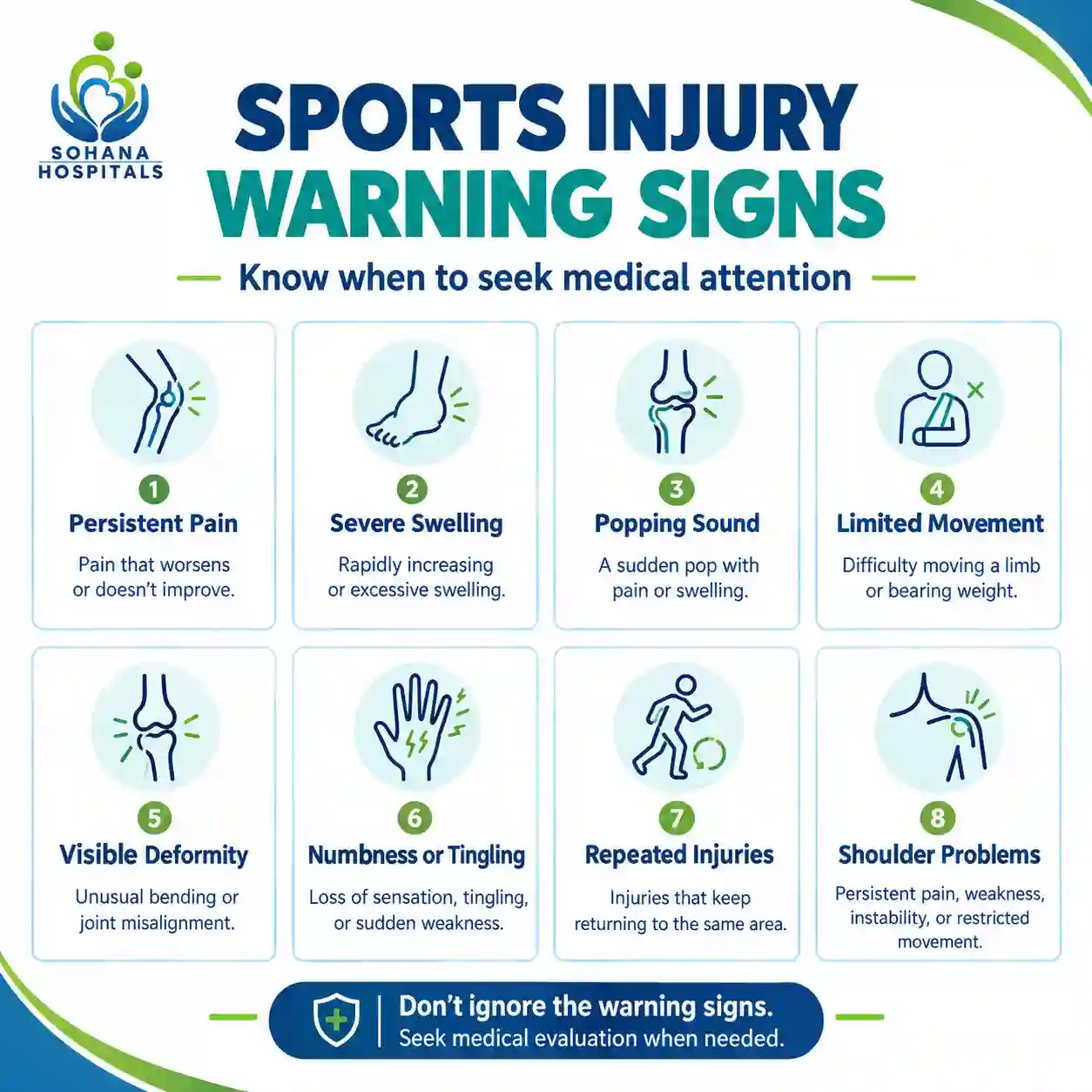
Persistent Pain
Tried RICE at home? Took rest, applied ice, tried compression, and placed the injury spot at a higher level for healing your injury?
If your pain improves, well and good, but if pain is excessive, does not reduce, or gets worse after 48-72 hours of home remedies, it’s a signal that medical care is what you need.
Persistent pain is a prominent sign that you should get professional assessment and dedicated sports injury treatment.
Severe Swelling
Some swelling often comes with any injury. But be mindful of excessive swelling that spreads far beyond the injury site. Also, if swelling seems to increase, it could be a pointer to more serious injuries like those involving a ligament tear, internal bleeding, or even a fracture.
Depending on the suspected injury, a healthcare professional may recommend imaging such as X-rays, ultrasound, or MRI.
Popping Sound
A popping sound or sensation at the time of injury is sometimes linked with ligament, tendon, or cartilage injuries, especially when the injury occurs in the shoulder or knee. For example, in cases of ACL, rotator cuff, and other such injuries, a popping sensation may occur.
These injuries require targeted sports injury treatment. In fact, some cases may even need surgery. This makes it clear that you should seek fast evaluation for any popping sound, particularly if it comes from the knee or shoulder.
*Note: A popping sound in itself may not be a cause for concern unless accompanied by other symptoms.
Limited Use
If you find yourself unable to use your injured limb, it is a cause for concern. For example, if you cannot lift your arm, hold things with your hand, or put weight on your leg.
It could be an indicator of considerable structural damage. Any limitation in using your limbs could be due to an injury to a tendon, bone, or ligament. Whatever the scenario, timely sports injury treatment is what you need.
Visible Deformity
Deformities like any crookedness or misalignment at the site of injury just cannot wait. Such signs could mean dislocations, fractures, or serious ligament injuries.
Prompt diagnostic tests, assessment, and treatment are essential.
Numbness and Other Neurological Signs
Symptoms like numbness, tingling, or sudden weakness in a limb are something to pay attention to. These may point to neurological issues, such as nerve compression or injury.
If you experience any such red flags, do not ignore them, since they may indicate nerve or vascular involvement and result in long-lasting damage. Consult your healthcare provider without delay.
Read More: What Causes Numbness and Tingling in Hands and Feet
Repeated Injury
Had an injury earlier in the same body part? If your knee, ankle, or shoulder got injured earlier, and you suffer a new injury in the same area, visit an orthopaedic specialist – even if the injury seems minor.
Recurring injuries may be because of incomplete rehabilitation, weakness, instability, altered movement patterns, or an underlying structural problem that did not heal completely. Thorough assessment and treatment are essential to long-term function.
Shoulder Injuries
Happened to injure your shoulder and the pain radiates to your head or travels behind your back? It needs medical attention. The shoulder is a complex joint prone to getting injured easily. This makes early attention necessary.
Special symptoms to watch out for include weakness, instability, reduced range of motion, clicking, and difficulty reaching overhead or behind your back. Be more cautious if you also experience any clicking sounds or weakness.
Shoulder issues like rotator cuff tear, shoulder instability, and labral damage must be treated in time to avoid any complications in the future.
When to Seek Emergency Medical Care
Some sports injuries demand immediate medical intervention:
- You cannot move the affected arm or leg
- Total loss of sensation in the limb
- Inability to bear weight
- Dislocated joint
- Extreme swelling (a sign of internal bleeding)
- An evidently broken bone
- A head injury
- Concussion
- Loss of consciousness, repeated vomiting, worsening headache, confusion, seizures, unusual drowsiness, weakness, or other neurological symptoms
Read More: Can Stress Cause Neurological Symptoms?
Not sure, but something does not feel right? Visit your healthcare provider or directly consult an orthopaedic doctor at the earliest.
Experienced orthopaedic specialists like Dr. Gagandeep Singh Sachdeva, Chief Robotic Joint Replacement Surgeon & CEO at Sohana Hospital, Mohali, may use advanced diagnostic tools for precise diagnosis of the injury and its severity, and provide the right treatment for a fast, safe, and smooth recovery.
In your consultation with Dr. Gagandeep Singh Sachdeva, he may conduct a thorough review and ask you questions like: how you got injured, your symptoms, etc. After this, he may make an assessment that may include:
- A physical examination to check strength and range of motion
- Imaging tests like X-rays to look for any fractures or bone issues
- Ultrasound or MRI if there is a doubt of any soft tissue injury
Once a correct diagnosis is made, a tailored sports injury treatment approach is prepared. Depending on the type and intensity of the injury, you may be advised:
- Physiotherapy
- Bracing or other supportive aids
- Lifestyle modifications
- Medications
- Injections
- Surgical intervention
The aim at Sohana Hospital is to help you get back to your favourite activities and a normal life sooner – through the use of non-invasive and minimally invasive treatments
Sports Injury: Don’t Walk It Off
Players tend to overlook pain and continue to push forward. But remember, it may not always be the right thing to do. Some grave sports injuries could lead to persistent pain, instability, reduced function, or other complications if they are not appropriately assessed and managed.
Injury not improving? Or doesn’t allow you to move and function properly? You should get in touch with a trusted specialist.
Book a Sports Injury Assessment in Chandigarh, Mohali
Not sure whether your sports injury is minor or serious? This doubt in itself is a reason to schedule a consultation with a healthcare provider. Timely assessment is always better than delayed treatment.
Whether you are a professional sportsperson, amateur player, or a weekend warrior, contact Sohana Hospital for expert care. Dr. Gagandeep Singh Sachdeva and his team at Sohana Hospital have been providing expert sports injury treatment to patients for over 25 years now.
From structured physiotherapy, arthroscopy, and stem cell therapy to advanced robotic surgical intervention, the hospital has everything in place to help you return to the game faster.
Get expert sports injury treatment – Return to the game stronger
Frequently Asked Questions – Sports Injury Treatment
How long to wait before consulting a doctor for a sports injury?
If symptoms improve with RICE (rest, ice application, compression, elevation), you can watch for 3-5 days. However, if the condition stays the same or worsens after the initial period, a doctor consultation is essential.
What if I ignore a sports injury?
There may be complications like chronic pain, instability, or more serious damage over time. The issue may take longer to heal afterwards or need more complicated treatment.
Is there any home remedy for sports injury?
You can try RICE (rest, ice, compression, elevation) for minor injuries. Major sports injuries, however, may need immediate medical intervention.
Which doctor treats sports injuries?
A team comprising orthopaedic specialists, sports medicine experts, and physiotherapists may treat sports injuries – based on the nature and severity of the injury.
When is emergency care needed for sports injury?
If you have severe pain, inability to move, deformity, or any neurological symptoms, you must seek emergency treatment.