
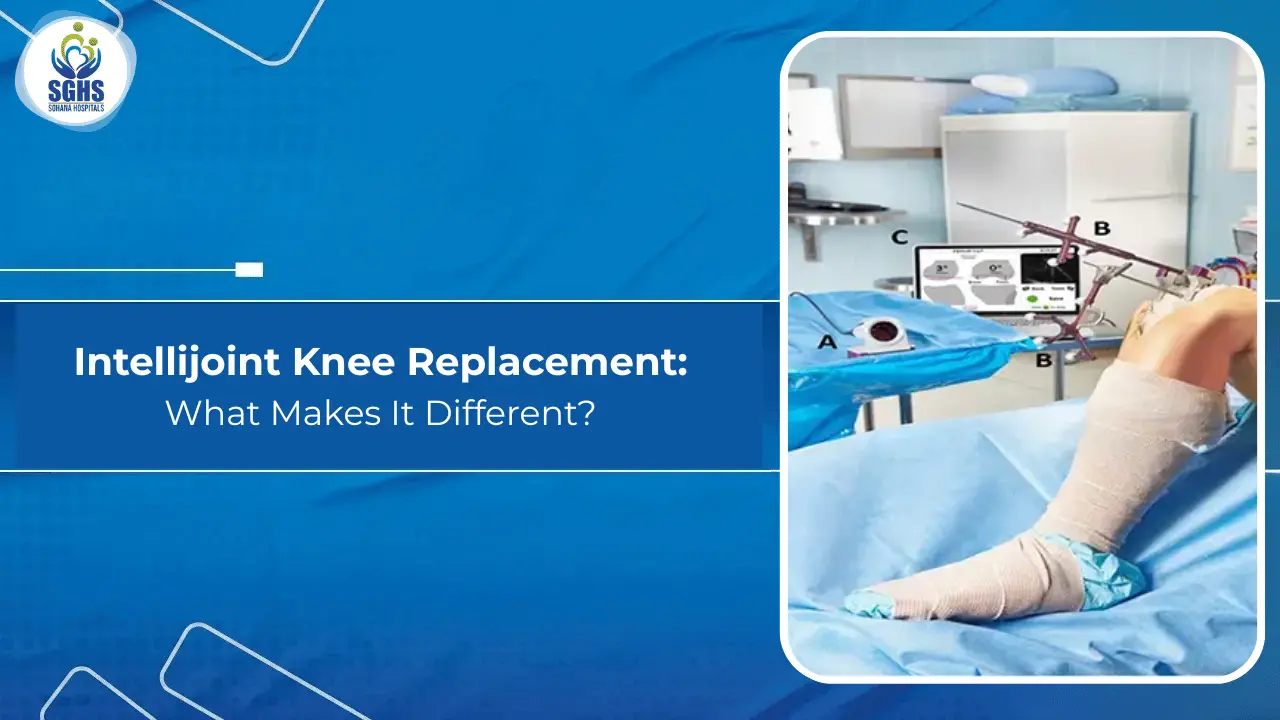
AI-guided navigation for constant intraoperative measurements during surgery – enabling surgeons to perform all surgical steps with high precision – is what sets Intellijoint Knee Replacement apart.
The medical field has been witnessing consistent and rapid advancements. Intellijoint Knee is the latest technological advancement in the field of knee replacement surgery.
Invented in the year 2025 by Intellijoint Surgical®, a Western firm dedicated to developing and commercialising surgical planning & navigation tools for THA (Total Hip Replacement) and TKR (Total Knee Replacement), Intellijoint Knee is all set to transform the lives of knee patients in North India.
What Happens During Knee Replacement Surgery?
In simple words, it is an operation in which your orthopaedic surgeon replaces the damaged parts of your knee with an artificial implant. A cut is made in the knee to remove the damaged parts and implant artificial ones. Everything is done under anaesthesia so that you do not feel any pain.
Knee replacement is fast becoming an increasingly popular surgery among knee patients – those dealing with:
- Severe knee damage
- Chronic knee pain
- Limited movement
These problems often occur due to:
- Osteoarthritis
- Rheumatoid arthritis
- Serious knee injuries
Patients generally turn to knee replacement when they have already tried various knee treatments without success:
- Physiotherapy
- Pain-killers
- Knee injections
- PRP (Plasma Rich Platelets) therapy
- Hyaluronic therapy
- Arthroscopy
- Stem cell therapy
Knee replacement surgery allows knee patients to get pain-free knee joints and return to an active life once again:
- Going for walks
- Standing and climbing stairs
- Doing work (household and professional)
- Cycling, driving, and travelling
- Playing with grandchildren
- Sitting cross-legged
- Visiting religious shrines
- Engaging in hobbies
- Attending weddings and other functions
- Renewed freedom and independence
- Feeling younger and enjoying life
No walker, no stick – easy mobility, confidence, and independence!
What Happens in Traditional Knee Replacement?
Traditional knee replacement is done manually by orthopaedic surgeons. Mechanical tools are used. Surgeons rely on imaging tests (like X-rays) and visual clues during the surgery, along with their surgical experience and expertise for judgement about bone cutting and implant alignment.
How successful is traditional knee replacement? More than 90% of conventional TKRs continue to function well for 15 years, and nearly 80% work after 25 years. This explains why it found favour with knee patients.
Drawbacks of Traditional Knee Replacement:
- Bigger cut
- More tissue trauma
- More blood loss
- More painful
- Longer recovery
- Results depend largely on the surgeon’s skill
- Personalisation lacking
- New knee joint may or may not feel natural (depending on surgeon’s expertise)
- Requires imaging tests like X-rays, CT Scans & MRIs
- Surgeon depends solely on visual hints (no AI guidance)
What Makes Intellijoint Knee Different?
Intellijoint Knee is an innovative US-based AI-guided navigation technology that consistently updates the surgeon during the operation. Combined with the surgeon’s experience, it has the potential to deliver consistent and predictable outcomes, thereby enhancing success rates.
The Intellijoint Knee comprises 3 components:
- Mini optical camera
- A single tray of instruments
- Compact workstation with software application
The system works to continuously make precise measurements, which are simultaneously made available to the surgeon. This helps the surgeon to make accurate bone cuts and align the implant precisely according to a patient’s unique bone structure. Personalised knee surgery means better results!
Patient Benefits with Intellijoint Knee:
- Smaller cuts (minimally invasive surgery)
- Minimal tissue trauma
- Negligible blood loss
- Virtually painless surgery
- Minimal complication risk
- Faster recovery
- Personalised surgery
- AI-navigation and real-time guidance to the surgeon(s)
- Continuous intraoperative measurements
- Precise implant alignment
- Better balance, stability, and movement (natural feeling joint)
- Consistent & predictable outcomes (in complex cases, too)
- CT scans not needed
- Minimises human error
Each of these benefits is huge for a patient. To exemplify, with traditional knee replacement, recovery may be as long as 3-6 months. But with Intellijoint Knee, patients may be back to a normal routine as early as 30-45 days.
*Note: Recovery also depends on various other factors, including a patient’s age and overall fitness, any underlying medical conditions, complexity of the surgery, etc.
Where to Get Intellijoint Knee Replacement Surgery?
The revolutionary AI-navigated Intellijoint Knee technology from the USA is available in select hospitals in India. Sohana Hospital, Mohali (Punjab) is proud to be the first in the region to have introduced Intellijoint Knee & Hip for the benefit of patients.
Acclaimed for bringing the latest medical technologies from across the world to North India, the hospital also boasts an exceptional team of orthopaedic surgeons. Led by the award-winning orthopaedist, Dr. Gagandeep Singh Sachdeva, Chief Robotic Joint Replacement Surgeon & CEO, Sohana Hospital, the team has been consistently delivering par-excellence outcomes in knee replacement.
The latest addition, Intellijoint Knee, is all set to further enhance results in knee patients. Not only will patients say goodbye to knee pain, but also have natural-feeling joints and recover faster.
Pain-free knees are just a call away
Intellijoint Knee at Sohana Hospital