
If your knee is severely damaged because of any disease or injury, you may have to face persistent knee pain, stiffness, swelling, and other associated symptoms. It may also seriously impact your ability to walk, stand, climb stairs, and perform routine activities. Knee pain may also disrupt your sleep.
What to do in such a situation? You may have tried non-surgical treatment options, such as physiotherapy, painkillers, and knee injections, but they do not bring any relief. At this stage, your doctor may advise total knee replacement surgery (TKR) or knee arthroplasty.
Why knee replacement? Knee replacement surgery is a highly safe and effective procedure that helps give relief from pain, repair deformity in the leg(s), and restore movement. Metal and plastic parts (knee implants) are used to cap the ends of the bones that form the knee joint.
How successful is the procedure? Over the years, there have been significant advancements in knee implants and knee replacement technologies. This has considerably enhanced the efficacy of this surgery to make it one of the most successful procedures in the world.
How many people choose knee surgery? As per the Indian Joint Registry, nearly 200,000 knee replacements were performed in India in 2020 alone[1]. Some conditions that necessitate TKR include osteoarthritis, rheumatoid arthritis, traumatic arthritis, etc.
Where to get the surgery? Sohana Hospital offers the experience and expertise of highly trained orthopaedic surgeons who specialise in TKR.
Knee Anatomy
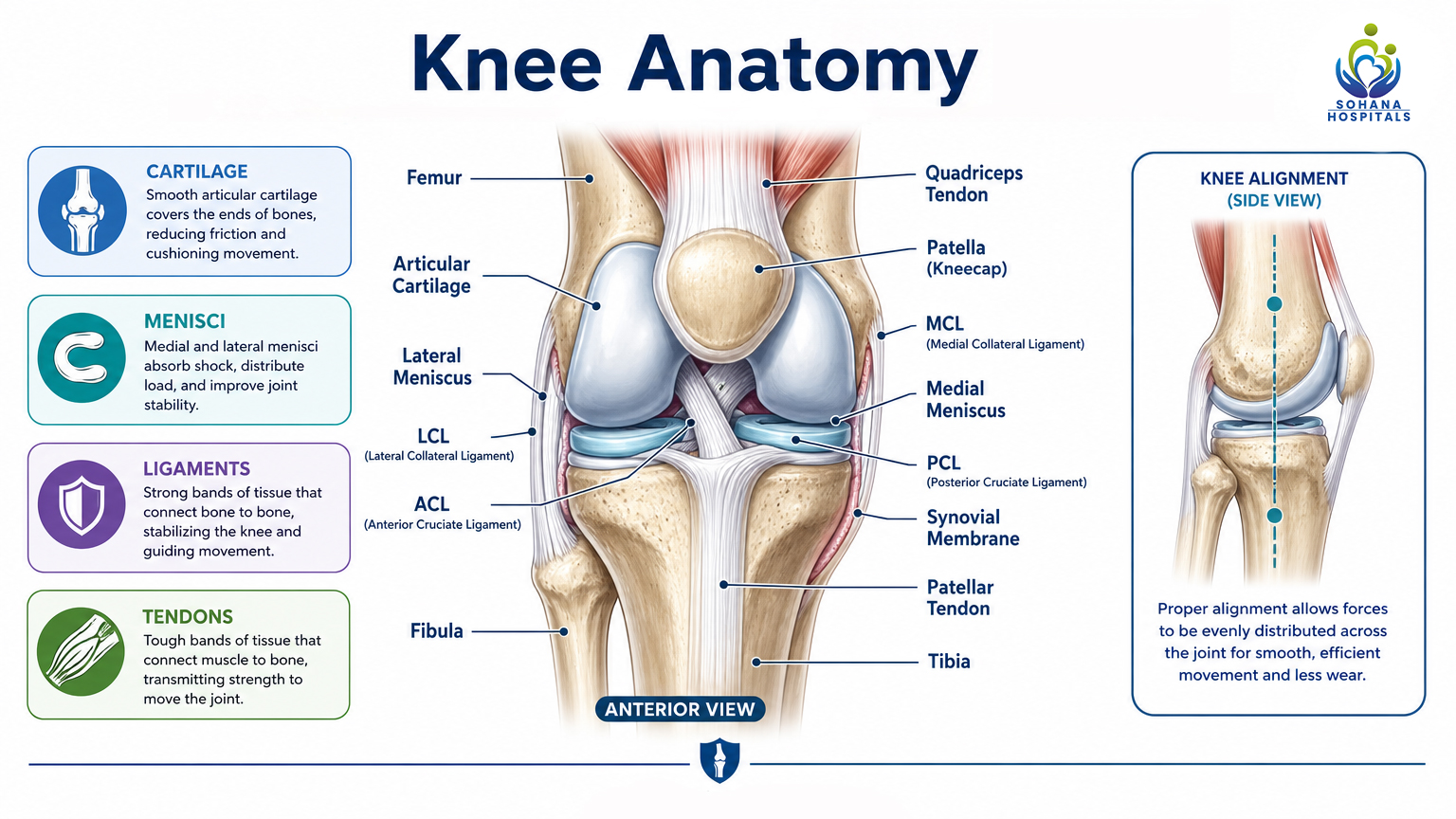
- Joints are connecting points of bones.
- The knee is the biggest joint in the body.
- Most joints are movable, working like hinges for bones.
- The knee joint is two long leg bones held together by muscles, tendons, and ligaments.
- Cartilage covers the end of each bone. It works as a shock absorber to protect the knee.
- The two groups of muscles in the knee are the quadriceps (in the front of the thigh) and the hamstrings (at the back of the thigh).
- While the quadriceps help straighten the leg, the hamstrings help bend the leg.
- Muscles are connected to bones with tendons.
- Bones are connected to each other with ligaments.
- Functions of ligaments include – providing stability and protecting the joints, limiting the forward and backward movement of the shin bone.
Also read: Intellijoint KNEE & Intellijoint HIP: Personalised Arthroplasty at Sohana Hospital
Here are the parts in the knee joint:
| Tibia | Shin bone |
| Femur | Thighbone |
| Patella | Kneecap |
| Cartilage | Protective (soft, rubbery) tissue covering the bone surface – to reduce friction |
| Synovial membrane | Tissue lining the joint and sealing it into a joint capsule Produces synovial fluid for joint lubrication |
| Ligament | Connective tissue (strong, elastic) surrounding the joint Connects bone to bone Gives support and limits the movement of the joint |
| Tendon | Tough, fibrous connective tissue Joins muscles to bones Helps control joint movement |
| Meniscus | Located between the femur and tibia C-shaped part of the cartilage Absorbs shock Enhances contact area Deepens the knee joint |
What are the Causes of Knee Damage?
Diverse factors can lead to the stage where knee replacement surgery remains the only option for lasting relief and restoring movement. The prominent reasons include:
Osteoarthritis
The knee cartilage wears off (usually with age), leading to bones rubbing against each other, further leading to knee pain and stiffness.
Rheumatoid arthritis
An autoimmune condition in which the body’s immune system starts attacking itself. Joints, including the knee, may be seriously affected. It is the most common form of inflammatory arthritis.
Post-traumatic arthritis
It typically happens after a serious knee injury, such as a fracture, a torn knee ligament, etc., which causes knee pain and restricts knee function.
Also read: Best Age for Knee Replacement Surgery: Is There Really a Limit?
What is a Knee Implant Like?
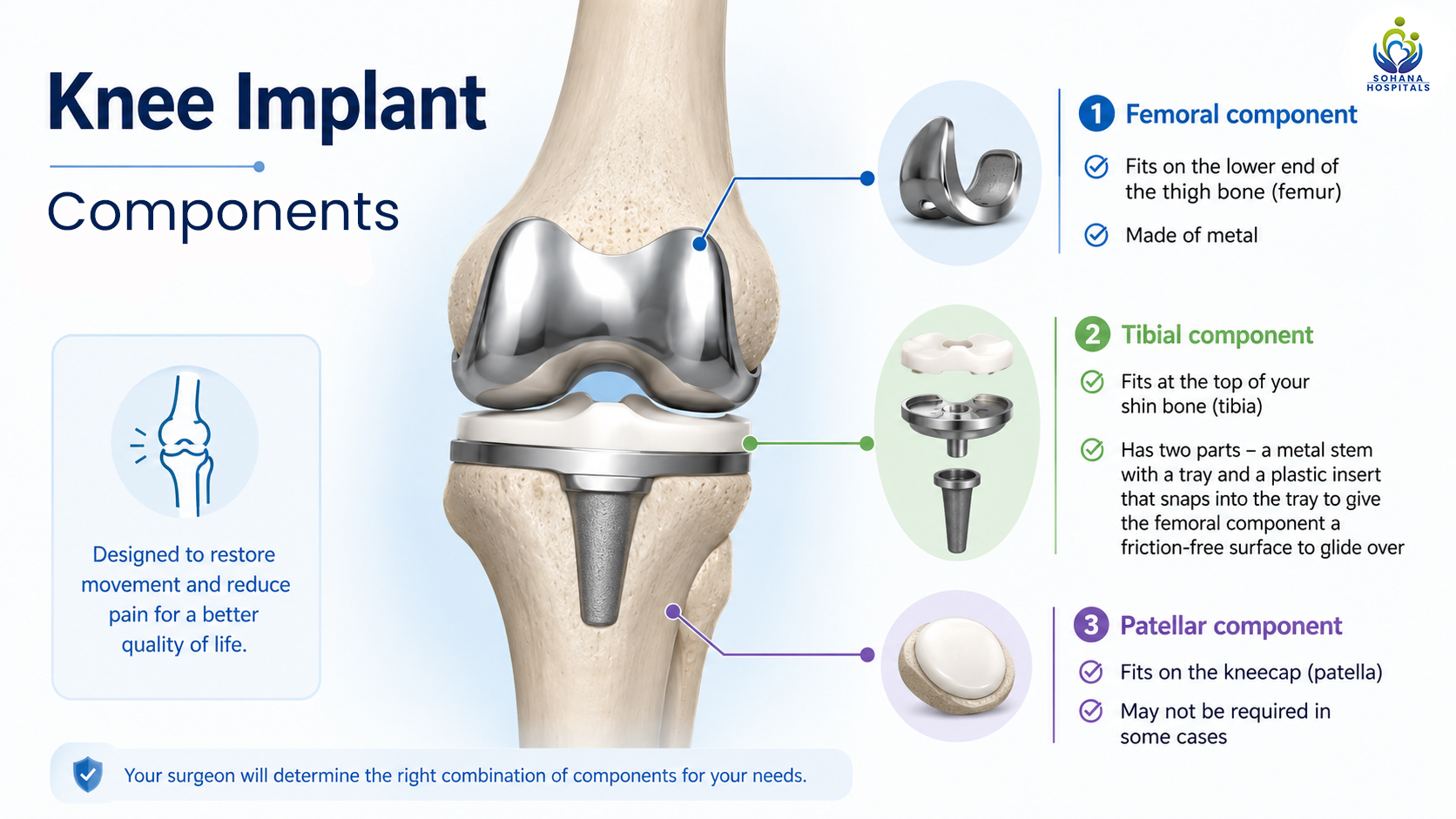
A total knee implant has various components:
Femoral component
- Fits on the lower end of the thigh bone (femur)
- Made of metal
Tibial component
- Fits at the top of your shin bone (tibia)
- Has two parts – a metal stem with a tray and a plastic insert that snaps into the tray to give the femoral component a friction-free surface to glide over
Patellar component
- Fits on the kneecap (patella)
- May not be required in some cases
Also read: How Long Do Knee Implants Last? A Complete Guide
What are the Steps in Total Knee Replacement (TKR)?
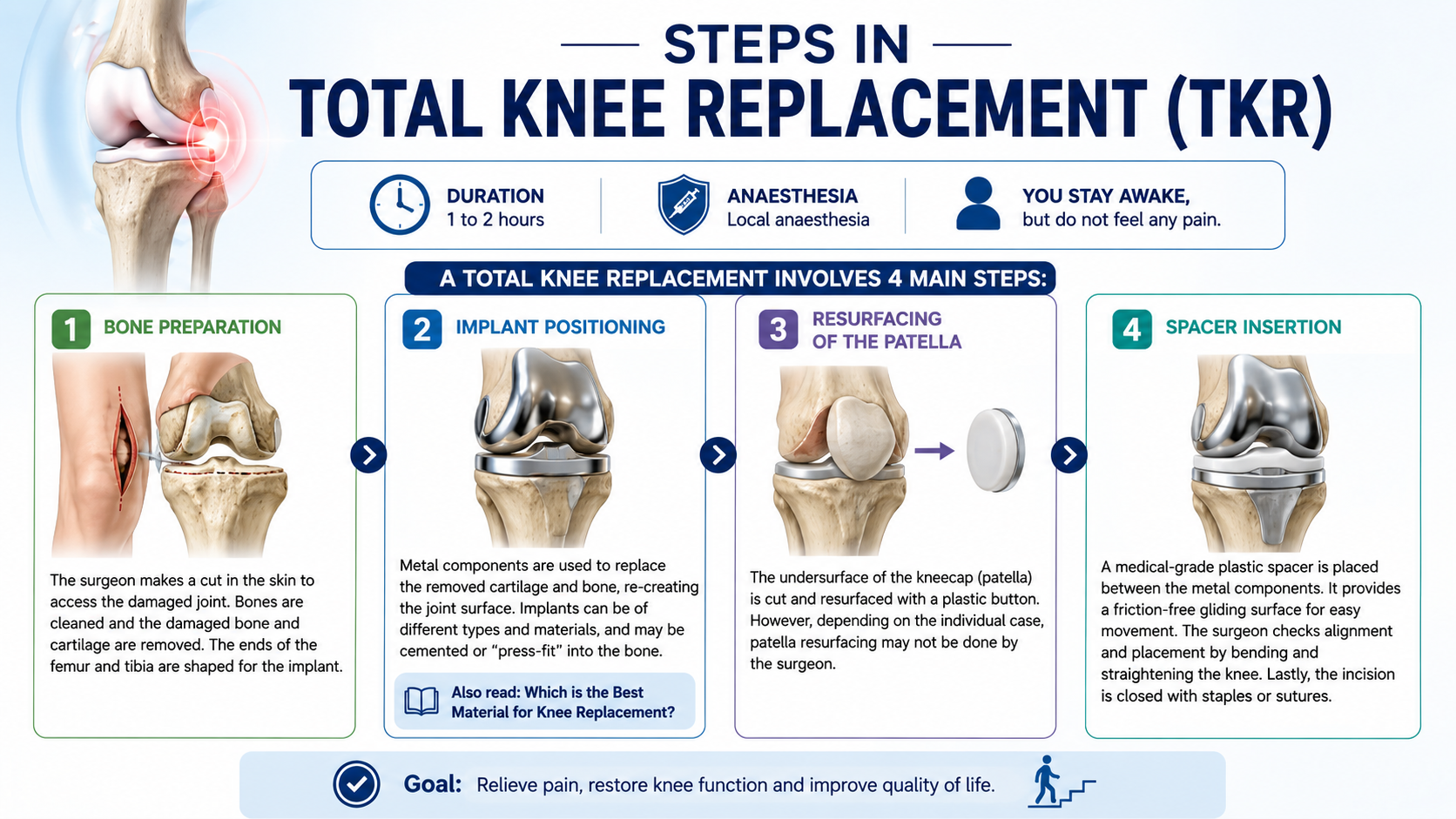
Knee replacement surgery usually takes 1 to 2 hours and is done under local anaesthesia. You stay awake but do not feel any pain. A total knee replacement involves 4 main steps:
Bone Preparation
Your surgeon makes a cut in the skin to access the damaged joint. Bones are cleaned to prepare them for surgery. The damaged bone and cartilage are removed. Further, the ends of the bones (the femur and tibia) are shaped for the implant.
Implant Positioning
The surgeon uses metal components to replace the removed cartilage and bone. This helps re-create the joint surface. These artificial implants can be of different types and materials. Also, they may be cemented or “press-fit” into the bone.
Also read: Which is the Best Material for Knee Replacement?
Resurfacing of the Patella
The undersurface of the kneecap (patella) is cut and resurfaced with a plastic button. However, depending on the individual case, patella resurfacing may not be done by the surgeon.
Spacer Insertion
A medical-grade plastic spacer is placed between the metal components of the knee implant. It provides a friction-free gliding surface for easy movement of the metal components. The surgeon checks the implant alignment and placement by bending and straightening the knee joint. Lastly, the incision is closed with staples or sutures.
Also read: Life After Robotic Knee Replacement: What to Expect
What is the Recovery Like?
Walk the same day
Most patients at Sohana Hospital experience a relatively fast recovery. Movement is essential to healing. You will start walking within 24 hours – using support (walker) and help from dedicated physiotherapists at Sohana Hospital.
4-6 week recovery
You are likely to get back to doing daily activities, like household work, cycling, climbing stairs, going for a walk, etc., within 4-6 weeks. Having said that, it is important to mention that some patients may recover faster or slower than others.
Factors affecting recovery
In addition to the surgeon’s expertise, recovery also depends on a particular patient’s age, overall health, medical history, bone structure, and the type of surgery (conventional knee replacement or robotic knee replacement).
Also read: Common FAQs About Knee Replacement Recovery – Answered by an Orthopaedic Surgeon
Regular physiotherapy
One of the most significant aspects of recovery is following the instructions and advice of your surgeon and physiotherapist. Physiotherapy after a knee surgery is very important. The more religiously you perform physiotherapy, the faster you are likely to recover. Also, if you face any problem during the recovery phase, it is always good to talk to your surgeon.
Innovative Approaches to Total Knee Replacement Surgery
When does surgery become necessary?
We realise that total knee replacement surgery may not be your first choice, but if your knee pain has worsened to a point where you experience pain even at rest and your daily life is getting impacted, it may be time to book an appointment with the world-renowned orthopaedist, Dr. Gagandeep Singh Sachdeva (Chief Robotic Joint Replacement Surgeon and CEO) at Sohana Hospital.
Also read: Is Knee Replacement the Last Option? Myths vs Facts
Restoring mobility
Our knee surgeons are dedicated to helping you get rid of pain and restore mobility so that you can get back to doing what you love. We have advanced knee treatment options, exceptional patient care, and the best results.
Pioneers in robotic technology
At Sohana Hospital, we offer CUVIS robotic knee replacement. We are the first hospital in North India to introduce robotic knee technology. The cutting-edge robot assists our surgeons with precise pre-planning of the surgery, according to your unique bone structure. By performing a virtual surgery before the actual surgery and giving real-time feedback through the surgery, the AI-powered robot ensures unmatched surgical accuracy.
Also read: Robotic vs Traditional Knee Replacement – Which is Right for You?
Painless surgery, faster recovery
For the patients, it translates into a virtually painless surgery with minimal blood loss and low complication risk. The recovery is also faster, and the new knee gives a natural feel with a superior range of motion. What’s more, with accurate placement and alignment, the implants last longer.
Best-in-class facilities
Sohana Hospital is one of the few hospitals in India with ultra-modular, infection-proof, 7-star operation theatres. The length of your stay typically varies between 3 and 5 days. Today we have several surgical techniques and implants, which is why your surgeon will suggest the type of implant and surgery ideal for your condition.
Also read: Hospital Stay for Knee Replacement: What to Expect
Proven track record
With the best knee surgeons in Chandigarh, Sohana Hospital boasts more than 30,000 successful knee replacement surgeries. We are known for giving world-class knee care at the most affordable prices.
Why Choose Sohana Hospital for your Total Knee Replacement Surgery?
Here’s why we are the trusted choice of national and international patients:
- Established in 1995
- NABH, NABL, ISO accredited hospital
- World-class facilities
- Team led by the award-winning knee surgeon, Dr. Gagandeep Singh Sachdeva
- 30,000+ successful knee surgeries
- Minimally invasive total knee replacement surgery using the CUVIS robot
- Empanelled with all the major government and private organisations
- All major health insurance plans accepted
If you’ve been dealing with chronic knee pain that did not improve with non-surgical treatments, book an appointment with a total knee replacement surgeon at Sohana Hospital today! We can help you get back to a healthier, pain-free life!
Reference Source: