
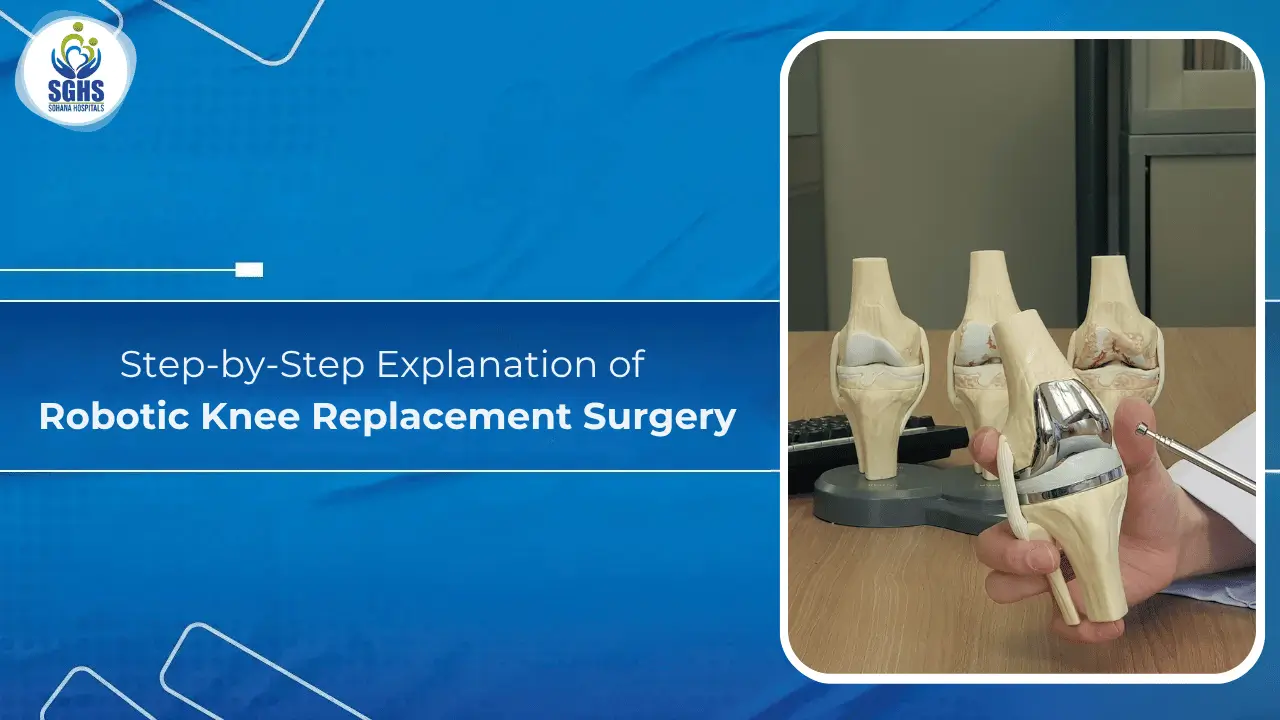
Knee pain can be a significant hurdle, making every activity a challenge. Whether you try to walk, stand, climb stairs, or even sleep, your knees hurt all the time. A desire to lead a pain-free and independent life makes people turn to robotic knee replacement.
The procedure, being highly precise and effective, an increasing number of knee patients have started opting for it. However, even after you make up your mind to undergo robotic knee replacement, you may still want to know the exact steps it involves.
At Sohana Hospital, patients get the benefit of the cutting-edge robotic knee replacement technology, performed under the expert guidance of Dr. Gagandeep Singh Sachdeva, one of the best knee surgeons in Chandigarh. He brings 25+ years of surgical expertise to the field and utilises the world’s most advanced CUVIS robot for knee replacement. The aim is to ensure a faster recovery, enhanced mobility, and natural knee function for the patients.
In this blog, we give an elaborate, step-by-step explanation of robotic knee replacement. This information will help you understand the procedure, be better prepared, and feel comfortable.
What is Robotic Knee Replacement Surgery?
Robotic knee replacement is a ground-breaking surgical technology that helps orthopaedic surgeons perform knee replacement with unmatched precision. It is important to know that the robot does not conduct the surgery, but is like another instrument in the surgeon’s tool kit. It enhances the capabilities of the surgeon through real-time 3D imaging and computer-guided navigation.
Robotic knee surgery scores over traditional knee surgery in many respects. The implant placement and alignment are accurate, and there is minimal damage to surrounding tissues. For the patient, it means less pain, faster recovery, and long-lasting results.
You may also like: Benefits of Robotic Knee Replacement Over Traditional Surgery
Who Can Benefit from Robotic Knee Replacement?
Patients with a range of knee issues can take advantage of this advanced procedure. This includes individuals with:
- Osteoarthritis in their knee(s)
- Rheumatoid arthritis
- Post-traumatic arthritis after an injury
- Joint deformity
- Severe joint stiffness
- Limited mobility affecting routine activities
- Persistent pain that does not subside with medicines and physiotherapy
If you’ve been advised knee replacement, consulting a trusted orthopaedic expert can help you determine if robotic knee surgery is right for you.
Step-by-Step Explanation of Robotic Knee Replacement Surgery
Let’s see how the advanced knee surgery progresses at Sohana Hospital – a leading centre for robotic orthopaedic care in Mohali, Punjab.
Step 1: Thorough Pre-Surgery Assessment
We start with a detailed consultation, your medical history, and diagnostic evaluation.
- Physical examination: Our expert orthopaedic doctors check your knee’s range of motion, severity of pain, and overall condition of the joint.
- Advanced diagnostics: Imaging tests like X-rays and 3D CT scans are done to prepare a virtual model of your knee joint.
- Tailored surgical plan: The AI-integrated planning software creates an accurate map of your knee joint. This helps plan artificial implant placement with accuracy in sub-millimetres.
This personalised approach ensures that knee surgery is done according to a patient’s unique anatomy, which improves long-term results.
Step 2: Preparation for Surgery
Some standard pre-operative protocols are carried out before the operation:
- Routine blood tests and medical clearance
- Reviewing medicines (some may need to be stopped temporarily)
- Guidelines for fasting and other pre-surgery instructions
- Physiotherapy instructions for faster recovery after surgery
At Sohana Hospital, all surgeries are done in dedicated 7-star modular operation theatres, which helps minimise infection risk to near-zero levels. Sohana Hospital is one of the few hospitals in India to have such world-class OTs.
Step 3: Anaesthesia and Positioning
On the surgery day, the patient gets general or spinal anaesthesia, to ensure that you experience no pain during the procedure.
You are carefully positioned on the operating table, allowing surgeons proper access to the knee joint while maintaining safety and comfort.
Step 4: Customised Treatment Plan
Before the real surgery begins, the robotic system maps the exact shape and structure of your knee in real-time. A virtual surgery shows surgeons how much bone and cartilage are to be removed.
The robotic system uses this data to produce a tailored surgical plan. This ascertains that the artificial implant perfectly aligns with your knee’s natural movement and structure.
Step 5: Bone Preparation and Implant Placement
After the planning phase is over, our highly skilled orthopaedic surgeon uses the robotic arm of the CUVIS joint robotic system to cut the damaged bone and cartilage with sub-millimetre precision. The robot makes sure that every incision is according to the pre-planned measurements, so as to minimise tissue trauma.
Once the joint is ready, the surgeon positions the artificial implant – with perfect alignment and balance.
Throughout this time, the CUVIS robotic system continues to give real-time feedback. This enables the surgeon to make adjustments as per the finest details and ensure maximum stability and natural knee movement.
Step 6: Securing the Sutures
Once the prosthetic knee implant is secured in position, the surgical site is carefully sutured. Following this, the patient is shifted to the recovery room. Here, your vital signs (body temperature, pulse rate, respiration rate, BP) are closely observed as the effect of anaesthesia wears off.
Robotic knee replacement procedures typically take around 1–2 hours. And regarding hospital stay, most patients generally spend 3-5 days in the hospital.
Benefits of Robotic Knee Replacement Surgery
Robotic knee replacement offers several key benefits over traditional knee surgery:
- Higher Precision in implant positioning for better joint balance and durability
- Reduced Tissue Trauma with smaller cuts and accurate bone cutting
- Minimal blood loss due to smaller incisions
- Less pain due to tiny incisions and enhanced surgical accuracy
- Faster Recovery as most patients start walking (with support) within 24 hours and resume normal life in 30-45 days
- Durable Implants because of proper alignment and precise surgery
Recovery and Rehabilitation
Recovery begins almost immediately after surgery. Sohana Hospital has a dedicated team of trained physiotherapists who cater to each patient with utmost care. With regular physiotherapy sessions, you are likely to witness significant recovery in 30-45 days of surgery. Here are the key milestones:
- Day 1–2: Gentle knee movements and walking with support (using a walker). You also start going to the washroom with help from the round-the-clock available staff at Sohana Hospital.
- Week 1: Continue walking with a walker inside your room.
- Weeks 2–4: Enhanced flexibility and strength exercises. You may start walking with a stick and perform minor tasks.
- After 4-6 Weeks: With continued physiotherapy, most patients resume normal activities, like household chores, driving, travelling, going for 2-3 km walks, and gardening, etc.
Sticking to the personalised rehabilitation plan developed for you by our orthopaedic team, helps you recover faster and get the best results.
Why Choose Sohana Hospital for Robotic Knee Replacement?
Sohana Hospital is among Punjab’s top destinations for robotic orthopaedic procedures. The hospital, with a legacy of more than 30 years, is committed to offering advanced treatment options with a patient-centric approach – at competitive prices.
Key Highlights:
- Experienced knee surgeons led by Dr. Gagandeep Singh Sachdeva, Chief Robotic Joint Replacement Surgeon & CEO, Sohana Hospital
- Advanced diagnostics and the world’s most advanced CUVIS robot for joint replacement
- One-of-their-kind 7-star modular operation theatres specifically for knee surgeries
- 24×7 post-surgery care and availability of support staff
- Holistic physiotherapy and rehabilitation programs tailored to each patient’s specific needs
With highly experienced orthopaedic specialists and world-class treatment facilities, Sohana Hospital is known across the world for providing safe, effective, and compassionate knee care.
Conclusion
Robotic knee replacement surgery is the future of knee care. It offers unparalleled accuracy, safety, and a quicker return to normal life. At Sohana Hospital, patients benefit from the expertise of a dedicated team of orthopaedic specialists, who aspire to give pain-free mobility to knee patients each day.
If you have been dealing with chronic knee pain that refuses to go away despite trying all possible conservative and non-surgical treatments, it may be time to consider robotic knee replacement at Sohana Hospital.
Get treated by Sohana experts – make a faster return to normal activities!
FAQs – Robotic Knee Replacement
1. How does robotic knee replacement differ from traditional knee replacement?
Robotic knee surgery offers unmatched accuracy and minimal tissue trauma. This leads to less pain, faster recovery, and better implant alignment.
2. Is robotic knee replacement safe?
Yes. It is one of the safest surgical procedures, especially when performed by experienced knee surgeons at Sohana Hospital.
3. How long is recovery with robotic knee replacement?
Most patients at Sohana Hospital report resuming normal activities within 4–6 weeks. However, physiotherapy plays a crucial role in speeding up rehabilitation.
4. Can both knees be operated on together?
Yes. Many patients choose to get bilateral robotic knee replacement. Generally, those with no comorbidities and overall good health qualify for getting both knees done together. This way, they need to get admitted to the hospital only once, and the financial burden is less.
5. Who is the best doctor for robotic knee replacement in Punjab?
Dr. Gagandeep Singh Sachdeva at Sohana Hospital, Mohali, is an award-winning and one of the most trusted orthopaedic specialists in robotic knee replacement surgery. With 25+ years of experience and 30,000+ successful knee procedures, he is known for his expertise and high success rates.