
*हिंदी में पढ़ें: पैरालिसिस (लकवा) के मुख्य कारण क्या हैं?
Paralysis is a serious neurological condition that can arise from diverse reasons, which interfere with the proper functioning of the nervous system. It is your nervous system that transmits signals from your brain to the different parts of your body, instructing them what to do.
When the nervous system gets damaged, your nerves and muscles do not get messages from the brain. Causes of paralysis range from injury and infection to chronic neurological disorders. In this blog, we are going to learn the major causes of paralysis.
Paralysis Causes
A damaged nervous system means hampered communication between the brain and the rest of the body. It is like turning off the internet. When you try to access a page again, it is unavailable. Likewise, a paralysed individual loses the capability to control those muscles in their body that have lost connection with the central nervous system.
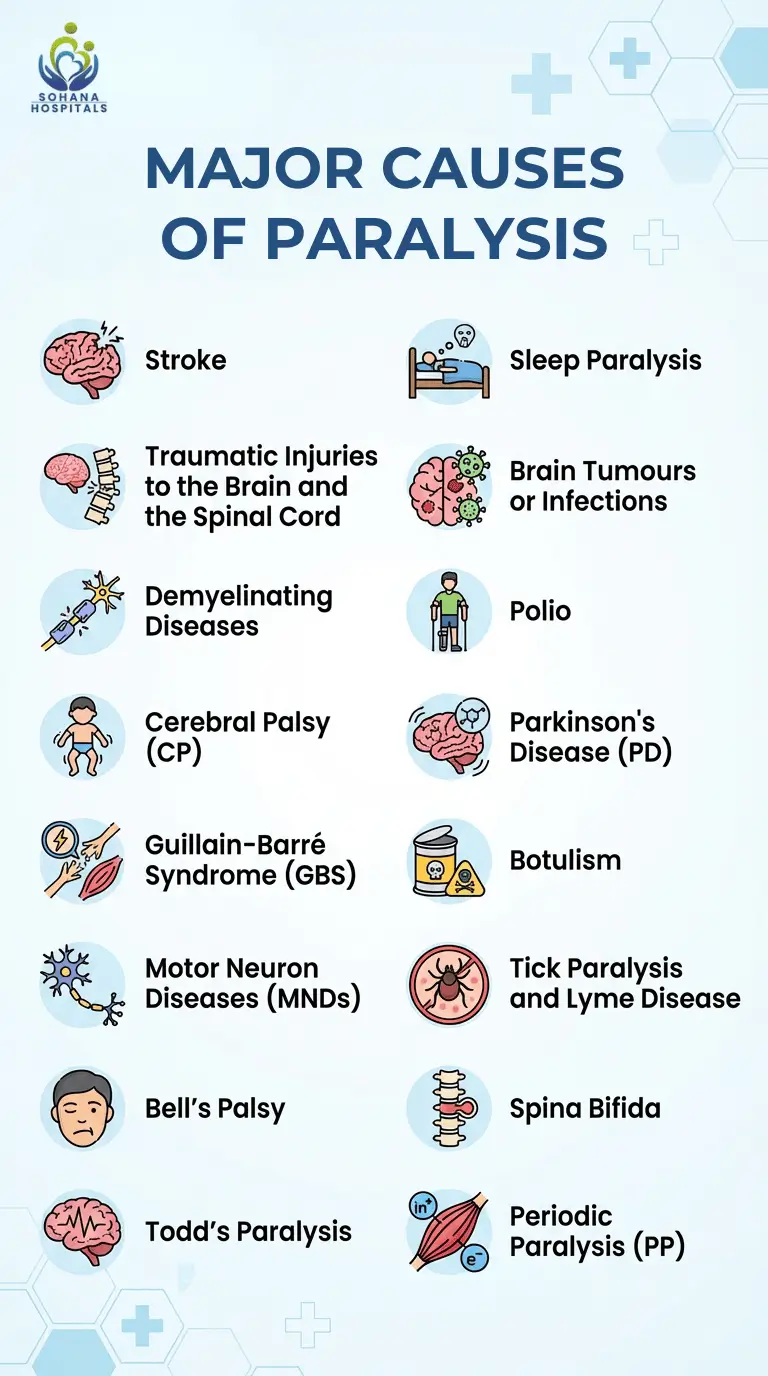
Stroke
It is the most common cause of sudden paralysis. It occurs when the blood supply to the brain reduces or gets disrupted, or a blood vessel ruptures. When this happens, the brain does not receive adequate oxygen and nutrients. Brain cells start dying within minutes. Depending on the location and intensity of the stroke, the patient may suffer either hemiplegia (paralysis on one side of the body) or the damage may be restricted to particular body parts.
👉 Also Read: How to Prevent Brain Stroke? Risks Factors & Prevention Strategies
Traumatic Injuries to the Brain and the Spinal Cord
Head injuries due to vehicle crashes, falls, sports accidents, violence cases, etc., can damage the central nervous system. This results in paralysis as spinal nerves and nerve pathways that carry messages from the brain to different parts of the body get damaged.
| 👉Did you know? Preethi Srinivasan, a national-level swimmer and the captain of the Tamil Nadu women’s cricket team, got paralysed neck-down in a tragic diving accident. Not only did she learn swimming again, but she is also a motivational speaker and advocate for people with disabilities. |
Demyelinating Diseases
These are autoimmune conditions that attack and damage the protective coating (myelin sheath) of nerve cells over time. This results in communication problems between the brain and the rest of the body, as neurons cannot effectively send signals. It leads to varying degrees of paralysis as muscles continue to weaken. There are many demyelinating diseases, with Multiple Sclerosis (MS) being the most common one.
Cerebral Palsy (CP)
A congenital condition affecting movement, posture, muscle tone, and coordination due to abnormal brain development or injury near the time of birth. CP is generally not a progressive disease, meaning that it does not worsen over time. Most persons with CP have normal to above-average intellect. Mild cases have near-normal life expectancy, but severe cases may have reduced lifespan due to associated complications.
| 👉Did you know? Born with cerebral palsy (a permanent neurological disorder affecting movement, muscle and posture), Manvendra Singh from Uttar Pradesh, India, in the year 2025, cracked the UPSC Engineering Services Examination in his first attempt, securing AIR 112. This IIT Patna graduate was diagnosed with cerebral palsy at six months of age and faced significant challenges in performing his daily tasks. He beat all odds to fulfil his dreams. |
Guillain-Barré Syndrome (GBS)
The human nervous system has two parts – the CNS (Central Nervous System), comprising the brain and spinal cord, and the PNS (Peripheral Nervous System), which includes all the remaining nerves all over the body. GBS is a rare autoimmune condition in which the immune system attacks peripheral nerves. The CNS is not affected, so thinking remains fine. However, GBS can progress rapidly and may require ventilatory support in severe cases.
Motor Neuron Diseases (MNDs)
Motor neurons are the nerve cells responsible for controlling the muscles that you use to walk, move your limbs, breathe, and speak. They are of two types: upper motor neurons (transmit signals from the brain down to the spinal cord) and lower motor neurons (further transmit those signals down to the muscles). MNDs damage these cells over time. Here are the common types of MNDs:
- ALS (Amyotrophic Lateral Sclerosis) is the most common MND. It affects both – upper and lower motor neurons. There is progressive degeneration of neurons, leading to muscle weakness and paralysis. Voluntary muscle activities are impacted.
- PLS (Primary Lateral Sclerosis) is an upper motor neuron disease that affects only the upper motor neurons, causing stiffness and jerks in muscles.
- SMA (Spinal Muscular Atrophy) is a lower motor neuron disease that affects just the lower motor neurons, making muscles floppy or flaccid, or causing uncontrollable twitching.
Bell’s Palsy
It causes sudden, temporary weakness in the facial muscles. Half the face seems to be paralysed and droops. A clinical study published in the Annals of the Indian Academy of Neurology suggests that Bell’s Palsy is a common cause of facial paralysis. The underlying cause is viral infection-induced inflammation in the cranial nerve VII. Most cases recover completely within weeks to months.
👉 Also Read: Signs & Symptoms of Paralysis – When to Seek Medical Help
Todd’s Paralysis
It typically happens just after a seizure and is temporary. It generally affects just one side of the body. The duration may range from a few minutes to several hours.
Sleep Paralysis
It refers to temporary paralysis that happens during the transition between sleep and wakefulness. Reasons include various sleep disorders, disturbed sleep patterns, and anxiety. It is important to note that it is not a neurological paralysis disorder, but a benign sleep phenomenon.
👉 Also Read: Sleep Disorders Explained: Effects on Memory, Mood & Cognitive Health
Brain Tumours or Infections
Growths or infections in the brain may destroy healthy brain tissue, raise pressure inside the skull, or press on nerves or the spinal cord. This may result in issues like weakness, trouble walking, difficulty maintaining balance, partial or total vision loss, trouble using or understanding language, and memory problems.
Polio
Polio is an acute infectious viral disease that mainly affects children below the age of 5 years. Caused by the poliomyelitis virus, it can affect nerves, leading to partial or full paralysis. Now, it is rare due to widespread vaccination, but still may occur in under-immunised populations. One in 200 infections leads to permanent paralysis. It damages the central nervous system and motor neurons. Beginning with the inability to move limbs and trouble breathing, it may eventually lead to paralysis and death, especially in unvaccinated children.
| 👉Did you know? Dr. Suresh H. Advani got inflicted by polio when he was just eight years old. The affliction made it challenging for him to move around, yet he went on to become a renowned cancer specialist, helping numerous patients. He was the first to perform bone marrow transplants in India. |
Parkinson’s Disease (PD)
The condition causes progressive loss of movement as the nervous system gets damaged over time. PD does not usually cause true paralysis (complete loss of muscle function) but leads to severe movement difficulties, tremors, stiffness (rigidity), difficulty maintaining balance, and extreme slowness. Over time, symptoms worsen, and the person with PD may find it difficult to walk, talk, or perform other simple tasks.
Botulism
It is a rare but serious condition caused by a toxin from the Clostridium botulinum bacteria that attacks the body’s nerves. The bacteria may enter the body through contaminated food or infected wounds. Botulism often results in difficulty breathing, paralysis of muscles, and even death.
Tick Paralysis and Lyme Disease
Some species of ticks have neurotoxins in their spit glands that can lead to paralysis. Lyme disease is transmitted by tick bites, and in severe cases, it can affect the nervous system, resulting in paralysis. It is to be noted that tick paralysis is due to neurotoxins, while Lyme causes infection-related neuropathy, not direct toxin paralysis.
Spina Bifida
It is a congenital (present at birth) spinal cord defect that occurs when the brain, spinal cord, or the protective coverings of these organs lack proper development. The patient may suffer varying degrees of paralysis, along with other neurological issues.
Periodic Paralysis (PP)
This is a rare condition caused by genetic differences inherited by some people. It involves seemingly random (episodic and not periodic) attacks of paralysis (weakness or stiffness in muscles). The attacks may affect the entire body or only one or two limbs (arms, legs), and may last from a few minutes to some days. Depending on the type, the paralysis attacks can occur as a result of high or low potassium levels in the blood, stress, exercise, high carbohydrate meals, colds, certain medicines, fasting, or high thyroid hormone levels.
Conclusion
Understanding the causes of paralysis helps in recognising the early signs of paralysis and preventing complications. While some underlying causes are beyond control, others, like polio, have been largely controlled now. Whatever the reason behind paralysis, it is essential to seek treatment for the affected person to enhance their quality of life.
Sohana Hospital, Mohali, has some of the best neurologists in Punjab, who have years of experience in dealing with various neurological conditions that lead to paralysis. The hospital has the most advanced diagnostics and modern treatment approaches to manage these conditions, and is known for providing compassionate care.
So, if a loved one is struggling with any paralysis-related condition, do reach out to Sohana Hospital, and get the best care in the tricity.