
Parkinson’s disease (PD) is a mobility-related neurological disorder (of the brain) that progresses and aggravates with time. PD occurs when dopamine-producing nerve cells in a part of the brain called the substantia nigra gradually become damaged and die. Dopamine is a chemical that helps control movement.
Tremors are a characteristic trait of Parkinson’s disease. The disease may begin slowly with benign symptoms, such as a subtle tremor in only one hand, foot, or jaw. However, patients may also experience slowed movement, stiffness, and balance issues that increase their risk of falls.
During the initial phases of PD, facial expressions may start to reduce. Arms may stop swinging while walking. Speech may also turn slurred. As the disease advances, symptoms usually worsen.
PD cannot be cured, but medicines can help control symptoms. In some cases, surgical intervention may also be advised.
| Did you know? It was in 1817 that the first research paper on PD was published by James Parkinson, describing it as a neurodegenerative disorder of the central nervous system. |
News Alert
- Parkinson’s is believed to affect nearly 10 million people across the world (roughly 0.3% of the global population)[1]
- 1 out of every 100 individuals aged over 60 is seen to have PD
- PD affects more men than women (with a 2.66 male/female ratio)[2]
- PD in India is more pronounced in the rural population than in the urban population
- In India, almost 70 out of 100000 people have PD[3]
- In North India, 67.71 in 1,00,000 people are affected by PD[4]
- PD progression is seen to be associated with depression and arterial blood pressure
- Risk factors include male gender, type-2 diabetes, head injury, trauma, genetic history, and Alzheimer’s disease
| Did you know? PD is the second leading neurodegenerative disorder and falls under the category of movement disorders. |
What are the Symptoms of Parkinson’s Disease?
Parkinson’s disease symptoms:
- May vary from person to person
- May change over time
- May be very mild and subtle in the beginning (difficult to notice)
- May first affect one side of the body, then both sides
- Often worse on one side than the other
- May resemble symptoms of other disorders
| Did you know? It is the loss of dopamine and its related neurotransmitter, norepinephrine, that leads to various PD symptoms. |
Here are the common Parkinson’s Disease Symptoms:
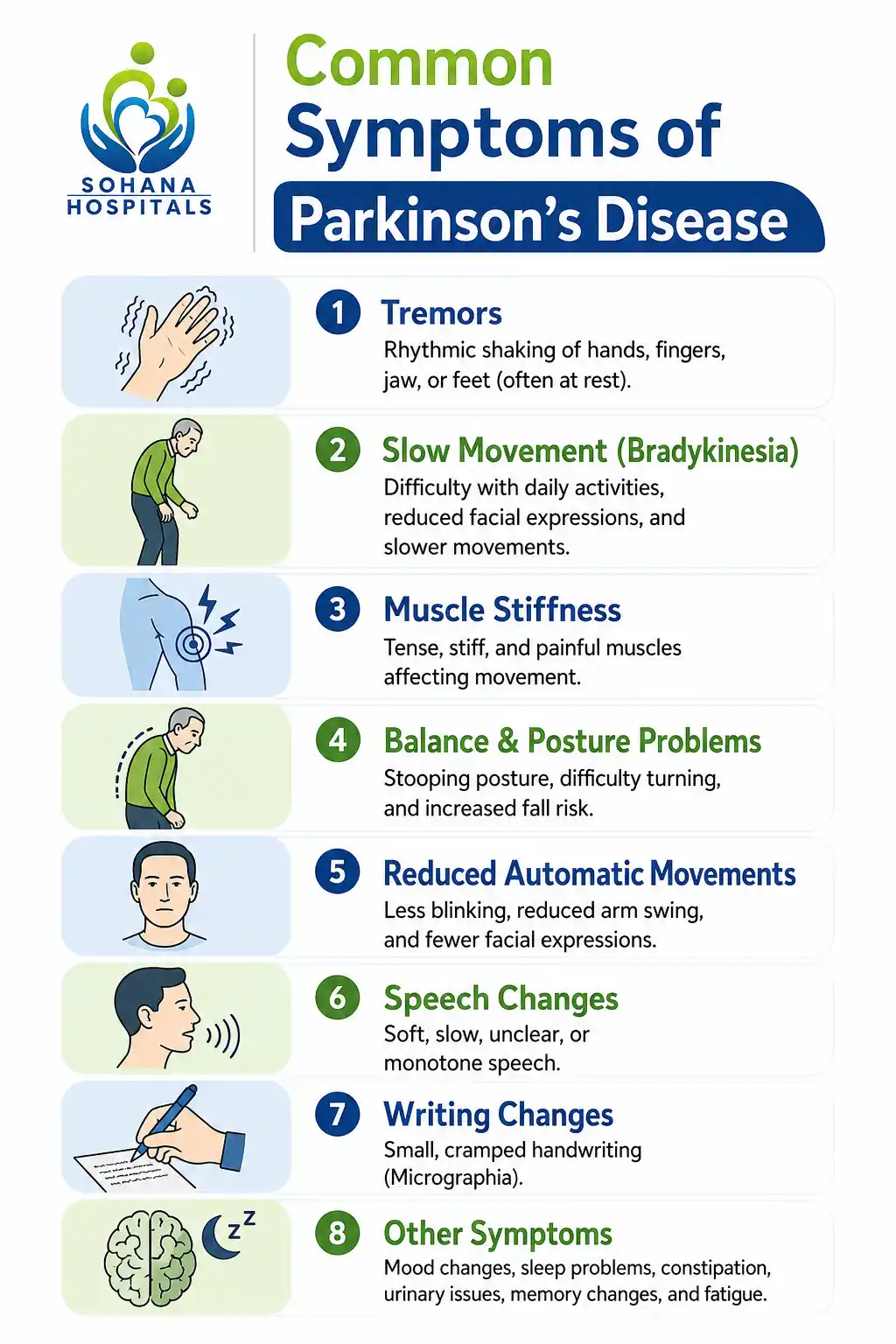
Tremor
There is rhythmic shaking in the fingers, hands, jaw, or foot. The patient may also depict a pill-rolling tremor (rub their forefinger and thumb back and forth). The hand may quiver when the patient is stressed or even at rest. Tremors are less when the patient is busy or moving.
Bradykinesia (Slowed movement)
Movement may slow down due to Parkinson’s disease, turning easy tasks hard. The affected individual may find it difficult to stand up from a sitting position, take a bath, or even get dressed. Facial expressions may also be affected. There may be difficulty blinking.
Muscle Rigidity
Muscles in just any body part may feel tense, stiff, and painful. Movements in the arm may become quick and jerky.
Poor Posture and Balance
It may become hard to maintain posture as it tends to droop. The individual may experience balance issues, have difficulty turning, and may also fall.
Loss of Automatic Movements
Humans have several actions and movements that happen on their own, without thinking. These movements or reflex actions may be affected. E.g., smiling, blinking, or swinging of arms while walking.
Changes in Speech
Speech difficulties include hesitation in speaking, slurred speech, and speaking quickly or softly. Speech may become monotone or flat. Typical speech patterns may go missing.
Changes in Writing
It may become troublesome to write, and writing may seem tiny and cramped (called micrographia).
Other Symptoms
There may be nonmotor signs of PD, including mood changes, anxiety, depression, drooling, urinary urgency, digestive issues, constipation, sexual dysfunction, and sleep issues. Patients may also act out dreams, need to urinate more frequently, have problems with smelling, thinking, and memory, and experience tiredness.
| Did you know? Typical PD symptoms appear after loss of 60–80% or more of the dopamine-producing cells in the substantia nigra (a critical structure in the midbrain that acts as the control centre for movement, balance, and reward functions). |
What are the Causes of Parkinson’s Disease?
The cause of PD is not known, but it occurs when neurons (nerve cells) in the brain start to die. Several PD symptoms are primarily due to loss of dopamine (a chemical messenger) along with changes in other brain chemical systems. Low dopamine results in irregular brain activity, and hence, movement issues and other PD symptoms.
Those with PD also lose norepinephrine (another chemical messenger), responsible for controlling several body functions, like blood pressure.
Here are some factors that are believed to lead to Parkinson’s disease:
Genes
Certain changes in the genes are associated with PD. But these are uncommon unless several members in the family have had the disorder.
Environmental factors
Some toxins and environmental factors may raise the risk of PD later in life. Examples of such toxins include MPTP (or synthetic heroin), pesticides, and contaminated water. It is important to note that environmental factors are not a proven cause for PD.
| Did you know? Chronic stress (e.g., emotional stress) may be a cause for dopamine loss and PD development. Depression is a factor observed in all stages of patients with PD. |
What are the Risk Factors for Parkinson’s Disease?
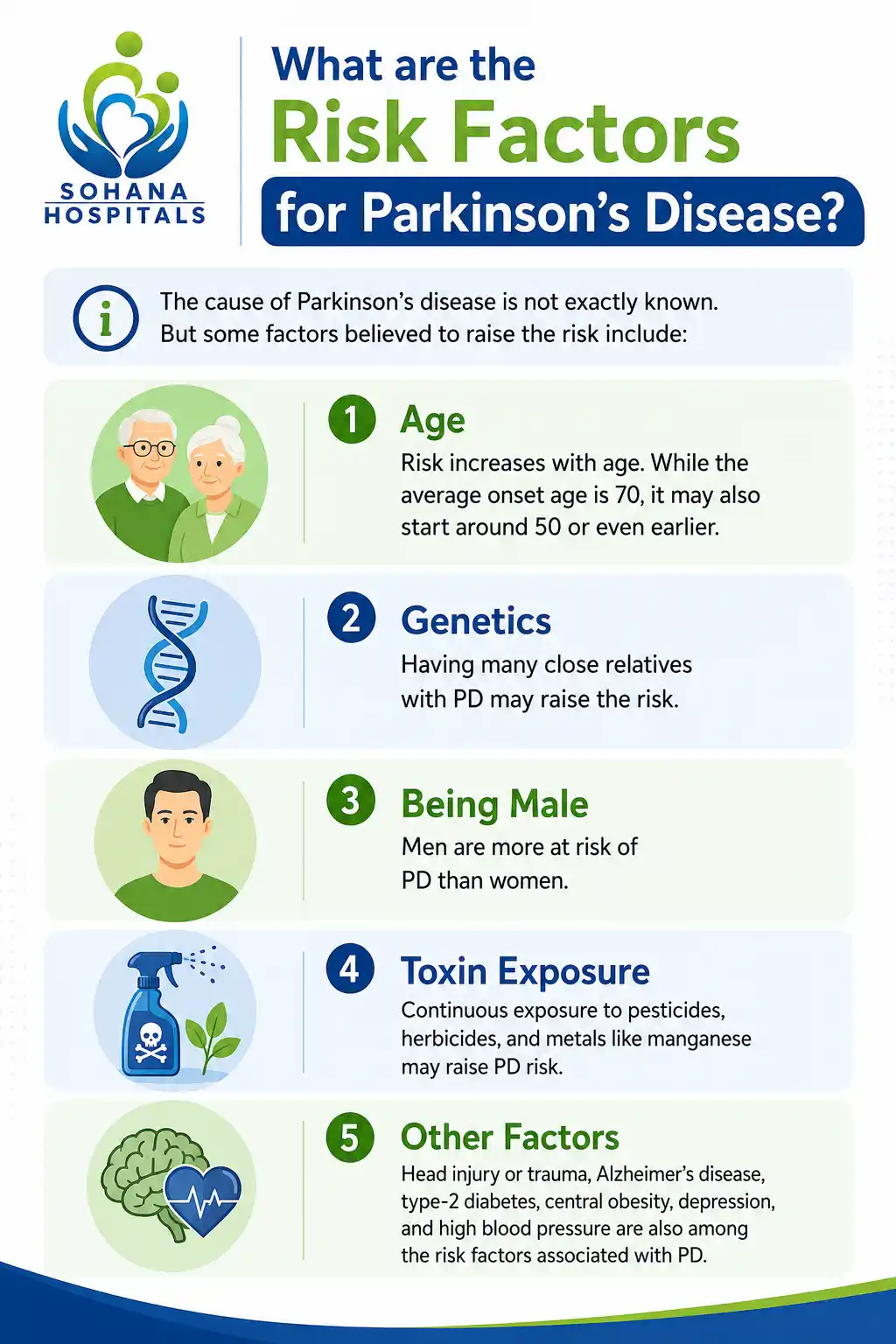
The cause of Parkinson’s disease is not exactly known. But some factors believed to raise the risk include:
Age
Risk increases with age. While the average onset age is 70, it may also start around 50 or even earlier.
Genetics
Having many close relatives with PD may raise the risk.
Being male
Men are more at risk of PD than women.
Toxin Exposure
Continuous exposure to pesticides, herbicides, and metals like manganese may raise PD risk.
Other Factors
Head injury or trauma, Alzheimer’s disease, type-2 diabetes, central obesity, depression, and high blood pressure are also among the risk factors associated with PD.
| Did you know? Sociodemographic variations, like dietary habits, tobacco, smoking, occupation, religion, and education, are not linked with Parkinson’s Disease. |
Conclusion
Parkinson’s disease may start subtly with minor signs and progress to pose a significant hindrance in the daily functioning of the affected individual. Primarily, it is associated with tremors and movement disorders.
The disorder is difficult to prevent since the causes are not exactly known. But it is possible to alleviate the symptoms with the right management strategies. Sohana Hospital, Mohali, is known for providing expert neurological care to Parkinson’s patients.
The hospital has advanced diagnostic services and treatment facilities, along with the best neurologists in Mohali, Chandigarh, who provide personalised and compassionate care to all patients. The aim is to improve the quality of life and allow the affected individuals to lead a normal and independent life.
If you observe any of the above-mentioned symptoms in yourself or a loved one, do not delay. Seek expert neurological care at Sohana Hospital.
Reference Sources:
- https://pmc.ncbi.nlm.nih.gov/articles/PMC4782561/
- https://www.sciencedirect.com/science/article/pii/S221339841630032X#:~:text=male/female%20ratio%20was%202.66.
- https://www.sciencedirect.com/science/article/pii/S221339841630032X#:~:text=The%20generalized%20incidence%20of%20PD%20for%20India%20is%20lowest%20from%20all%20over%20the%20world%20(70%20per%20100%2C000%20normal%20populations).
- https://www.sciencedirect.com/science/article/pii/S221339841630032X#:~:text=67.71/105%20prevalence%20of%20Parkinson%27s%20disease%20(PD)%20has%20been%20observed%20in%20north%20Indians.