
Your knee has three major compartments. In cases of severe knee damage, you may require total knee replacement surgery (replacement of all three compartments with artificial knee implants).
However, in some cases, replacing only one compartment, specifically the kneecap (or the patella, in medical terms), may be sufficient, since the other two compartments may be in good condition. This is when your doctor may recommend kneecap replacement surgery, instead of total knee replacement (TKR).
What is Kneecap Replacement Surgery?
Kneecap replacement or patellofemoral replacement is a partial knee replacement (PKR) surgery in which only the kneecap is replaced. Patients who have bone and cartilage damage restricted to the underside of the kneecap and the channel-like groove (the trochlear groove) in the thighbone (where the kneecap is located) are eligible for this surgery.
It generally happens in cases of patellofemoral arthritis. The surgery requires a smaller cut and causes less tissue trauma, especially if the robotic technology is used. Also, patients are likely to have a faster recovery as compared to those with total knee replacement.
Knee Anatomy
Your knee joint is your body’s largest and most complex movable joint. It connects the thigh bone (femur) to the shin bone (tibia). An individual with healthy knees can bend, straighten, and also slightly rotate their knee(s). The knee has three main compartments:
Medial Compartment
- Located on the inner side of the knee
- The meeting point of the thigh bone and the shin bone
Lateral Compartment
- Located on the outer side of the knee
- Comprises the lateral femoral condyle and the lateral tibial plateau
Patellofemoral Compartment
- Located at the front of the knee
- This area lies between the kneecap and the thigh bone
Trochlear groove
- Located inside the patellofemoral compartment
- It is where the kneecap slides forward and backwards when you bend or straighten your knee
Articular cartilage
The smooth, rubbery substance that covers the ends of bones
Prevents friction between bones, making easy movement possible
What Happens in Kneecap Replacement Surgery?
The most common cause for knee replacement surgery is knee osteoarthritis. The cartilage that covers the ends of bones for smooth movement gradually wears away. This causes bones to rub against each other, which damages them. The result? Pain, swelling, stiffness, and other symptoms arise in the knee, making mobility difficult.
Osteoarthritis may affect the entire knee (all three compartments) or just one compartment. When the damage occurs only in the patellofemoral compartment, you can opt for kneecap replacement.
In this operation, your doctor replaces the lower part of the kneecap, along with the trochlear groove, with artificial implants. The surgery saves the healthy cartilage, bone, and ligaments in the remaining parts of the knee.
Benefits of Kneecap Replacement Surgery
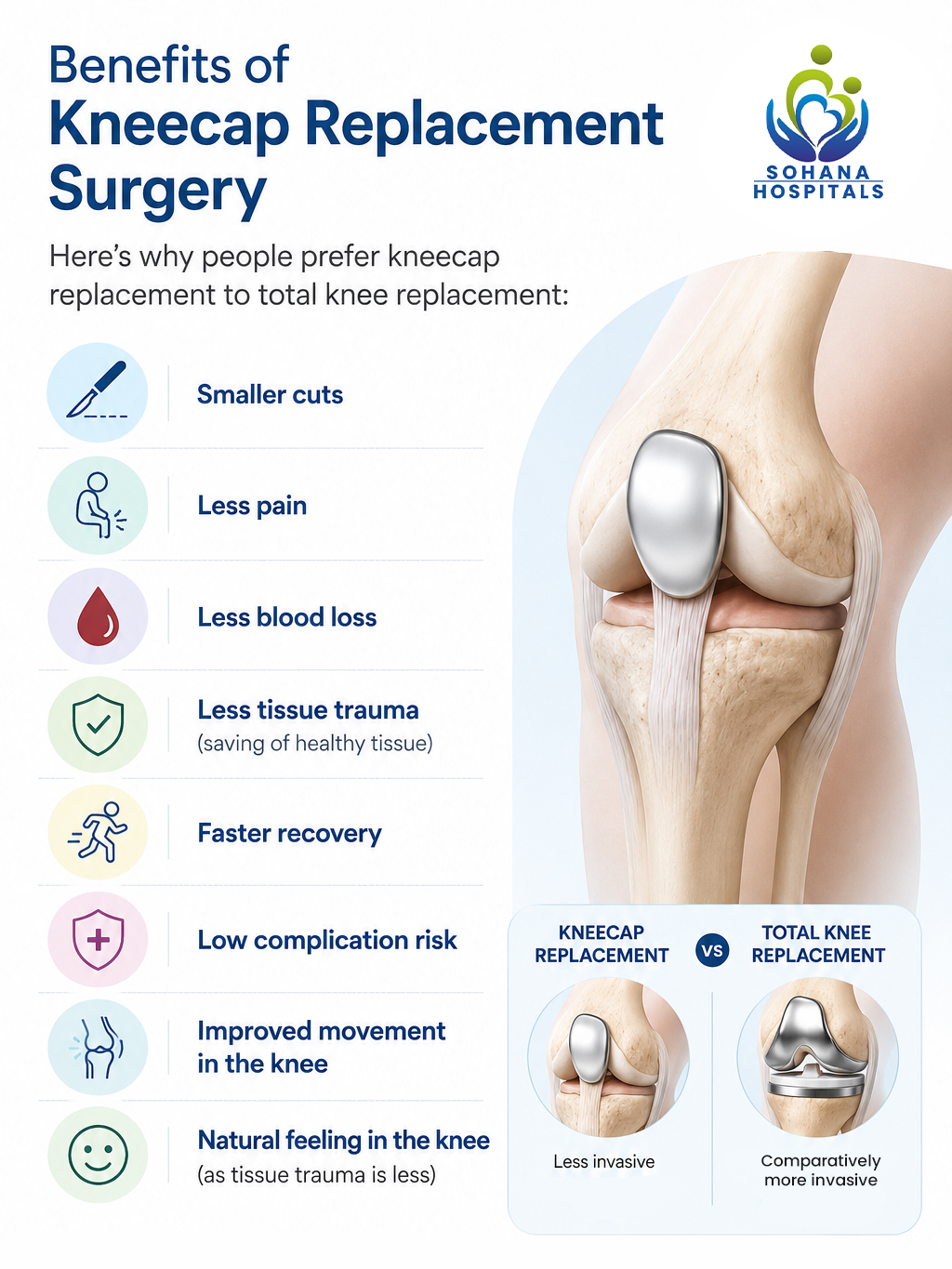
Here’s why people prefer kneecap replacement to total knee replacement:
- Smaller cuts
- Less pain
- Less blood loss
- Less tissue trauma (saving of healthy tissue)
- Faster recovery
- Low complication risk
- Improved movement in the knee
- Natural feeling in the knee (as tissue trauma is less)
Are You Eligible for Kneecap Replacement?
To check if you are a good candidate for kneecap (or patellofemoral) surgery, the doctor may conduct a thorough evaluation:
- Review your medical history to assess your general health
- Check the location of knee pain to ascertain that the problem lies in the kneecap
- Note which specific activities or movements hurt your knee
- Perform a physical examination
- Advise imaging tests like X-ray and MRI
The purpose of this evaluation is to verify whether kneecap surgery will be the right option for you to get relief from pain and restore movement.
Kneecap Replacement Procedure
Kneecap replacement surgery typically requires a shorter hospital stay than total knee replacement. Depending on various factors, you may even be allowed to go home the same day.
The procedure involves the following steps:
Anaesthesia
You get anaesthesia so that you do not feel any pain. Though awake, you will not feel any pain or discomfort during the surgery.
Examination of the Knee Joint
A cut is made to reach the inside of the knee. Once again, doctors make sure that replacing only the kneecap will be right for you.
Note: Robotic knee surgery has advanced AI-powered diagnostic tools that help doctors know accurate details of your knee and the damage beforehand (before the real surgery).
Bone Preparation
Special instruments are used to remove the damaged cartilage and bone from the patellofemoral compartment of your knee.
Note: If you choose robotic surgery, tissue trauma may be further reduced as the robot assists the surgeon with highly precise bone cleaning.
Implant Positioning
The back side of the kneecap and the trochlear groove are resurfaced and secured to the bone using the artificial knee implant.
From OT to Recovery Room
After the operation, you will be shifted from the OT to the recovery room. Here, all your vital statistics will be consistently monitored as the effect of anaesthesia wears off. Thereafter, you may be allowed to go home or moved to the ward (or a private room).
Recovery After Kneecap Replacement
Recovery in a kneecap replacement is the fastest of all partial knee replacement surgeries.
Pain Management
For some days post the procedure, you may have to take painkillers for a few days. This ensures you remain comfortable.
Walking
You will start walking the same day as your surgery. Trained physiotherapists at Sohana Hospital will be by your side, guiding and helping you. You may use a walker or stick for some days till you feel confident.
Physiotherapy
Our physiotherapists also help you perform the right exercises for a faster recovery. These exercises are meant to restore strength in your leg muscles and enhance the range of motion in your knee. Want to have a quick recovery? Stick to the prescribed routine for physiotherapy after joint replacement.
Schedule an Appointment with an Award-Winning Orthopaedic Surgeon
One factor that can significantly improve the outcomes of your kneecap surgery is your doctor’s expertise and the technology you choose.
Sohana Hospital has some of the best knee doctors in Chandigarh. The team is led by Dr. Gagandeep Singh Sachdeva, Chief Robotic Joint Replacement Surgeon & CEO, Sohana Hospital. With nearly 25 years of experience and over 30,000 successful knee replacement surgeries, he is a name to reckon with in the entire North Indian region.
He is known for successfully treating a wide range of knee conditions, including patellofemoral (kneecap) arthritis. Also, he specialises in robotic knee surgery, which offers exceptional advantages, such as unmatched precision, a painless procedure tailored to your unique knee anatomy, high safety, minimal blood loss, and fast recovery.
Dr. Gagandeep Singh Sachdeva will thoroughly examine your knees to find out if you have isolated patellofemoral arthritis. If pain is limited to your kneecaps, he has the expertise to repair the affected knee joint, thus eliminating the need for a total knee replacement.