
*हिंदी में पढ़ें: घुटना की सर्जरी के बाद कौन-कौन से व्यायाम करें और किन चीज़ों से बचें
After getting a total knee replacement surgery, you may want to resume a normal lifestyle – minus the pain – as soon as possible. And you are right to expect so because that’s the reason you got the surgery.
However, it requires a little patience. Following the doctor-advised exercise routine and avoiding what they prohibit can help you get back on your feet faster while also ensuring the best results.
Although modern innovations, such as robotic knee replacement, allow you to start walking within 24 hours of the procedure, complete recovery may take around 30-45 days.
In this blog, we are going to explore the exercises you should perform after your knee surgery, along with what not to do. The aim is to speed up the recovery process for a quicker return to routine activities.
Exercises to Do After Knee Replacement
Rehabilitation, physiotherapy, and exercises after knee replacement surgery are as crucial as your surgery itself. In the absence of the right exercises, weakness, stiffness, and prolonged recovery can impact the long-term functioning of the new knee.
There are different exercises for different stages of recovery. So, make sure you do them slowly and discontinue if you experience sharp pain, swelling, or instability.
Here we present exercises that are frequently suggested by physiotherapists for the revival of strength, flexibility, and walking ability.
| Excercise Name | Explanation | How to Practice | Benefits |
| Ankle Pumps | Often the first exercise after knee surgery – for improved blood flow and to prevent blood clots. | ➡ Sit or lie down in a comfortable position ➡ Move feet up and down in a pumping motion ➡ To be done in sets of 15-20, several times a day | ➡ Improves blood circulation ➡ Reduces swelling ➡ Keeps you safe from deep vein thrombosis (DVT) |
| Quadriceps Sets | Help strengthen thigh muscles and boost stability in the knee joint | ➡ Press down on your knee for 5 seconds while keeping your front thigh muscles tight. ➡ To be repeated 10-15 times | ➡ Improves knee strength and stability ➡ Alleviates stiffness ➡ Promotes faster straightening of the knee |
| Straight Leg Raises | Help rebuild muscle strength without putting stress on the knee – to prepare you for walking | ➡ Lie down with the operated leg straight and the other bent ➡ Raise the straight leg slowly ➡ Hold for a few seconds, then bring it down ➡ Repeat 10-12 times | ➡ Strengthens thighs ➡ Promotes knee control ➡ Improves movement in the knee |
| Heel Slides | Enhance bending and flexibility in the knee – for comfortable sitting and climbing stairs | ➡ Lie down on your back ➡ Gradually move your heel towards your body ➡ Bend your knee as much as you can without discomfort ➡ Straighten your leg ➡ Repeat 10-15 times | ➡ Enhances range of motion in the knee ➡ Lowers stiffness |
| Knee Extension Stretch | For regaining full straightening of the knee | ➡ Keep a rolled towel under your ankle ➡ Let your knee straighten on its own ➡ Hold for 20-30 seconds | ➡ Enhances alignment in the knee ➡ Improves stiffness ➡ Improves gait |
| Seated Knee Bends | Enhance comfort and knee movement in the sitting posture | ➡ Be seated on a chair with feet on the floor ➡ Slowly move the foot backwards as much as you can without discomfort ➡ Repeat 10–15 times | ➡ Enhanced knee bending ➡ Makes standing and sitting more comfortable |
| Standing Knee Bends | Stronger hamstrings and better walking ability | ➡ Stand with a chair or wall for support ➡ Gently bend your knee backward ➡ Slowly bring the foot down ➡ Repeat 10-12 times | ➡ Stronger hamstring muscles ➡ Better balancing ability ➡ Smoother walking |
| Walking | One of the best recovery exercises (but take care to perform other doctor-advised exercises too) | ➡ Initially, use a walker for support and walk inside the home only ➡ Slowly increase the distance | ➡ Builds endurance ➡ Improves balance ➡ Restores confidence |
| Swimming | Superb low-impact exercise (once your wound has fully healed & you have doctor’s approval) – but must continue with other exercises too | ➡ Start with gentle swimming, and slowly increase intensity and duration ➡ Take care of proper warm-up (before swimming) and cool down (after your swimming session) ➡ Practise proper technique | ➡ Muscle strengthening ➡ Improved range of motion |
| Stationary Cycling | Once approved by your physiotherapist, cycling helps promote knee movement | ➡ 5-10 minutes in the beginning with little or no resistance ➡ Slowly increase time and resistance till you can do it for 20-30 minutes – without pain. | ➡ Low-impact exercise ➡ Improves flexibility ➡ Strengthens muscles |
In general, you should go for lower-impact physical activities. That is in addition to doctor and physiotherapist-recommended exercises. It will help boost knee longevity.
What to Avoid After Knee Replacement
While stretching and strengthening exercises are crucial for recovery after knee replacement surgery, some activities are better avoided. Protecting your new knee is just as important as exercising.
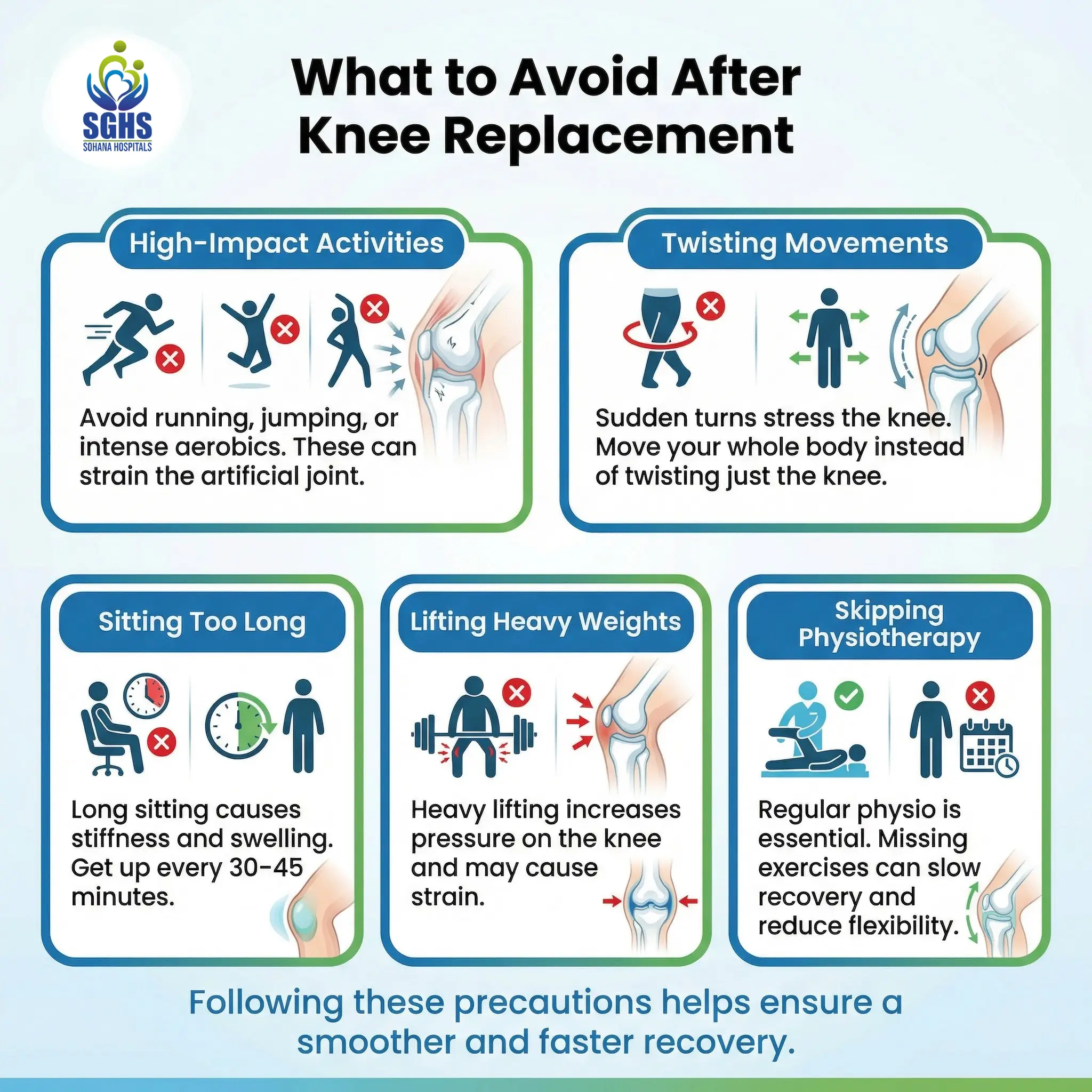
1. High-Impact Activities
Avoid running, jumping, or intense aerobics. These can put excessive strain on the new artificial joint and negatively impact its longevity.
2. Twisting Movements
Sudden turns can stress the knee. Be mindful that you move your entire body instead of twisting only the knee.
3. Sitting Too Long
Stay mobile. Sitting continuously for long periods of time can cause stiffness and swelling. Get up and stretch every 30–45 minutes.
4. Lifting Heavy Weights
Heavy lifting raises pressure on the knee joint. Avoid lifting heavy objects so as not to strain your knee.
5. Skipping Physiotherapy
Physiotherapy is the most critical aspect post surgery – opines Dr. Gagandeep Singh Sachdeva, Chief Robotic Joint Replacement Surgeon & CEO, Sohana Hospital, Mohali. Regular physiotherapy speeds up your rehabilitation journey. Contrarily, missing these exercises can slow down recovery and limit flexibility in the new knee.
Recovery Tips for Better Results
- Follow your physiotherapy plan without missing even one session
- Take all medications as directed by your doctor
- For swelling, keep the knee elevated and use ice
- Eat a protein-rich diet to promote faster healing
- Maintain a healthy weight
- Listen to your body and avoid overexertion
*Note: Remember, recovery takes time. Be patient and stay positive. Most patients at Sohana Hospital report major improvement within 4-6 weeks as they start going for 2-3 km walks, performing household work, driving confidently, gardening, and doing all that they love.
Final Thoughts
A knee replacement surgery is fast becoming a preferred choice to regain pain-free movement. The right exercises strengthen your muscles, protect your new knee joint, and help you return to an active lifestyle. The key lies in being consistent, avoiding risky activities, and trusting the rehabilitation process.
With proper care and guidance from experienced orthopaedic specialists and physiotherapists at Sohana Hospital, you can walk, climb stairs, and enjoy life once again.
If you or a loved one is struggling with knee issues, visit Sohana Hospital for consultation with the best knee doctor in Chandigarh. Alternatively, if you’ve already had your knee surgery done, you can seek trusted advice from expert physiotherapists and orthopaedists for a faster recovery.
With its advanced robotic technology, the hospital is at the forefront of virtually painless knee replacement surgeries, enabling knee patients to walk sooner and recover faster.
Reference Source: