
A total knee replacement is fast becoming an increasingly common procedure for the benefits it offers. Not only do people get freedom from knee pain, but they can also lead a more fulfilling life, doing what they love.
However, with the passage of time, some knee replacements fail. There may be various factors behind it. When it happens, you may experience knee pain, stiffness, swelling, and instability. This may interfere with your ability to perform routine activities.
At this time, what option do you have? Your doctor may advise you to undergo a revision knee replacement. As the name indicates, it is a second knee surgery in which some or all parts of the original artificial knee implant are replaced with new ones.
The goal of revision knee replacement surgery is the same as that of primary knee replacement surgery (TKR) – to help you get relief from knee pain and improve mobility. However, it is often a more complicated and longer procedure than TKR.
Revision knee surgery may require more detailed planning along with advanced instruments and specialised implants to ensure optimal results.
Components of a Knee Replacement Implant
A prosthesis or knee implant comprises metal and plastic parts. They are:
- Femoral
- Tibial
- Patellar
As per AAOS, over 90% of knee replacements continue to function well after 15 years, and almost 82% of knee replacements function well even after 25 years. The data highlights that the majority of the TKR surgeries are highly successful.
However, over time, the need for a revision knee surgery may arise due to factors like wearing out or loosening of the implant.
Revision Knee Surgery Types
Revision knee surgery can be of different types, depending on whether one or more parts of the implant need to be replaced.
- Some patients may need the removal and replacement of only one part of the implant.
- Sometimes, all three parts of the implant require replacement.
- In some other cases, doctors may also have to rebuild the bone around the knee with bone graft or augments (metal pieces to make up for the missing bone).
- Sometimes, the bone is so damaged that standard implants cannot be used. In such cases, specialised implants may be needed for additional support. These implants have longer, thicker stems to fit deeper inside the bone.
When is Revision Knee Surgery Needed?
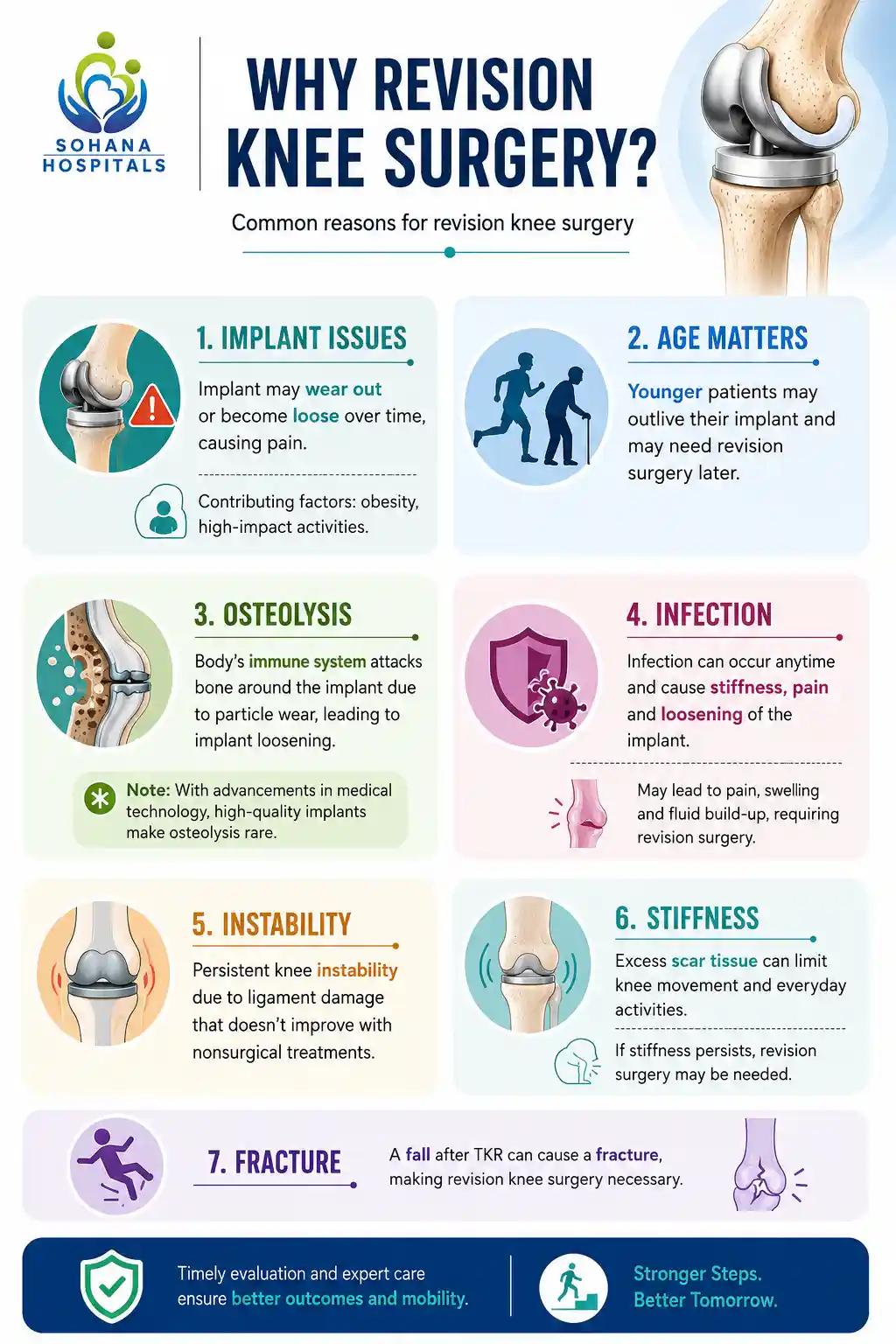
Implant Issues
When TKR is performed, the implant is firmly attached to the bone. This allows the new knee joint to function properly. With time, the implant may wear out or become loose, resulting in knee pain.
Some factors believed to contribute to wearing out or loosening of the implant include obesity and high-impact activities, like running, jumping, etc.
Age Matters
Those who get their primary knee replacement surgery at a younger age may outlive the life of their knee implant. They are likely to need a revision knee surgery later on.
Osteolysis
It is a condition in which the body’s immune system attacks the healthy bone around the implant. It occurs when tiny particles from the plastic spacer wear off and collect around the joint. The end result is the implant getting loosened.
*Note: With advancements in medical technology, high-quality implants are available, making osteolysis a rare occurrence.
Infection
Infection is something that can influence the success of any surgery, including total knee replacement. Infection may occur soon after the procedure or years later.
Infection may cause the artificial joint to become stiff, painful, and eventually, loose. Even if the implant does not become loose, the infection may lead to pain, swelling, and fluid build-up, making revision surgery necessary.
Instability
If a patient experiences frequent swelling along with a feeling of an unstable knee due to reasons such as damaged ligaments and does not improve with nonsurgical treatments, it may necessitate revision knee surgery.
Stiffness
In cases where there is the formation of excessive scar tissue around the knee joint, the patient may not be able to achieve the required flexibility to perform routine activities.
If this stiffness continues to pose a limitation, the patient may need revision knee surgery.
Fracture
A patient must be cautious about tripping and falling after their TKR surgery. If they happen to suffer a fall and it results in a fracture, revision knee surgery will most likely be needed.
Revision Knee Surgery Preparation
Medical Assessment
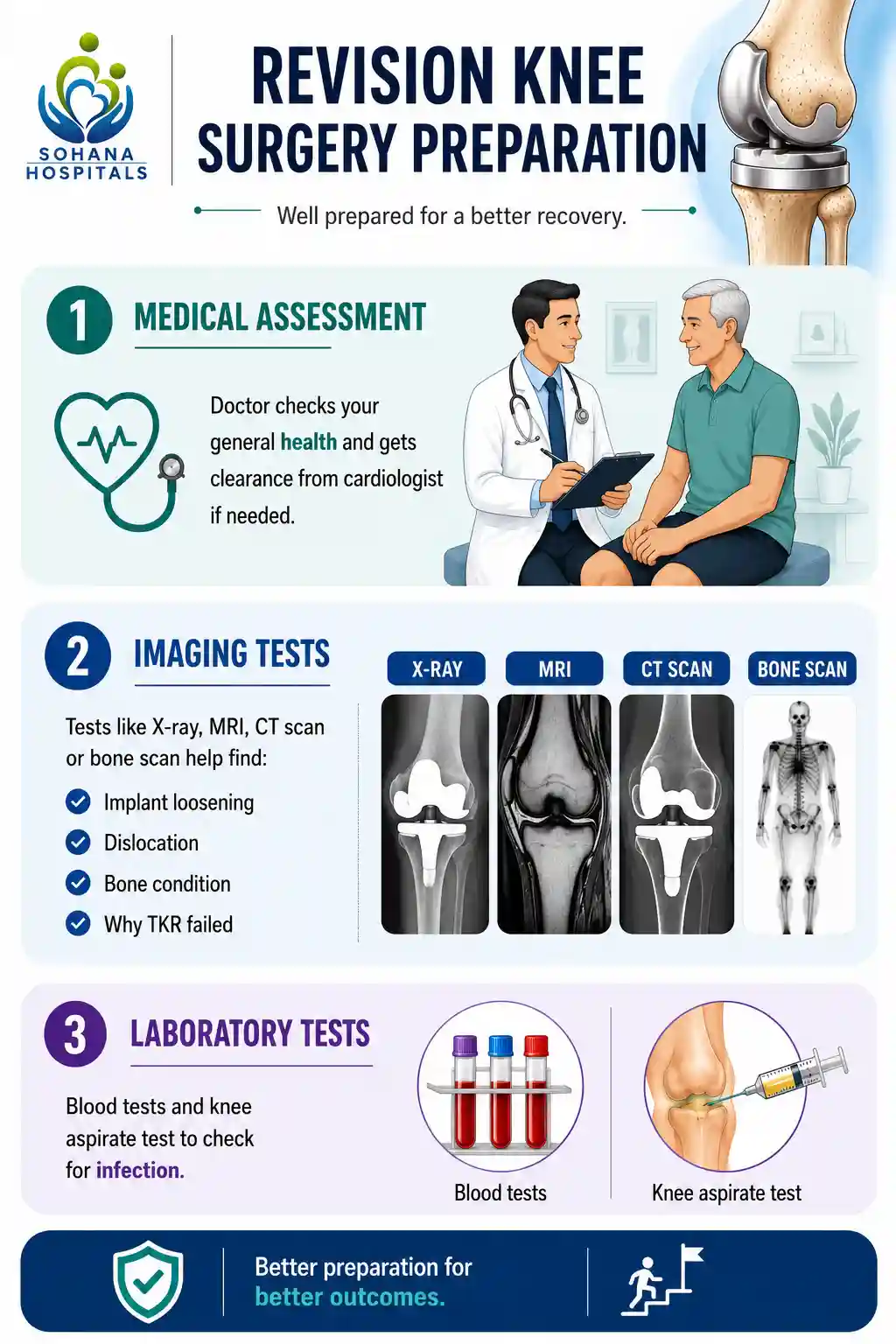
Your doctor will conduct a thorough physical examination to ensure that you are in good health for the surgery and recovery. Those with other health issues, like heart problems, also need to get clearance from their cardiologist.
Imaging Tests
Depending on your condition, your doctor will suggest one or more tests like X-rays, a nuclear medicine bone scan, an MRI (Magnetic Resonance Imaging), or a CT Scan (Computerised Tomography) to get information about:
- Implant loosening
- Change in the position of the implant parts (dislocation)
- Condition of the bone
- Why was your TKR unsuccessful
Laboratory Tests
These include blood tests and a knee aspirate test to check for infection.
Revision Knee Surgery Steps
Anaesthesia
Before surgery, you will be given anaesthesia so that you can have a comfortable and painless surgery experience.
You may get either a general anaesthesia (that puts you to sleep) or regional anaesthesia (you stay awake, only the body below the waist is numbed).
Actual Surgery
Revision total knee replacement surgery is generally more complicated and takes more time than a primary TKR surgery. Depending on the complexity of your case, the procedure may even take several hours, as opposed to 1-2 hours in primary TKR.
- Firstly, an incision is made – most often, the same as that in your first TKR, only it may be slightly longer to allow for the removal of the previous knee implants.
- Soft tissues in the knee are examined to ensure they are infection-free.
- All the parts of the artificial implant are checked to find out if they are loose, worn out, or moved from their original position.
- Depending on the condition, the original implant may be removed while taking care to save maximum bone.
- If your original implant used cement, it is also removed. This makes the revision surgery more complex and time-consuming.
- Once the original implant is removed, the bone surfaces are prepared for the new (revision) implant. In cases involving significant bone loss around the knee, metal augments, platform blocks, and, in rare cases, bone graft material may be required to build the knee once again.
- In the last step, the specialised revision implant is put in place. This is followed by repairing the damaged neighbouring soft tissues and carefully testing the movement of the new joint.
- After the surgery is completed, you will be shifted to the recovery room. You may stay here for some hours during which your recovery from anaesthesia will be monitored. Once the anaesthesia wears off, you are moved to the ward.
Recovery During Your Stay in the Hospital
You may have to stay in the hospital for some days. The recovery may be slower than that with primary TKR.
Pain
Less pain may help you recover faster. To help you be relatively pain-free, your doctor may use a combination of different pain-relieving medications, such as local anaesthetics and NSAIDs.
Physiotherapy
Physical therapy exercises are necessary to strengthen your leg muscles and restore movement (and flexibility). The goal is to allow you to start moving and performing routine activities as early as possible.
Blood Clots
Just like physiotherapy, follow your doctor’s instructions for preventing the formation of blood clots and reducing swelling in the leg. These measures to improve blood circulation and check blood clotting may include:
- Wearing the special compression stockings
- Wearing inflatable compression boots
- Taking blood thinners
- Moving your foot and ankle soon after surgery
Infection
Although rare, it is a complication that can affect the success of any surgery. Your doctor may prescribe antibiotics prior to the surgery and even afterwards to minimise infection risk.
Recovery at Home
Wound Care
There will be staples or stitches at the surgical site. These will be removed some days after the surgery, and your doctor will let you know when to visit next for suture removal. Take care not to let your wound come into contact with water, as long as the wound is not completely dry.
Physiotherapy
Remember, physiotherapy is your key to faster recovery. Keep moving and do not skip the exercises advised by your doctor and physiotherapist. It helps enhance strength and flexibility in the leg so that you can get back to performing routine activities sooner.
Read more: Exercises to Do After Knee Replacement & What to Avoid
For a Faster & Smoother Recovery
Stick to your doctor’s advice about medications, infection, blood clot formation, and physical therapy. It will help you recover well and resume your normal routine earlier, while also minimising the risk of complications.
Long-Term Results
Sohana Hospital frequently gets cases where primary TKR has failed, and the patient requires a second (revision) knee surgery.
Expert surgeons, including the world-renowned orthopaedist, Dr. Gagandeep Singh Sachdeva (CEO & Chief Robotic Joint Replacement Surgeon, Sohana Hospital), have been successfully performing complex revision knee surgeries to restore pain-free mobility in people.
Now, with the introduction of the US-based Intellijoint KNEEⓇ technology – an advanced AI-assisted navigation technology designed to improve precision and alignment during knee replacement surgery, results are all set to get even better.
Most patients who undergo revision knee replacement at Sohana Hospital witness good results. There is a significant reduction in pain and an increase in mobility and knee function, allowing patients to lead a normal life and be independent.
Why Choose Sohana Hospital
Sohana Hospital is a leading name in joint replacement. The hospital witnesses a huge footfall of patients not just from Punjab, Haryana, and other neighbouring states but also from different countries across the world.
The reasons are easy to understand. Trusted orthopaedic experts utilise the most advanced technologies to revive mobility in patients.
Sohana Hospital is known for:
- Highly experienced surgeons skilled in performing revision knee replacement
- Most advanced technologies (the latest addition being AI+Robotic Intellijoint technology from the US)
- World-class infrastructure (including 7-star modular operation theatres with international infection-control standards)
- Best-in-class stay facilities (deluxe, semi-deluxe, and private rooms along with wards)
- Round-the-clock presence of support staff
- Perfect hygiene
- A patient-centric, compassionate approach
- Empanelment with all major government and private organisations
- Affordable treatment costs
- A proven track record in treating the most complex cases
*Note: The need for revision knee replacement surgery varies from patient to patient. Treatment decisions should always be made after detailed evaluation by an experienced orthopaedic surgeon.
Don’t suffer in silence – Get your knee problem treated by the best knee doctors in Chandigarh!
FAQs – Revision Knee Replacement
Do I have any alternatives to knee surgery?
Depending on your symptoms, your surgeon may choose to wait and watch for some time before proceeding with the surgery. They may also advise some antibiotics or braces to avoid knee surgery.
What if I do not get the surgery?
It may not be a good idea. Over time, the condition may worsen, impacting mobility and making the operation more complex in the future. In case of infection in the knee joints, there may be a possibility of it spreading to other parts of the body.
What are the common reasons for revision knee replacement?
The major causes for a revision knee surgery often include:
- Infection
- Mechanical loosening of the implant
- Instability
- Wear and tear of plastic implant parts
- Osteolysis or Bone degradation
- Improper alignment
The causes for implant loosening are not always very clear. Mechanical failure can result from high-impact and repetitive activities. Younger TKR patients are also susceptible to implant loosening and wear and tear.
How do specialised knee implants provide stability and movement after a revision knee surgery?
Modern revision knee implants are designed to adapt to potential changes in the bone. They also provide more robust fixation. This translates into better balance in the joint and smoother movement. Patients can enjoy enhanced comfort in routine activities and a reliable knee over time.