
Fast Facts
- Joint replacement is one of the most successful surgeries to date.
- On an estimate, nearly 2,00,000 knee replacement surgeries[1] are performed in India (2020 data).
- A major reason for knee replacement is osteoarthritis.
- Around 13 out of every 100[2] Indian women and 10 out of every 100 Indian men, aged 60 or above, have symptoms of knee osteoarthritis.
- Partial knee replacement is a type of joint replacement.
- Total knee replacement (TKR) surgeries are more common than partial knee replacements (PKR) because most patients with knee arthritis have all three knee compartments damaged.
- The cartilage does not contain any blood vessels, which gives it a white colour instead of pink.
Overview
A partial knee replacement (PKR), unicompartmental knee replacement surgery, or unicondylar knee replacement is a surgical procedure in which only one of the three compartments of your knees is replaced with an artificial implant.
It is a preferred alternative to total knee replacement surgery, which replaces the entire knee (all three compartments) with prosthetic implants.
PKR is typically performed in those osteoarthritis patients who have damage limited to only one compartment of the knee.
In this blog, we are going to explore partial knee replacement (PKR) in detail. It will help you understand when partial knee replacement is the preferred choice, and whether you are eligible for it or not.
Components of the Knee
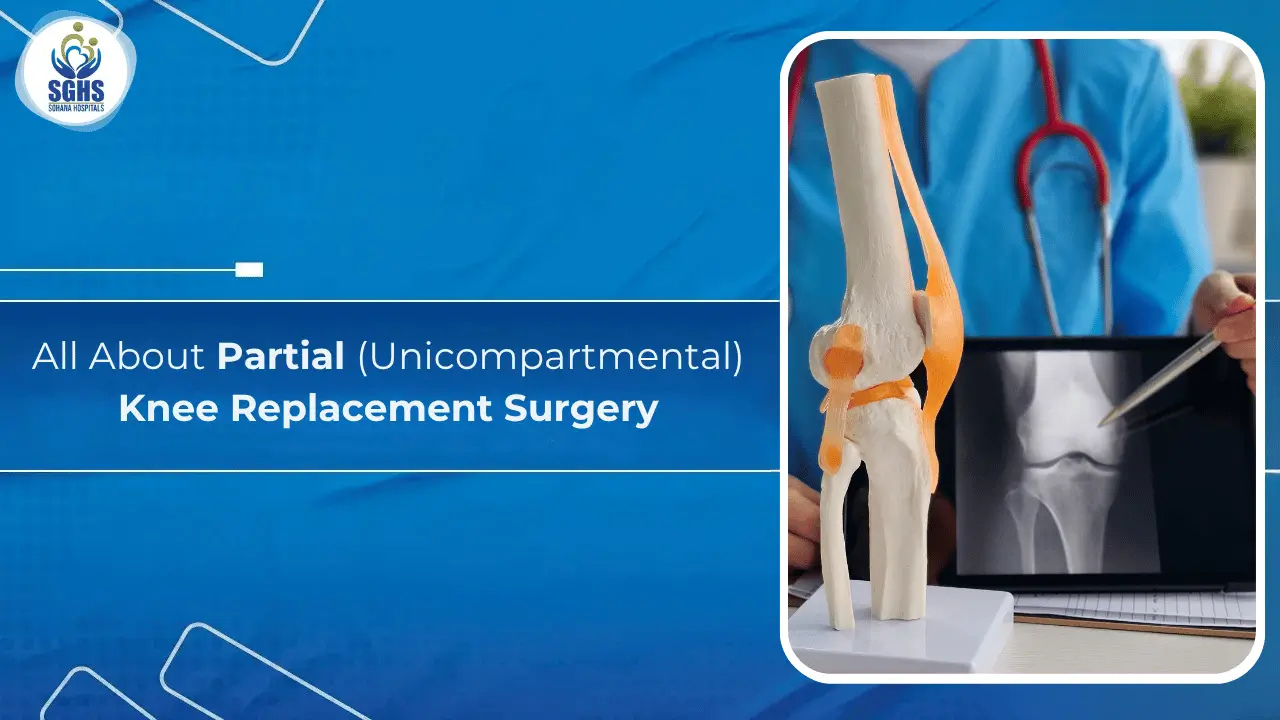
The human knee joint works like a door hinge connecting the femur (thigh bone) with the tibia (shin bone) and the patella (knee cap). We are able to walk and perform other activities as long as the knee joint is in good health and functions properly.
The knee joint comprises several parts, including:
Articular Cartilage
It is smooth but tough, rubbery white tissue covering the ends of your bones and providing cushioning between them. It is the cartilage that allows bones to move smoothly against each other without rubbing.
Meniscus
Meniscus refers to the two crescent (C-shaped) pieces of cartilage that act as shock absorbers between the bones and keep the knee stable. It is because of a healthy meniscus that you are able to bend and straighten your leg properly.
Ligaments
Ligaments are strong, supportive bands of soft tissue that connect the thigh bone with bones in the lower leg. It is the knee ligaments that hold the bones together, stabilise the knee joint and its movement, and prepare the knees for unusual movement.
Synovium
Synovium (or synovial membrane) is a thin membrane lining the joint. It is a vital component of the knee joint that has its own functions and also supports other tissues in the joint. Most of all, it produces the fluid that lubricates the cartilage.
Types of Partial Knee Replacement
Partial knee replacement is used to replace one of the three compartments of your knee:
- Medial Compartment – the inner compartment of the knee
- Lateral Compartment – the outer compartment of the knee
- Patellofemoral Compartment – the compartment under the kneecap
Who is Eligible for a Partial Knee Replacement Procedure?
Partial knee replacement is typically performed on younger patients (aged below 50). However, other than that, your overall health and the severity of knee damage have a vital role to play in determining your eligibility:
- You have osteoarthritis in only one compartment of your knee
- Knee pain disrupts your daily activities
- There is stiffness in your knee, but the range of motion is still good
- There is very little deformity in the knee[3] (knock-knees or bowed legs)
- You experience weakness in your leg
- Your knee ligaments are stable
- Total knee replacement surgery is not right for you due to age or bone quality
- You have tried conservative treatments (weight loss, physical therapy, and injections) for knee pain relief, but they did not prove effective
However, if you have any of the following, you may not be eligible for PKR:
- Inflammatory arthritis
- Severe stiffness in the knee
- Ligament damage
Sohana Hospital, Mohali, has one of the best knee surgeons to treat all kinds of knee pain and help you lead a pain-free life.
Benefits of Partial Knee Replacement Surgery
Partial (or unicompartmental) knee replacement surgery has many advantages as compared with total knee replacement, especially when done with robotic technology. The prominent benefits are:
- Smaller cuts
- Less blood loss
- Takes less time than TKR (Total Knee Replacement)
- Less time under anaesthesia
- Lower risk of infection and other complications
- Fewer days in hospital
- Faster recovery and quicker return to normal routine
- Preserves ACL (Anterior cruciate ligament) & PCL (Posterior Cruciate Ligament)
- More natural feeling in the knee
- Saving of healthy bone and tissue
- Lower price
Recovery after Partial Knee Replacement Surgery
Since only one compartment of the knee is replaced with a prosthetic implant, as opposed to all three compartments (as in TKR), most patients report a faster recovery after partial knee replacement surgery. Your knees can take your body weight soon after PKR[4].
However, in the first few days, you may still need to use a walker or stick for support. Also, with regular physiotherapy sessions, you can soon regain strength and range of motion in your knee.
You can start performing low-impact exercises after PKR. Examples of these exercises include walking, swimming, biking, tennis, and golf. However, it is better to avoid high-impact activities such as jogging until your doctor gives you a green flag to do so.
Conclusion
Partial knee replacement (PKR) is not as common a knee procedure as total knee replacement (TKR). But if only one part (compartment) of your knee is damaged, you may be recommended PKR. It can help restore easy mobility without major surgery. You regain freedom of mobility and still have a natural feeling in your knee. With a wide range of non-surgical and minimally invasive surgery options, Sohana Hospital is known for giving knee patients the gift of pain-free movement.
FAQs – Partial Knee Replacement
Which conditions does partial knee replacement treat?
Partial knee replacement (PKR) is used to treat different knee conditions, such as arthritis, osteoarthritis, knee pain, swelling or stiffness in the knee, and limited movement.
How to prepare for a partial knee replacement?
First, you get a physical examination done by expert orthopaedic doctors at Sohana Hospital. Then, blood and imaging tests are done. Doctors will also check your medical history and what medicines you are taking. You may also be asked to get an ECG to check your heart health. If found fit for PKR, doctors will explain everything in detail and give you other instructions. At Sohana Hospital, we also help you with insurance and other paperwork.
What happens during a partial knee replacement?
You are made to lie down on a table in the OT. Anaesthesia is given to numb the body so that you do not experience any pain. Depending on whether you choose conventional or robotic PKR, your orthopaedic surgeon will replace the damaged knee compartment with an artificial implant – either manually or using an AI-powered robot.
How long does a partial knee replacement operation take?
It generally takes 1- 2 hours[5].
What happens after PKR surgery?
After surgery, you are shifted to a recovery room. You are continuously monitored (vital signs, wearing off of anaesthesia, and pain level) for a few hours to make sure everything is fine. Some patients even go home the same day. Our doctors will let you know if you need to stay overnight in the hospital.
What is the success rate of partial knee replacement?
PKR has a high success rate of about 90 to 95%. It implies that 90% of patients undergoing PKR will have a comfortable journey for about 10 years. However, you must follow the recovery tips advised by your doctor.
How long does a partial knee replacement last?
A partial knee replacement usually lasts for a long time (10 years or more). However, some arthritis patients may need a total knee replacement in the future if the condition starts affecting the other compartments of their knees.
When can I go back to work after a partial knee replacement?
It depends on what kind of work you have – how much knee stress your work involves. Most people need to rest for a week or two after a partial knee replacement. Following this, you can return to your desk job. For other kinds of work, you should talk to your doctor. Also, physiotherapy is vital after knee replacement surgery.
Which is better – partial knee replacement or full knee replacement?
It depends on your individual condition. If all three compartments of your knee are damaged, total knee replacement (TKR) would be a better choice. On the other hand, if only one compartment of your knee is damaged, you may be better off with partial knee replacement (PKR). The reason is that PKR offers the benefits of smaller cuts, faster recovery, and a natural knee feeling.
Reference Sources:
- https://pmc.ncbi.nlm.nih.gov/articles/PMC8149501/#:~:text=According%20to%20a,the%20coming%20decade.
- https://pmc.ncbi.nlm.nih.gov/articles/PMC12178484/#:~:text=About%2013%25%20of%20women%20and%2010%25%20of%20men%2060%20years%20and%20older%20worldwide%20have%20symptomatic%20knee%20osteoarthritis
- https://medlineplus.gov/ency/article/007256.htm#:~:text=You%20have%20only%20minor%20deformity%20in%20the%20knee.
- https://medlineplus.gov/ency/article/007256.htm#:~:text=You%20can%20put%20your%20full%20weight%20on%20your%20knee%20right%20away.
- https://orthoinfo.aaos.org/en/treatment/unicompartmental-knee-replacement/#:~:text=A%20partial%20knee%20replacement%20typically%20takes%201%20to%202%20hours.