
Whether you have undergone knee replacement surgery or are researching how to know it’s the right time to opt for it, you must be interested in checking – how long does a knee replacement last?
In this blog, we are going to have a look at the life and durability of artificial knee implants, discover the latest technology for knee replacement, and learn about the longevity of a knee replacement.
How Long Does a Knee Replacement Last?
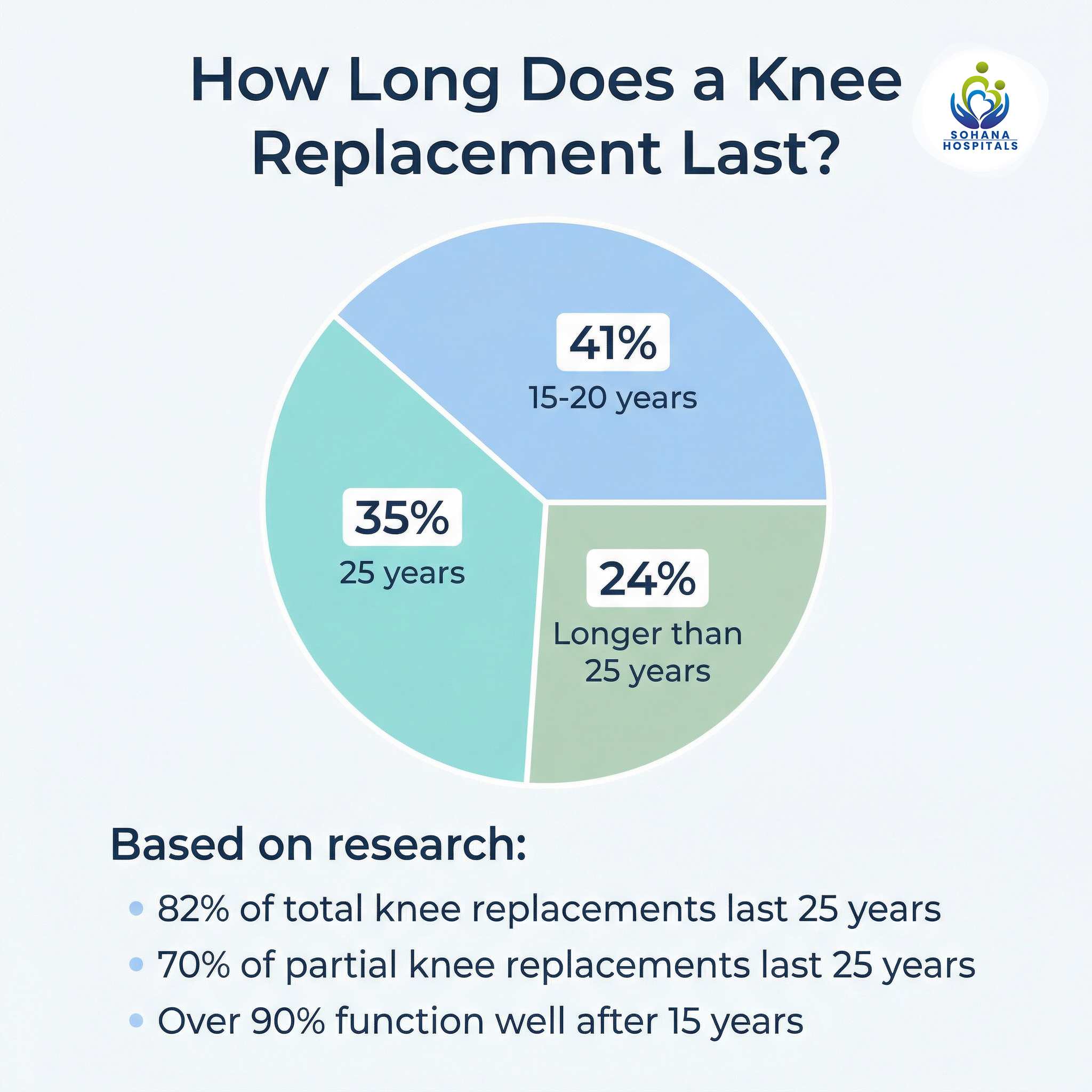
Once you have a successful knee surgery and recover well, you can expect your knee replacement to have a life expectancy of around 15-20 years. Depending on multiple factors, some may even last longer than 20 years, while others may require medical intervention earlier.
What does research say? 82 out of 100 total knee replacements and 70 out of 100 partial knee replacements lasted 25 years1. As per AAOS, over 90% of knee replacements continue to function well after 15 years2.
Having said that, it is vital to understand that no surgery is 100% successful, and nothing lasts forever; yet knee replacement surgery is one of the safest and most successful procedures across the globe. That is the reason an increasing number of people are choosing knee replacement over pain and immobility – to regain an active and independent life.
Factors Influencing Knee Replacement Life
Once you get a knee replacement done, it is natural to want your new knee joint to last as long as possible. Here are the prominent aspects on which the life of an artificial knee joint depends:
- Patient’s age when they got operated
- Overall health at the time of surgery
- Kind of activity level patient aspires for (after surgery)
- The type of implant
- Whether or not the patient maintains an ideal weight post-surgery
Those getting knee surgery at a younger age may need a second (revision) surgery later on. However, that does not mean you continue delaying knee replacement when you have reached an advanced stage of knee damage. Such a delay could lead to major complications in future.
Read for more on: Risks of delaying knee replacement surgery
Why Does the Need for Revision Knee Replacement Arise?
Revision knee surgery is often required when the artificial joint fails. Here are the common reasons:
| Infection | It’s the most serious complication that can happen. Patients who suffer an infection in the knee implants generally need a revision surgery. Pain, swelling, and instability in the new joint indicate infection. |
| Injury/dislocation | May happen due to a sudden-impact accident or a wrong-sized original implant. |
| Unstable or loose joint | Happens when the bone does not grow around the knee implant area. Symptoms include knee pain, swelling, and complete or partially dislocated joint. |
| Fracture | The knee implant is attached to the bones surrounding the knee. If any of these bones suffers a fracture, the implant may loosen. |
How Top-Notch Hospitals Rule Out Infection Risk
Leading super-speciality hospitals have state-of-the-art infrastructure and world-class OTs along with adherence to stringent hygiene protocols to eliminate infection risk for patients of knee replacement.
Sohana Hospital is one of the few hospitals in India that boasts completely germ-free and hence infection-free modular OTs (operation theatres). The 7-star OTs are reserved only for robotic knee replacement and are equipped with cutting-edge technologies to rule out infection risk.
From HEPA air filters and suction pumps, anti-bacterial floors, and glass walls to humidity, pressure, and temperature control, every aspect is taken care of meticulously. This ensures patients undergoing knee replacement at Sohana Hospital do not face any infection-related complications.
Apart from this, the best knee implants are used to avoid infection-risk.
Tips for Enhancing the Life of Your New Knee
Once your knee has been operated on successfully, you must follow your doctor’s advice and instructions for a fast and smooth recovery. This typically includes:
- a knee surgery recovery plan
- exercises and physiotherapy
- diet suggestions
- proper rest and sleep
- medications you have to take
- Maintaining a healthy weight (in the long run)
In addition to the recommended exercises, you can go walking, cycling, golfing, or swimming – starting slow and for a short time initially and then gradually increasing the duration. In case of swimming, make sure the wound has healed completely, and you have a clean chit from your doctor.
Stationary cycling after knee replacement surgery can be an excellent activity since it does not put weight on the new knee. Similarly, those fond of swimming can start engaging in their favourite activity to improve flexibility in the knee without any weight-strain.
Which activities to avoid? Most patients undergoing knee replacement at Sohana Hospital report significant recovery within 4-6 weeks. However, until your recovery is complete, you should steer clear of:
- Strenuous and high-impact activities (e.g. running, jumping)
- Activities that involve a risk of falling (e.g. soccer, football, skiing)
- Prolonged sitting
The aim is to build strength and flexibility in the new knee joint, and ensure a safe, quick, and smooth recovery – to enhance your overall quality of life.
Knee Replacement Surgery FAQs
1. How long does a partial knee replacement last?
Partial knee replacements are typically for younger patients aged 55-64 who have damage limited to just one part of the knee. This type of knee replacement lasts around 10 years.
2. How long does a titanium knee replacement last?
The longevity varies depending on several aspects. The patient’s age, weight, lifestyle, and activity levels play a crucial role. However, one thing about titanium cobalt implants is that they are biocompatible – meaning they don’t wear out, change, or cause immunity issues inside your body.
3. How long does a ceramic knee replacement last?
The life of any implant depends on a number of factors. One prominent benefit of ceramic implants is that they are scratch-proof. It implies they are quite durable and have a long life.
4. How long does a plastic knee replacement last?
Plastic implants are typically made of polyethylene. Technological advancements over the past few decades have hugely reduced the risk of plastic wearing out.
5. Can a knee replacement last 40 years?
There is a low probability of such long durability. There have been examples of knee replacements lasting for more than 25 years. However, research indicates knee replacements have a life of around 15-20 years.
6. Is knee replacement surgery successful?
According to AAOS, over 90% of knee replacements continue to function well after 15 years. And surprisingly, around 82% of TKRs remain functional even after 25 years. So, it would be safe to say that knee replacement surgery is highly safe and successful, especially if you maintain a healthy weight and follow your doctor’s advice.
Reference Sources:
- https://pmc.ncbi.nlm.nih.gov/articles/PMC6381229/#:~:text=82%25%20of%20TKRs%20last%2025%20years%20and%2070%25%20of%20UKRs%20last%2025%20years
- https://orthoinfo.aaos.org/en/treatment/total-knee-replacement#:~:text=Currently%2C%20more%20than%2090%25%20of%20modern%20total%20knee%20replacements%20are%20still%20functioning%20well%2015%20years%20after%20the%20surgery.